Acyclovir
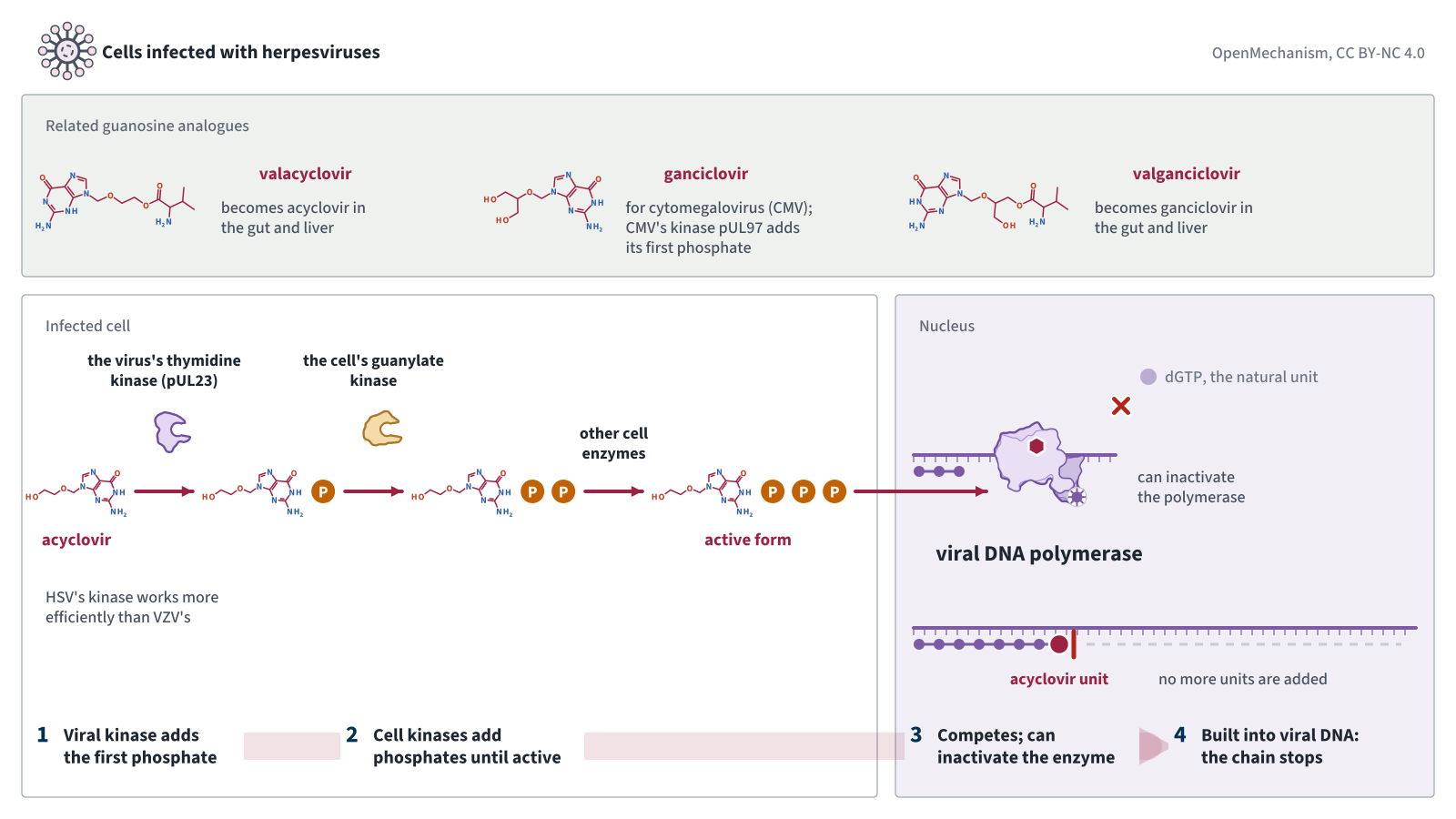
Inside cells infected with herpes simplex virus (), a viral enzyme starts turning acyclovir into its active form, and the cell's own enzymes finish the job. The active form blocks the virus's DNA-copying enzyme and ends the growing viral chain, so the copying of viral DNA is inhibited.
- Acts on
- Viral thymidine kinase, viral DNA polymerase
- Where
- Cells infected with herpes simplex virus
- Medicine type
- Small molecule
- Used for
- Infections
- Drug class
- Antivirals
Also called Zovirax and Aciclovir.
Key terms in this drawing (7)
- CMV
- Cytomegalovirus. A herpesvirus that can cause serious disease in people with weak immune systems.
- dGTP
- Deoxyguanosine triphosphate. One of the four natural building blocks used to make DNA.
- DNA
- Deoxyribonucleic acid. The molecule that stores genes.
- HSV
- Herpes simplex virus. The virus that causes herpes infections.
- pUL23
- UL23 protein (viral thymidine kinase). The herpes simplex virus kinase that adds acyclovir's first phosphate.
- pUL97
- UL97 protein kinase. The cytomegalovirus (CMV) kinase that adds ganciclovir's first phosphate.
- VZV
- Varicella-zoster virus. The herpesvirus that causes chickenpox and shingles.
How it works
Viral kinase adds the first phosphate. HSV thymidine kinase converts acyclovir to its monophosphate.1
Cell kinases add phosphates until active. Cellular enzymes convert the monophosphate through diphosphate to active triphosphate.1
Competes; can inactivate the enzyme. The triphosphate competes at viral DNA polymerase and can inactivate it.1
Built into viral DNA: the chain stops. Incorporation into viral DNA terminates chain growth, inhibiting viral replication.1
For teachers: download this drawing or build a slide deck.
See also
Condition pages: herpes infections and nerve pain after shingles.
Other antivirals: baloxavir marboxil; bulevirtide; darunavir; doravirine; enfuvirtide; glecaprevir and pibrentasvir; lenacapavir; nirmatrelvir; and 6 more.
Body system: infections.
Sources
- 1Zovirax (acyclovir): FDA label12.4 Microbiology: Mechanism of Action
- 2ChEMBL CHEMBL184Target and action classification: Human herpesvirus 1 DNA polymerase inhibitor
Also used for the drawing
The drawing also shows valacyclovir, ganciclovir and valganciclovir, and more detail at the viral DNA polymerase. These sources support those parts; the steps above come from the sources listed above. The thymidine kinase, guanylate kinase and viral DNA polymerase outlines are traced from the crystal and electron microscopy structures below.
- 3Valacyclovir tablets: FDA label12.3 Pharmacokinetics; 12.4 Microbiology
- 4Ganciclovir injection: FDA label12.4 Microbiology
- 5Valganciclovir: FDA label12.3 Pharmacokinetics; 12.4 Microbiology
- 6Ganciclovir ophthalmic gel (Zirgan): FDA label12.4 Microbiology
- 7Herpes simplex virus type 1 DNA polymerase. Mechanism of inhibition by acyclovir triphosphateReardon JE, Spector T, J Biol Chem 1989 (abstract)
- 8Mechanism of ganciclovir-induced chain termination revealed by resistant viral polymerase mutants with reduced exonuclease activityChen H et al., Proc Natl Acad Sci U S A 2014 (abstract)
- 9Resistance to a Nucleoside Analog Antiviral Drug from More Rapid Extension of Drug-Containing PrimersChen H et al., mBio 2021 (abstract)
- 10Structures of valacyclovir, ganciclovir and valganciclovir: ChEMBL (CHEMBL1349, CHEMBL182, CHEMBL1201314)canonical structures from the Atlas catalog snapshot
- 11Herpes simplex virus 1 thymidine kinase with acyclovirPDB 2KI5; Bennett, M.S. et al. FEBS Lett. 1999; 443:121-125
- 12Mouse guanylate kinase with GMP and ADPPDB 1LVG; Sekulic, N. et al. J.Biol.Chem. 2002; 277:30236-30243
- 13Herpes simplex virus 1 DNA polymerase with its processivity factor, on DNA, with acyclovir triphosphatePDB 8V1T; Shankar, S. et al. Cell 2024; 187:5572-5586.e15
Spotted a mistake? Report an error (hello@openmechanism.com). Since launch, every published error we fix is listed on the corrections page.
Notes and limits
- A schematic teaching drawing: not to scale, not exact structures, binding poses or a complete pathway, and not a guide to dosing, treatment or how a person will respond.
- The steps are in the order that explains them; one step is said to cause the next only where the source says so.
- Selected HSV1/HSV2 model; this is not universal activation by every virus.
- Biochemical/cell-culture potency is not equated with an individual clinical response.
All recorded limits are on the evidence page, and notes that apply to every page are on How to read a page. Version 1.0.0, not yet medically reviewed.
Cite this page
Tran D. Acyclovir [Internet]. OpenMechanism; 2026 [updated 2026 Oct 15; cited 2026 Oct 15]. Available from: https://openmechanism.com/medicines/acyclovir