Albendazole
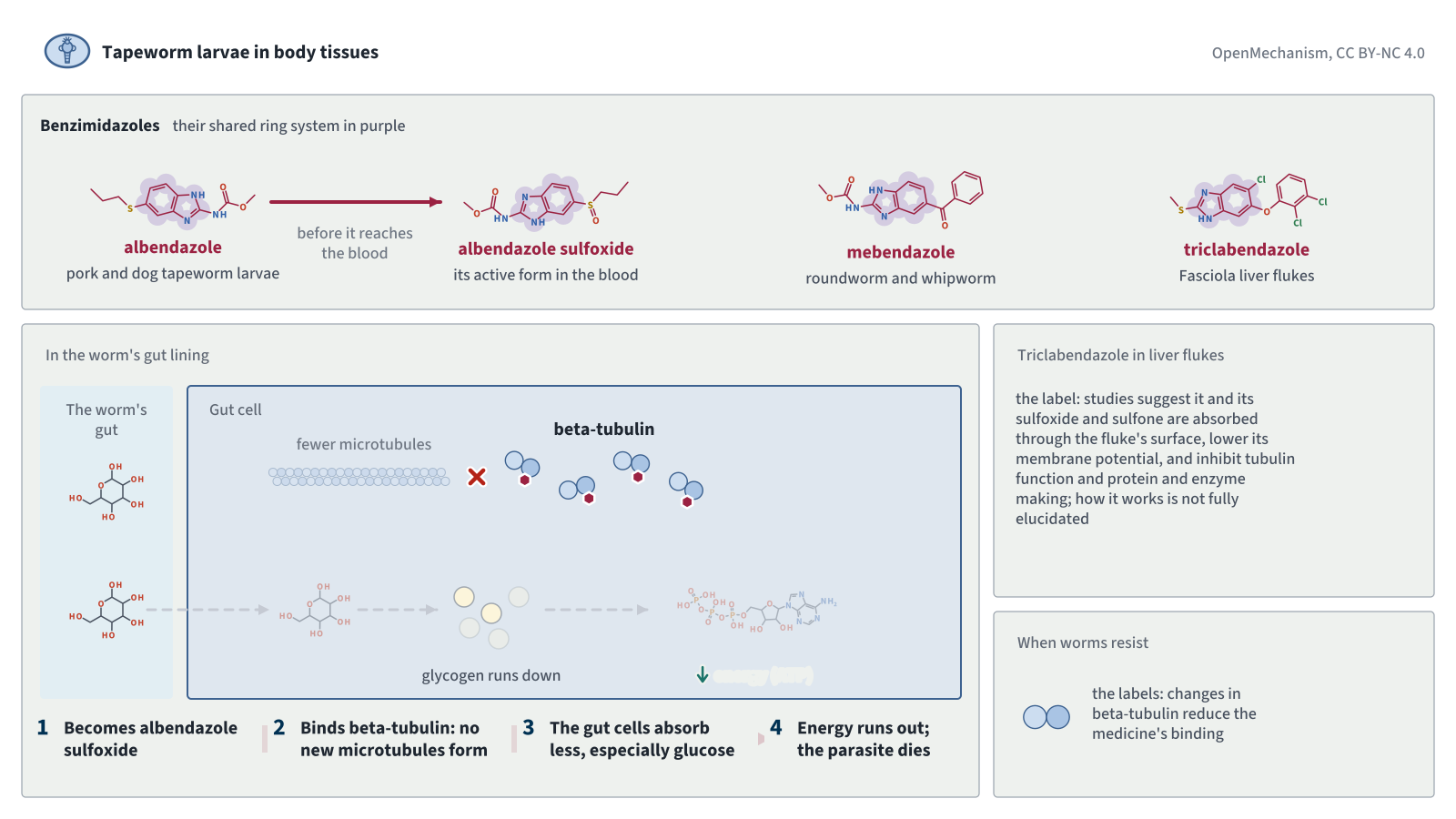
Albendazole is turned into albendazole sulfoxide, which carries its activity in the body. It binds beta-tubulin and stops it joining into ; with fewer microtubules, the worm's gut cells take up less glucose and its glycogen runs down, so it runs short of energy () and dies.
- Acts on
- Beta-tubulin (its colchicine-sensitive site) in the worm's cells
- Where
- Tapeworm larvae
- Medicine type
- Small molecule
- Used for
- Infections
Key terms in this drawing
- ATP
- Adenosine triphosphate. The molecule cells use to carry energy.
- microtubule
- Microtubule. A structure inside the cell, built from the protein tubulin, that the cell needs for dividing and for other vital work.
How it works
Becomes albendazole sulfoxide. Albendazole is rapidly converted to its sulfoxide metabolite before reaching the systemic circulation; the systemic anthelmintic activity has been attributed to albendazole sulfoxide.1
Binds beta-tubulin: no new microtubules form. Albendazole binds to the colchicine-sensitive site of beta-tubulin, inhibiting its polymerization into microtubules.1
The gut cells absorb less, especially glucose. The decrease in microtubules in the intestinal cells of the parasites decreases their absorptive function, especially the uptake of glucose by the adult and larval forms, and depletes glycogen storage.1
Energy runs out; the parasite dies. Insufficient glucose results in insufficient energy for the production of ATP, and the parasite eventually dies.1
For teachers: download this drawing.
See also
Condition pages: tapeworm larva infections and worm infections.
Related drawings: griseofulvin (binds the microtubule proteins of fungi).
Body system: infections.
Sources
- 1Albendazole tablets: FDA label12.3 Pharmacokinetics; 12.4 Microbiology: Mechanism of Action
- 2ChEMBL CHEMBL1483Target and action classification: Tubulin inhibitor
Also used for the drawing
The drawing also shows mebendazole and triclabendazole, the other benzimidazoles, and how worms resist. These sources support those parts; the steps above come from the sources listed above.
- 3Vermox (mebendazole): FDA label1 Indications and Usage; 12.4 Microbiology
- 4Egaten (triclabendazole): FDA label1 Indications and Usage; 12.4 Microbiology: Mechanism of Action
- 5
Spotted a mistake? Report an error (hello@openmechanism.com). Since launch, every published error we fix is listed on the corrections page.
Notes and limits
- A schematic teaching drawing: not to scale, not exact structures, binding poses or a complete pathway, and not a guide to dosing, treatment or how a person will respond.
All recorded limits are on the evidence page, and notes that apply to every page are on How to read a page. Version 1.0.0, not yet medically reviewed.
Cite this page
Tran D. Albendazole [Internet]. OpenMechanism; 2026 [updated 2026 Oct 16; cited 2026 Oct 16]. Available from: https://openmechanism.com/medicines/albendazole