Sodium stibogluconate
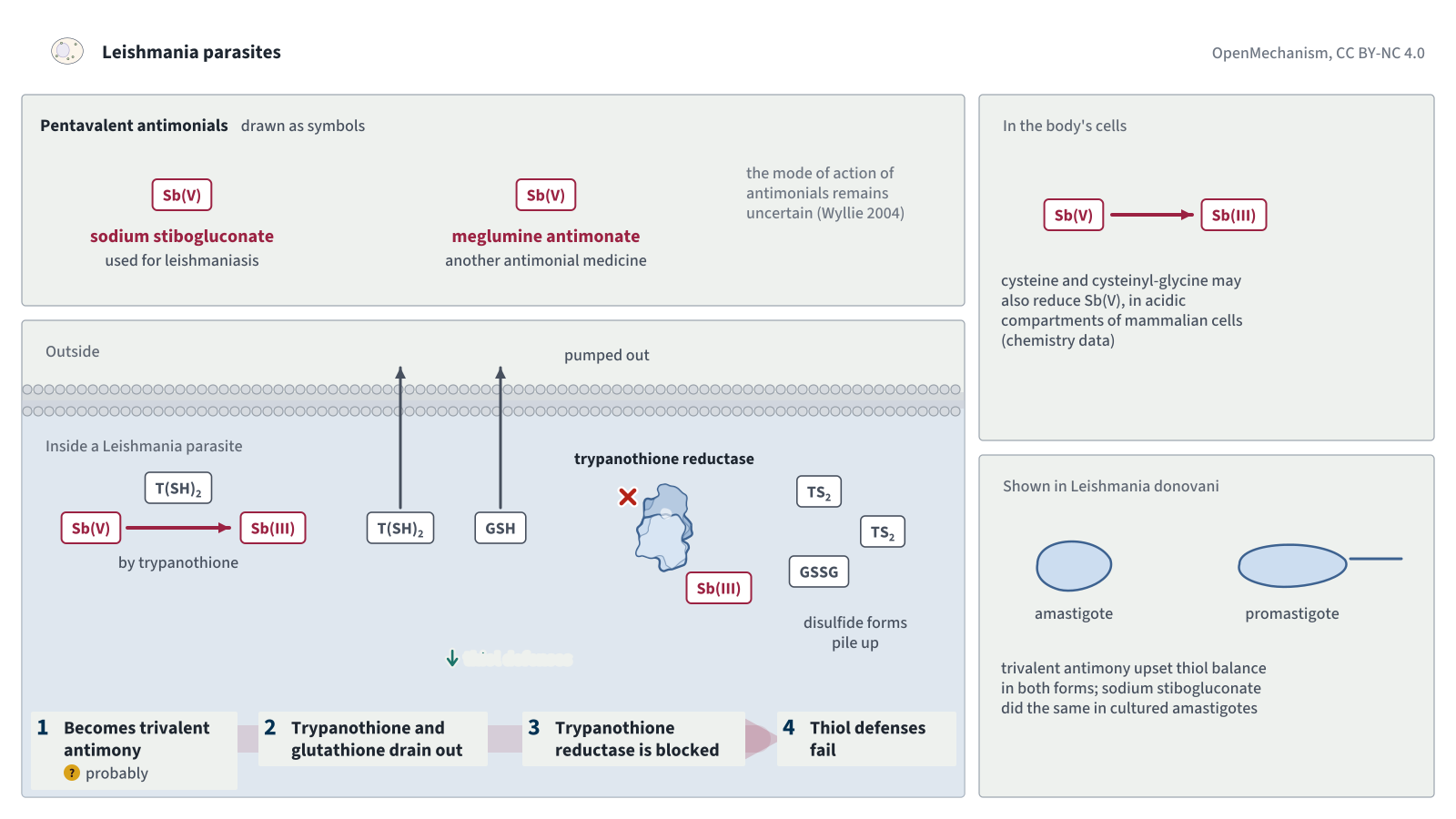
Its pentavalent antimony can be turned into the more toxic trivalent form, probably by trypanothione inside the parasite. Trivalent antimony drains trypanothione and glutathione out of Leishmania and blocks trypanothione reductase, so the parasite's thiol defenses fail. The mode of action of antimonials remains uncertain.
- Acts on
- Trypanothione and trypanothione reductase of Leishmania, through trivalent antimony
- Where
- Leishmania parasites
- Medicine type
- Small molecule
- Used for
- Infections
Step 1: probably
A chemistry study (Ferreira 2003) says: In conclusion, our data supports the hypothesis that Sb(V) is reduced in vivo by T(SH)2 within Leishmania parasites and by Cys or Cys-Gly within the acidic compartments of mammalian cells.
Clinical study: In a randomized trial of treatments for visceral leishmaniasis in East Africa, sodium stibogluconate alone was the standard arm; the trial measured parasite clearance 6 months after treatment, not how the medicine works: Primary and secondary efficacy outcomes were parasite clearance at 6-months follow-up and end of treatment, respectively. … The efficacy of SSG & PM was comparable to SSG (91.4% versus 93.9%, difference = 2.5%, 95% CI: -1.3 to 6.3%, p = 0.198).
Musa A et al., PLoS Negl Trop Dis 2012 (PMID 22724029)
This study was picked with a literature search and is not yet checked by our reviewer.
Key terms in this drawing
- GSH
- Glutathione (reduced). A small sulfur-containing molecule that protects cells from oxidative damage.
- GSSG
- Glutathione disulfide. Glutathione after it has been used up (oxidized).
- Sb(III)
- Trivalent antimony. The form antimony probably takes inside the parasite, where it disturbs thiol defenses.
- Sb(V)
- Pentavalent antimony. The form of antimony in sodium stibogluconate and meglumine antimonate.
How it works
Becomes trivalent antimony. Pentavalent antimony, , can be reduced to the more toxic trivalent antimony, ; the data support the hypothesis that Sb(V) is reduced in vivo by trypanothione within Leishmania parasites and by cysteine or cysteinyl-glycine within acidic compartments of mammalian cells.1
Trypanothione and glutathione drain out. Trivalent antimony decreases the parasite's thiol buffering capacity by inducing rapid efflux of intracellular trypanothione and glutathione.2
Trypanothione reductase is blocked. Trivalent antimony also inhibits trypanothione reductase in intact cells, so the disulfide forms of trypanothione and glutathione accumulate.2
Thiol defenses fail. These two mechanisms combine to profoundly compromise the thiol redox potential in both amastigotes and promastigotes; sodium stibogluconate induces similar effects in cultured amastigotes.2
For teachers: download this drawing.
See also
Condition pages: leishmaniasis.
More medicines for infections: acyclovir; albendazole; amoxicillin; amoxicillin and clavulanate; amphotericin B; artesunate; atovaquone; azithromycin; and 51 more.
Related drawings: eflornithine (lowers trypanothione too, in African trypanosomes).
Body system: infections.
Sources
- 1Thiol-induced reduction of antimony(V) into antimony(III): a comparative study with trypanothione, cysteinyl-glycine, cysteine and glutathioneFerreira Cdos S et al., Biometals 2003 (abstract)
- 2Dual action of antimonial drugs on thiol redox metabolism in the human pathogen Leishmania donovaniWyllie S et al., J Biol Chem 2004 (abstract)
- 3ChEMBL CHEMBL2365492Target and action classification
- 4Sodium stibogluconate (SSG) & paromomycin combination compared to SSG for visceral leishmaniasis in East Africa: a randomised controlled trialMusa A et al. PLoS Negl Trop Dis 2012 (abstract)
Also used for the drawing
The trypanothione reductase outline is traced from the crystal structure below.
- 5Leishmania infantum trypanothione reductase with antimony (Sb(III)) and NADPHPDB 2W0H; Baiocco, P. et al. J.Med.Chem. 2009; 52:2603
Spotted a mistake? Report an error (hello@openmechanism.com). Since launch, every published error we fix is listed on the corrections page.
Notes and limits
- A schematic teaching drawing: not to scale, not exact structures, binding poses or a complete pathway, and not a guide to dosing, treatment or how a person will respond.
- Wyllie et al. 2004 note that the mode of action of antimonial medicines remains uncertain.
- The reduction of Sb(V) to Sb(III) by trypanothione inside the parasite is a hypothesis supported by chemistry data (Ferreira 2003).
- A hypothesis supported by chemistry data (Ferreira 2003).
All recorded limits are on the evidence page, and notes that apply to every page are on How to read a page. Version 1.0.0, not yet medically reviewed.
Cite this page
Tran D. Sodium stibogluconate [Internet]. OpenMechanism; 2026 [updated 2026 Oct 16; cited 2026 Oct 16]. Available from: https://openmechanism.com/medicines/sodium-stibogluconate