Worm infections
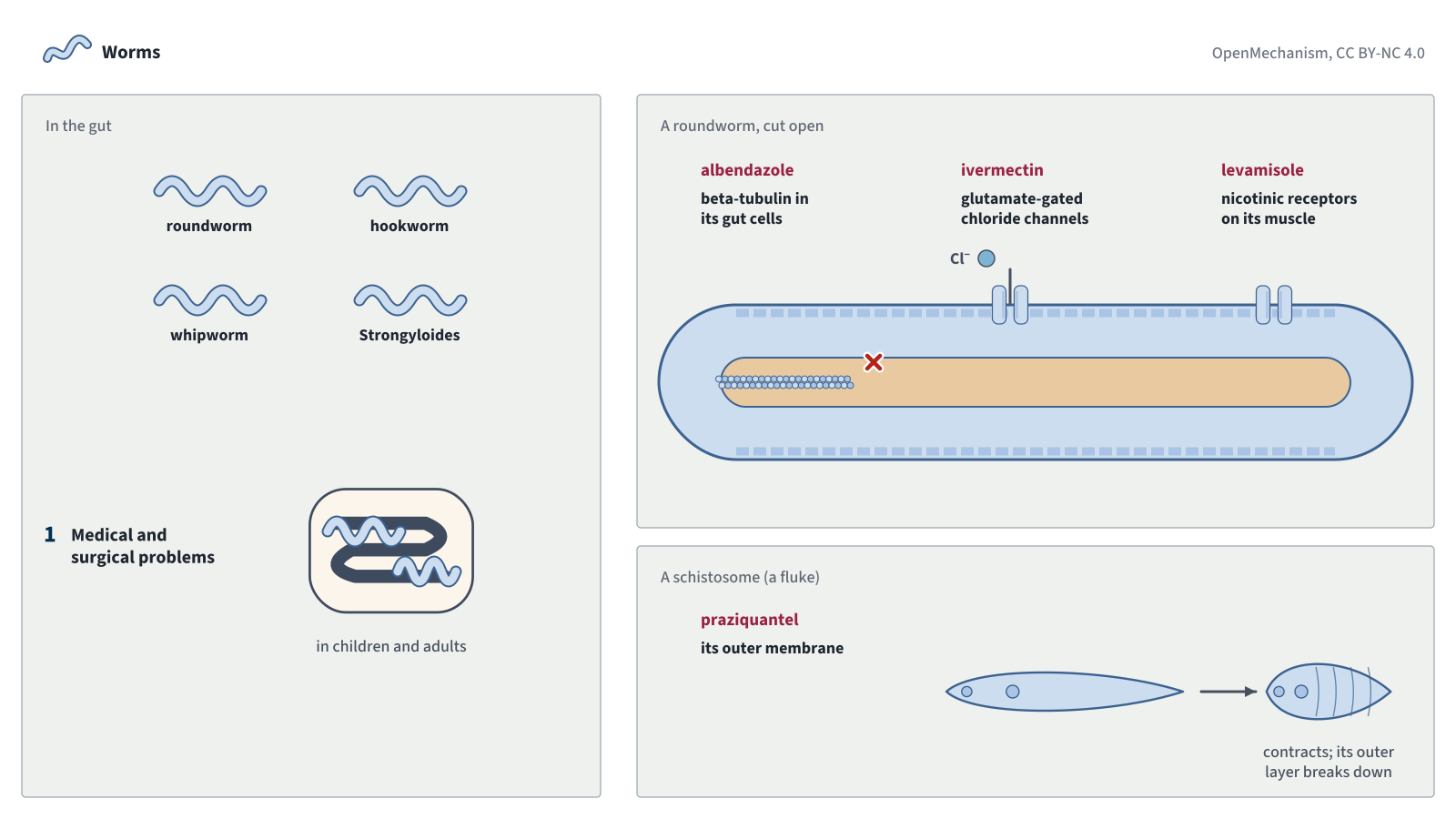
More than a quarter of the world's people are at risk of soil-transmitted worms: roundworm, hookworm, whipworm and Strongyloides, which can cause many medical and surgical problems. The medicines are donated free, yet only half of at-risk children were treated in 2016. Albendazole blocks worm tubulin; ivermectin opens chloride channels; levamisole makes worm muscle hypercontract; praziquantel makes schistosomes contract.
- Where
- Worms
- Body systems
- Infections; Stomach, gut & liver
- Medicines
- 4 medicines
For teachers: download this drawing.
What goes wrong
Medical and surgical problems. Soil-transmitted worms (roundworm, hookworm, whipworm and Strongyloides) can give infected children and adults a range of medical and surgical problems.1
What the source says
“More than a quarter of the world's population is at risk of infection with the soil-transmitted helminths Ascaris lumbricoides, hookworm (Ancylostoma duodenale and Necator americanus), Trichuris trichiura, and Strongyloides stercoralis.”
Source 1“Infected children and adults present with a range of medical and surgical conditions”
Source 1
Where medicines act
- A
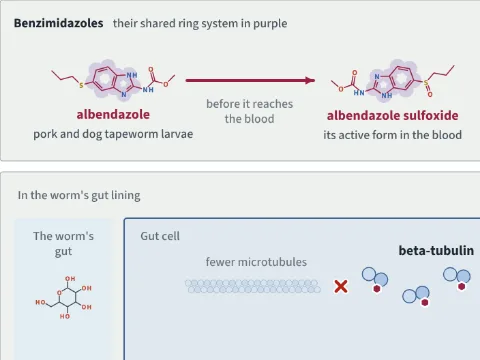
Albendazole: the worm's tubulin blocked
Albendazole binds the worm's beta-tubulin and stops forming; its gut cells absorb less glucose and lose their glycogen.2
What the source says
“Albendazole binds to the colchicine-sensitive site of β-tubulin inhibiting their polymerization into microtubules.”
Source 2“The decrease in microtubules in the intestinal cells of the parasites decreases their absorptive function, especially the uptake of glucose by the adult and larval forms of the parasites, and also depletes glycogen storage.”
Source 2 - B
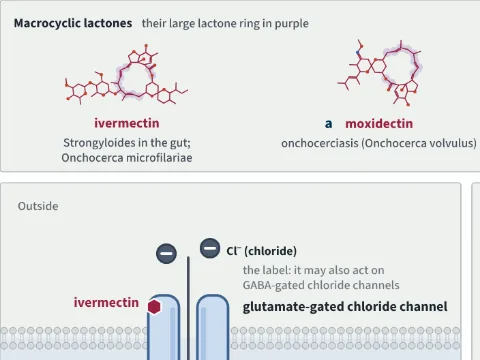
Ivermectin: the worm paralyzed
Ivermectin binds glutamate-gated chloride channels in invertebrate nerve and muscle, letting chloride in and paralyzing and killing the worm. It treats intestinal strongyloidiasis.3
What the source says
“Compounds of the class bind selectively and with high affinity to glutamate-gated chloride ion channels which occur in invertebrate nerve and muscle cells.”
Source 3“This leads to an increase in the permeability of the cell membrane to chloride ions with hyperpolarization of the nerve or muscle cell, resulting in paralysis and death of the parasite.”
Source 3“Strongyloidiasis of the intestinal tract”
Source 3 - C
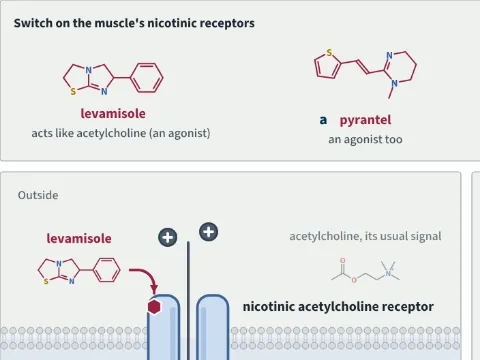
Levamisole: the worm's muscle locks
Levamisole acts on nicotinic acetylcholine receptors on the worm's body-wall muscle; the muscle hypercontracts and the worm dies.4,5
- D
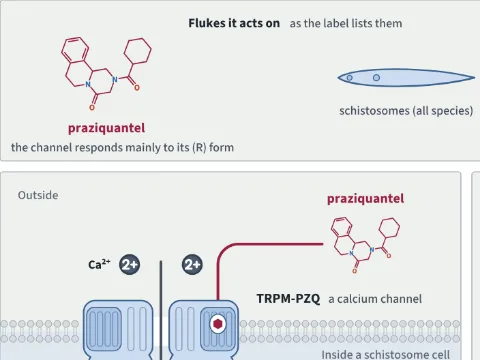
Praziquantel: the fluke contracts
Praziquantel changes the permeability of the schistosome's membrane, making it contract and its outer layer break down. It treats schistosomiasis.6
What the source says
“Praziquantel induces a rapid contraction of schistosomes by a specific effect on the permeability of the cell membrane.”
Source 6“The drug further causes vacuolization and disintegration of the schistosome tegument.”
Source 6“Schistosomiasis due to all species of schistosoma”
Source 6
See also
Body systems: infections; and stomach, gut & liver.
Other conditions: tapeworm larva infections; scabies and lice; C. difficile infection; cryptosporidiosis; giardiasis and amebiasis; and hepatitis B.
Sources
- 1Soil-transmitted helminth infectionsJourdan PM et al. Lancet 2018 (abstract). Saved copy
- 2Albendazole (Albenza): FDA label1 Indications and Usage; 12.4 Mechanism of Action. Saved copy
- 3Stromectol (ivermectin): FDA labelIndications and Usage; Clinical Pharmacology. Saved copy
- 4Mode of action of levamisole and pyrantel, anthelmintic resistance, E153 and Q57Martin RJ, Robertson AP. Parasitology 2007 (abstract). Saved copy
- 5The Caenorhabditis elegans unc-63 gene encodes a levamisole-sensitive nicotinic acetylcholine receptor alpha subunitCuletto E et al. J Biol Chem 2004 (abstract). Saved copy
- 6Biltricide (praziquantel): FDA label1 Indications and Usage; 12.4 Microbiology. Saved copy
Notes and limits
- The benefit of deworming whole populations has been questioned, though treatment clearly reduces severe harm.1
Notes that apply to every page are on How to read a page.
Spotted a mistake? Report an error (hello@openmechanism.com). Since launch, every published error we fix is listed on the corrections page.
Cite this page
Tran D. Worm infections [Internet]. OpenMechanism; 2026 [updated 2026 Oct 18; cited 2026 Oct 18]. Available from: https://openmechanism.com/conditions/worm-infections