Penicillin G
Bacteria build a peptidoglycan cell wall as they multiply. Penicillin G blocks this building, so the wall becomes unstable and the bacterium dies.
- Acts on
- Peptidoglycan biosynthesis
- Where
- Growing bacteria
- Medicine type
- Small molecule
- Used for
- Infections
- Drug class
- Antibiotics
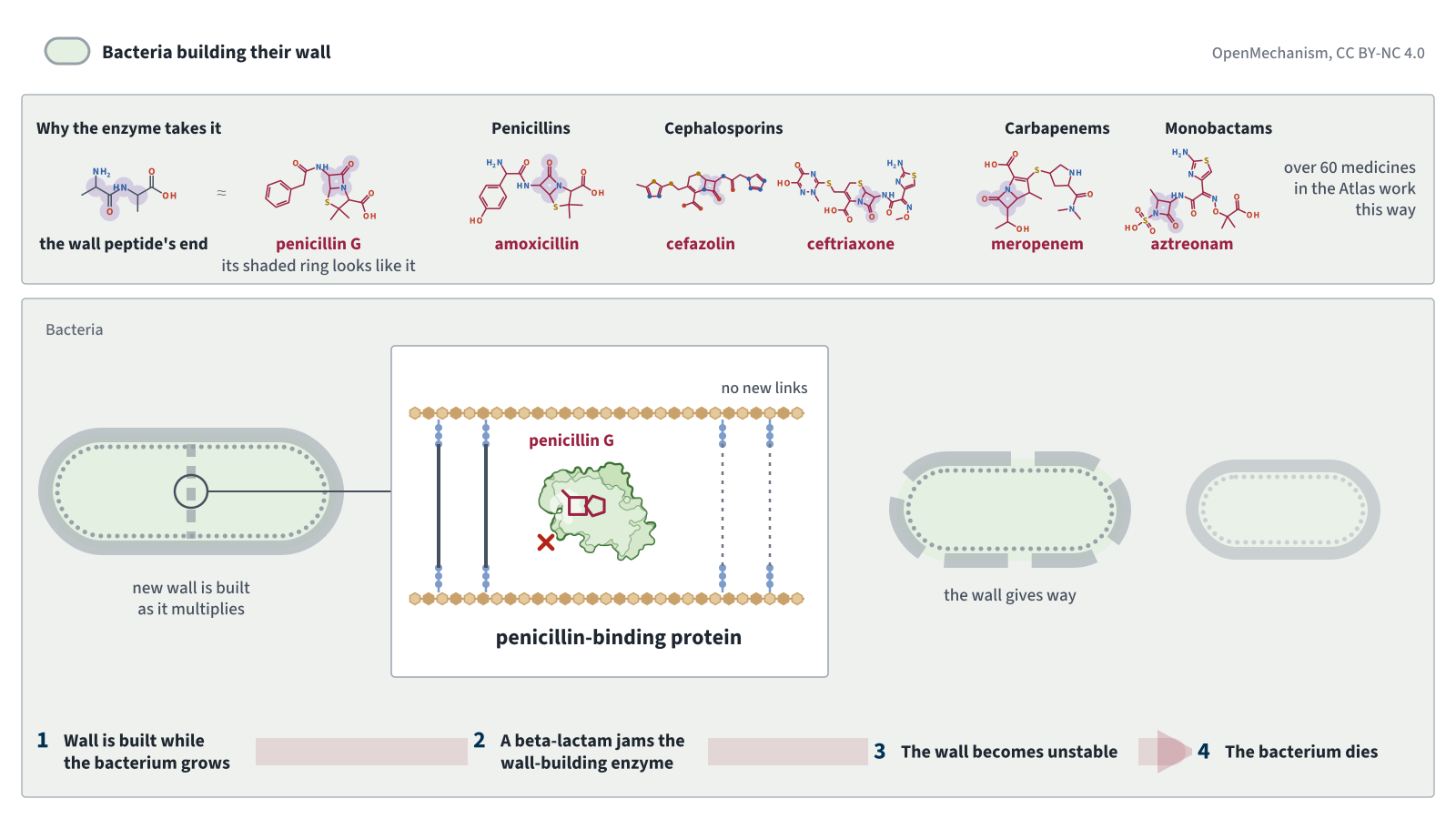
Key terms in this drawing
- PBP
- Penicillin-binding protein. A bacterial enzyme that builds the cell wall; beta-lactam antibiotics, such as penicillins and cephalosporins, bind it.
How it works
Wall is built while the bacterium grows. Susceptible bacteria synthesize peptidoglycan during active multiplication.1
A beta-lactam jams the wall-building enzyme. Penicillin G inhibits bacterial cell-wall peptidoglycan biosynthesis.1
The wall becomes unstable. The inhibited wall becomes osmotically unstable.1
The bacterium dies. Wall instability leads to bacterial death.1
For teachers: download this drawing or build a slide deck.
See also
Condition pages: antibiotic-resistant infections; bloodstream infections and endocarditis; pneumonia; and syphilis.
Other antibiotics: amoxicillin; amoxicillin and clavulanate; azithromycin; bedaquiline; ceftazidime and avibactam; ceftriaxone; cephalexin; ciprofloxacin; and 14 more.
Explained: probenecid and penicillin.
Related drawings: probenecid (slows penicillin's excretion by the kidney tubules).
Body system: infections.
Inside the body: the bacterial cell wall.
Sources
- 1Bicillin C-R 900/300 (penicillin G benzathine and penicillin G procaine): FDA labelMicrobiology: Mechanism of Action
- 2ChEMBL CHEMBL29Target and action classification: Bacterial penicillin-binding protein inhibitor
Also used for the drawing
The drawing also shows the other beta-lactams (penicillins, cephalosporins, carbapenems and aztreonam) and how they act at the wall-building enzymes. These sources support those parts; the steps above come from the sources listed above. The penicillin-binding protein outline is traced from the crystal structure below.
- 3Amoxicillin: FDA label12.4 Microbiology
- 4Cefazolin: FDA labelMicrobiology
- 5Ceftriaxone: FDA labelMicrobiology
- 6Meropenem: FDA label12.4 Microbiology
- 7Aztreonam (Azactam): FDA labelMicrobiology
- 8Structural and kinetic analysis of the monofunctional Staphylococcus aureus PBP1Bon CG et al., J Struct Biol 2024 (abstract)
- 9Mechanism of action of penicillins: a proposal based on their structural similarity to acyl-D-alanyl-D-alanineTipper DJ, Strominger JL, Proc Natl Acad Sci U S A 1965
- 10The penicillin-binding proteins: structure and role in peptidoglycan biosynthesisSauvage E et al., FEMS Microbiol Rev 2008 (abstract)
- 11Structures and mechanism records: ChEMBL (amoxicillin CHEMBL1082, cefazolin CHEMBL1435, ceftriaxone CHEMBL161, meropenem CHEMBL127, aztreonam CHEMBL158)canonical structures and penicillin-binding-protein mechanism records from the Atlas catalog snapshot
- 12D-alanyl-D-alanine: PubChem CID 5460362isomeric SMILES
- 13Streptococcus pneumoniae penicillin-binding protein 2x acyl-enzyme complexPDB 1QMF; Gordon, E.J. et al. J.Mol.Biol. 2000; 299:501
Spotted a mistake? Report an error (hello@openmechanism.com). Since launch, every published error we fix is listed on the corrections page.
Notes and limits
- A schematic teaching drawing: not to scale, not exact structures, binding poses or a complete pathway, and not a guide to dosing, treatment or how a person will respond.
- The steps are in the order that explains them; one step is said to cause the next only where the source says so.
- The selected label does not specify a single PBP isoform or a solved enzyme pose.
- Not every bacterial species/strain is susceptible.
All recorded limits are on the evidence page, and notes that apply to every page are on How to read a page. Version 1.0.0, not yet medically reviewed.
Cite this page
Tran D. Penicillin G [Internet]. OpenMechanism; 2026 [updated 2026 Nov 6; cited 2026 Nov 6]. Available from: https://openmechanism.com/medicines/penicillin-g