Azithromycin
Azithromycin, a macrolide, binds the large part () of the bacterial ribosome, so bacteria cannot make proteins or build new large parts. It spreads into tissues such as lung, skin and tonsil, and its is long (68 hours), thought to be because tissues take it up and later release it.
- Acts on
- of the bacterial ribosome's 50S (large) subunit
- Where
- Bacterial ribosomes; body tissues
- Medicine type
- Small molecule
- Used for
- Infections
- Drug class
- Antibiotics
Also called Zithromax.
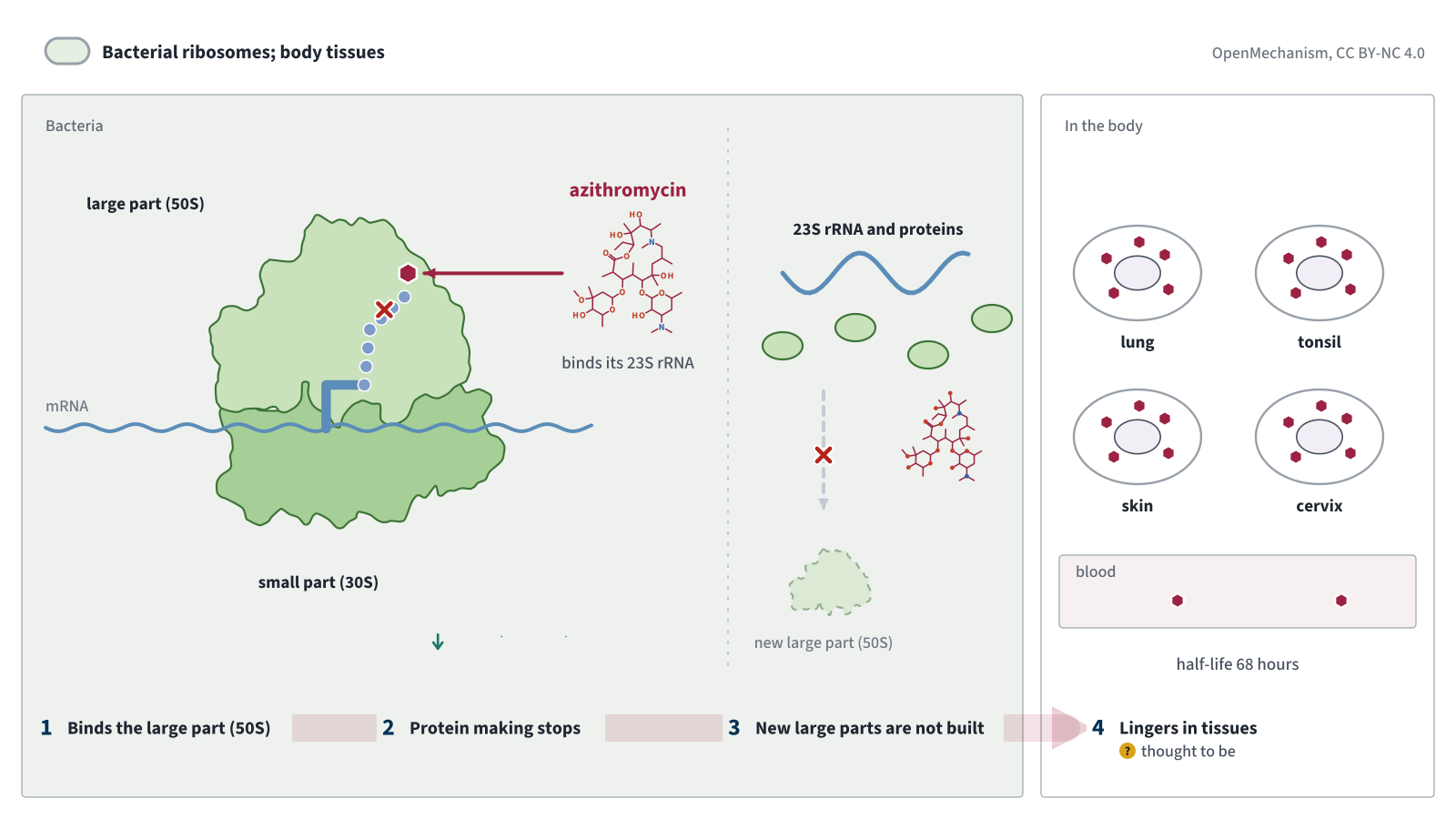
Step 4: thought to be
The Zithromax label says: The prolonged terminal half-life is thought to be due to extensive uptake and subsequent release of drug from tissues.
Clinical study: In a study of azithromycin's pharmacokinetics in people, levels in tissues were far above those in blood and fell slowly: Tissue concentrations of azithromycin were much higher than serum concentrations. … Concentrations in tissues declined with apparent half-lives of 2.3 days in prostate and 3.2 days in tonsil.
Foulds G et al., J Antimicrob Chemother 1990 (PMID 2154441)
This study was picked with a literature search and is not yet checked by our reviewer.
Key terms in this drawing (5)
- 30S
- 30S ribosomal subunit. The small part of the bacterial ribosome.
- 50S
- 50S ribosomal subunit. The large part of the bacterial ribosome.
- half-life
- Half-life. The time it takes for the amount in the blood to fall by half.
- mRNA
- Messenger RNA. A copy of a gene that a cell reads to make a protein.
- rRNA
- Ribosomal RNA. RNA that is part of the ribosome, such as the bacterial ribosome's 16S and 23S rRNA.
How it works
Binds the large part (50S). Azithromycin, a macrolide, binds the 23S rRNA of the 50S (large) ribosomal subunit of susceptible bacteria.1
Protein making stops. This inhibits bacterial protein synthesis.1
New large parts are not built. Azithromycin also impedes the assembly of the 50S ribosomal subunit.1
Lingers in tissues. Azithromycin penetrates body tissues, including skin, lung, tonsil and cervix. Its terminal half-life is 68 hours, thought to be due to extensive uptake into and later release from tissues.1
For teachers: download this drawing.
See also
Condition pages: pneumonia; and skin and soft-tissue infections.
Other antibiotics: amoxicillin; amoxicillin and clavulanate; bedaquiline; ceftazidime and avibactam; ceftriaxone; cephalexin; ciprofloxacin; clindamycin; and 14 more.
Explained: why some medicines lengthen the QT interval.
Body system: infections.
Sources
- 1Zithromax (azithromycin): FDA label12.1 Mechanism of Action; 12.3 Pharmacokinetics; 12.4 Microbiology
- 2ChEMBL CHEMBL529Target and action classification: Bacterial 70S ribosome inhibitor
- 3The pharmacokinetics of azithromycin in human serum and tissuesFoulds G et al. J Antimicrob Chemother 1990 (abstract)
Also used for the drawing
The ribosome outline is traced from the electron microscopy structure below.
- 4Escherichia coli stalled ribosome with linezolidPDB 7S1G; Tsai, K. et al. Nat.Struct.Mol.Biol. 2022; 29:162-171
Spotted a mistake? Report an error (hello@openmechanism.com). Since launch, every published error we fix is listed on the corrections page.
Notes and limits
- A schematic teaching drawing: not to scale, not exact structures, binding poses or a complete pathway, and not a guide to dosing, treatment or how a person will respond.
- The label says the prolonged terminal half-life is thought to be due to extensive uptake and subsequent release of the medicine from tissues, and that the clinical significance of some tissue concentrations is unknown.
All recorded limits are on the evidence page, and notes that apply to every page are on How to read a page. Version 1.0.0, not yet medically reviewed.
Cite this page
Tran D. Azithromycin [Internet]. OpenMechanism; 2026 [updated 2026 Oct 14; cited 2026 Oct 14]. Available from: https://openmechanism.com/medicines/azithromycin