Lenacapavir
Lenacapavir binds the protein shell () of . This blocks viral from getting into the cell nucleus and also disrupts how new virus particles are assembled, released and shaped.
- Acts on
- HIV-1 capsid
- Where
- The HIV-1 capsid
- Medicine type
- Small molecule
- Used for
- Infections
- Drug class
- Antivirals
Also called Sunlenca.
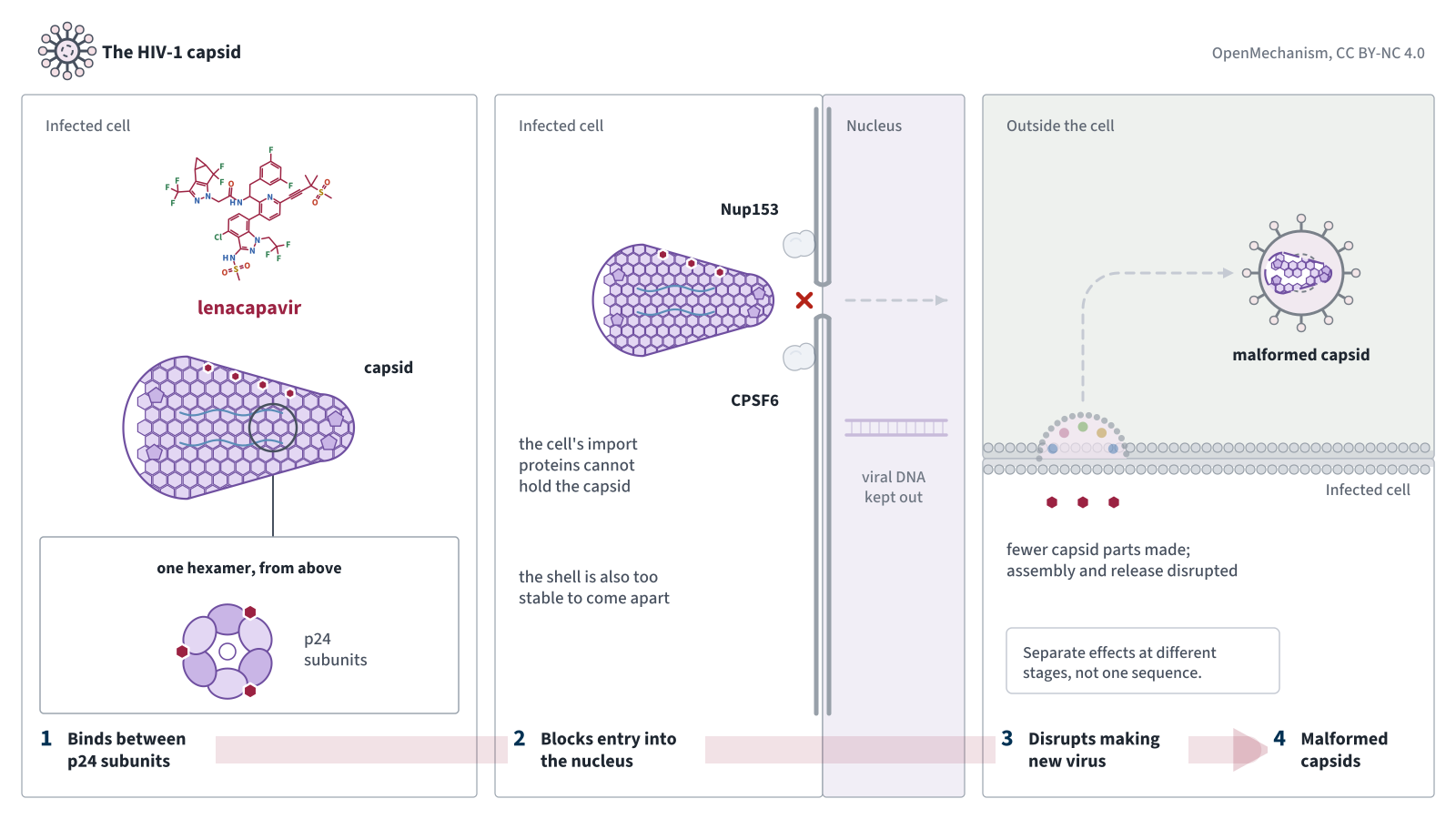
Key terms in this drawing (6)
- capsid
- Viral capsid. The protein shell around a virus's genome; HIV-1's is a cone built from p24 proteins.
- CPSF6
- Cleavage and polyadenylation specificity factor 6. A cell protein that binds the HIV-1 capsid near the nuclear pore.
- DNA
- Deoxyribonucleic acid. The molecule that stores genes.
- HIV-1
- Human immunodeficiency virus type 1. A retrovirus. Its capsid encloses the viral genome and helps deliver it into new host cells.
- Nup153
- Nucleoporin 153. A protein of the nuclear pore that the HIV-1 capsid binds on its way into the nucleus.
- p24
- Capsid protein p24. The protein units that form the HIV-1 capsid shell.
How it works
Binds between p24 subunits. Lenacapavir binds interfaces between p24 subunits in capsid hexamers.1
Blocks entry into the nucleus. It prevents nuclear-import proteins from binding capsid, disrupting capsid-mediated proviral-DNA nuclear uptake.1
Disrupts making new virus. Separate effects on Gag/ interfere with assembly and release and reduce capsid-subunit production.1
Malformed capsids. Changed subunit-association kinetics yield malformed capsids.1
For teachers: download this drawing or build a slide deck.
See also
Condition pages: HIV infection.
Other antivirals: acyclovir; baloxavir marboxil; bulevirtide; darunavir; doravirine; enfuvirtide; glecaprevir and pibrentasvir; nirmatrelvir; and 6 more.
Related drawings: darunavir (protease inhibitors, which stop Gag-Pol being cut, so new virus cannot mature).
Body system: infections.
Sources
- 1Sunlenca (lenacapavir sodium): FDA label12.4 Microbiology: Mechanism of Action
- 2ChEMBL CHEMBL4594438Target and action classification: Structural capsid protein inhibitor
Also used for the drawing
The drawing also shows what the capsid is made of and the stages where it works. These sources support those parts; the steps above come from the sources listed above.
- 3Atomic-level modelling of the HIV capsidPornillos O et al., Nature 2011 (abstract)
- 4Assembly and analysis of conical models for the HIV-1 coreGanser BK et al., Science 1999 (abstract)
- 5Clinical targeting of HIV capsid protein with a long-acting small moleculeLink JO et al., Nature 2020 (abstract)
- 6Structural and mechanistic bases for a potent HIV-1 capsid inhibitorBester SM et al., Science 2020 (abstract)
- 7Lenacapavir: ChEMBL CHEMBL4594438synonyms and canonical structure from the Atlas catalog snapshot
Spotted a mistake? Report an error (hello@openmechanism.com). Since launch, every published error we fix is listed on the corrections page.
Notes and limits
- A schematic teaching drawing: not to scale, not exact structures, binding poses or a complete pathway, and not a guide to dosing, treatment or how a person will respond.
- Other medicines in the same family may not follow every step or share the same clinical endpoint.
- The steps are in the order that explains them; one step is said to cause the next only where the source says so.
- The last three effects are parallel stages of capsid function, not consequences that must occur sequentially in one virion.
- Cell-culture susceptibility and exact hexamer geometry remain separate from clinical response.
All recorded limits are on the evidence page, and notes that apply to every page are on How to read a page. Version 1.0.0, not yet medically reviewed.
Cite this page
Tran D. Lenacapavir [Internet]. OpenMechanism; 2026 [updated 2026 Oct 15; cited 2026 Oct 15]. Available from: https://openmechanism.com/medicines/lenacapavir