Darunavir
Darunavir blocks protease, the viral enzyme that cuts the long protein in infected cells. Without these cuts, the new virus particles cannot become mature.
- Acts on
- HIV-1 protease
- Where
- HIV-1-infected cells and new virus particles
- Medicine type
- Small molecule
- Used for
- Infections
- Drug class
- Antivirals
Also called Prezista.
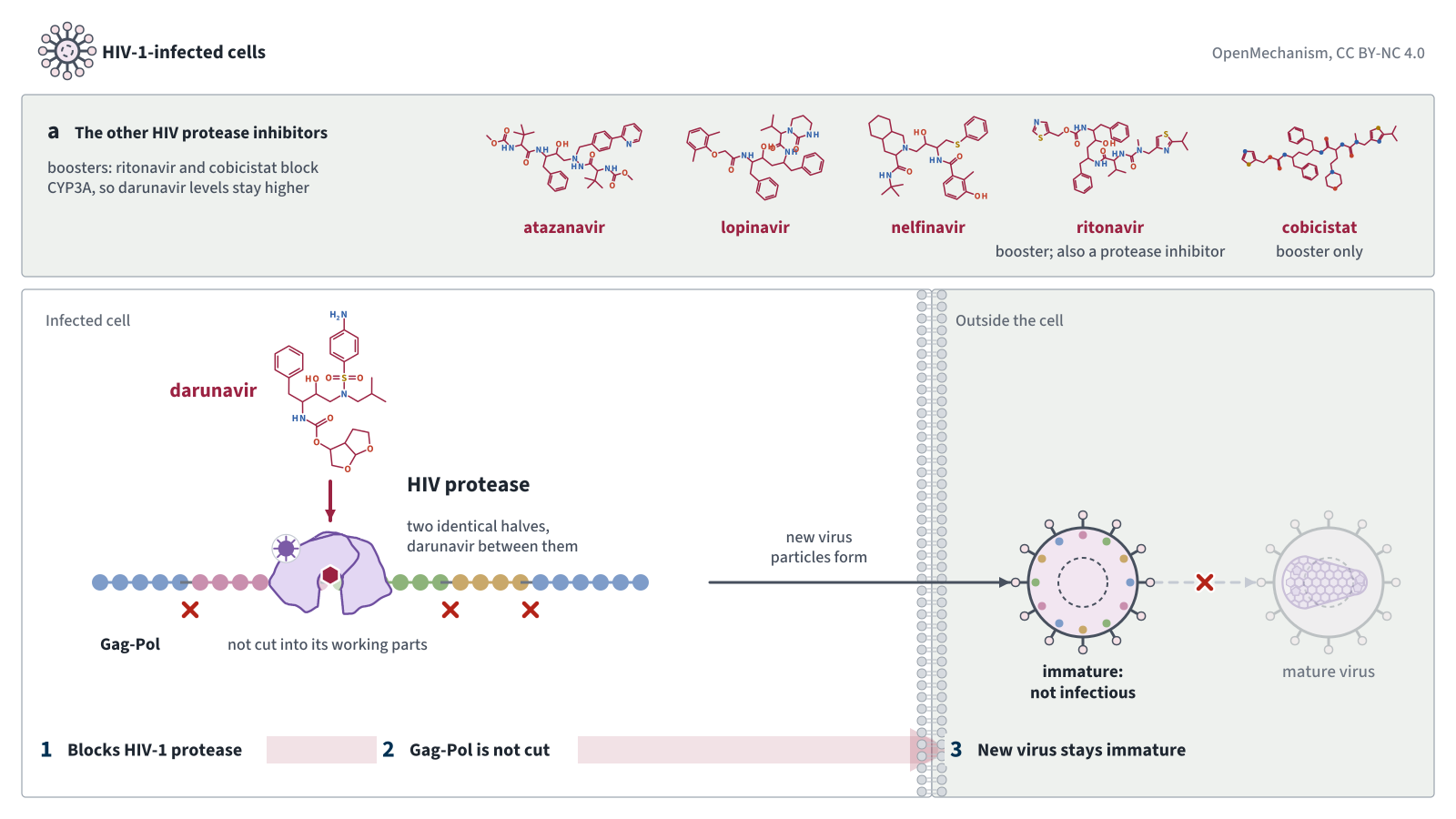
Key terms in this drawing
- CYP3A
- Cytochrome P450 3A. Liver enzymes that break down several medicines; ritonavir blocks them for nirmatrelvir and darunavir, and cobicistat for darunavir.
- Gag-Pol
- Gag-Pol polyprotein. A long HIV-1 protein that the viral protease cuts into working parts.
- HIV
- Human immunodeficiency virus. A virus that, left untreated, destroys CD4 T cells over time and raises the risk of infections and cancers.
- HIV-1
- Human immunodeficiency virus type 1. A retrovirus. Its capsid encloses the viral genome and helps deliver it into new host cells.
How it works
Blocks HIV-1 protease. Darunavir is an inhibitor of the HIV-1 protease.1,2
Gag-Pol is not cut. It selectively inhibits the cleavage of HIV-1 encoded Gag-Pol polyproteins in infected cells.1,2
New virus stays immature. This prevents the formation of mature virus particles.1,2
For teachers: download this drawing.
See also
Condition pages: HIV infection.
Other antivirals: acyclovir; baloxavir marboxil; bulevirtide; doravirine; enfuvirtide; glecaprevir and pibrentasvir; lenacapavir; nirmatrelvir; and 6 more.
Related drawings: lenacapavir (the capsid of the mature virus, and lenacapavir, which binds it).
Body system: infections.
Sources
- 1Prezista (darunavir): FDA label12.4 Microbiology: Mechanism of Action; 12.3 Pharmacokinetics
- 2Prezcobix (darunavir and cobicistat): FDA label12.4 Microbiology: Mechanism of Action; 12.3 Pharmacokinetics
- 3ChEMBL CHEMBL1323Target and action classification: Human immunodeficiency virus type 1 protease inhibitor
Also used for the drawing
The drawing also shows the other HIV protease inhibitors, the two boosters and the protease's cutting site. These sources support those parts; the steps above come from the sources listed above. The HIV protease outline is traced from the crystal structure below.
- 4Reyataz (atazanavir): FDA label12.4 Microbiology: Mechanism of Action
- 5Kaletra (lopinavir and ritonavir): FDA label12.1 Mechanism of Action; 12.4 Microbiology: Mechanism of Action
- 6Viracept (nelfinavir): FDA label12.4 Microbiology: Mechanism of Action
- 7Norvir (ritonavir): FDA label12.4 Microbiology: Mechanism of Action
- 8Tybost (cobicistat): FDA label12.1 Mechanism of Action; 12.4 Microbiology
- 9Role of hydroxyl group and R/S configuration of isostere in binding properties of HIV-1 protease inhibitorsPetroková H et al., Eur J Biochem 2004 (abstract)
- 10Structure of HIV-1 protease in complex with potent inhibitor KNI-272 determined by high-resolution X-ray and neutron crystallographyAdachi M et al., Proc Natl Acad Sci U S A 2009 (abstract)
- 11Structures: ChEMBL (atazanavir CHEMBL1163, lopinavir CHEMBL729, nelfinavir CHEMBL584, ritonavir CHEMBL163, cobicistat CHEMBL2095208)canonical structures from the Atlas catalog snapshot
- 12HIV-1 protease (its two halves) with darunavirPDB 4LL3; Kozisek, M. et al. Febs J. 2014; 281:1834-1847
Spotted a mistake? Report an error (hello@openmechanism.com). Since launch, every published error we fix is listed on the corrections page.
Notes and limits
- A schematic teaching drawing: not to scale, not exact structures, binding poses or a complete pathway, and not a guide to dosing, treatment or how a person will respond.
- The labels describe darunavir given with ritonavir or cobicistat, which block CYP3A and so raise darunavir's levels in the body; this page gives no dosing advice.
All recorded limits are on the evidence page, and notes that apply to every page are on How to read a page. Version 1.0.0, not yet medically reviewed.
Cite this page
Tran D. Darunavir [Internet]. OpenMechanism; 2026 [updated 2026 Oct 15; cited 2026 Oct 15]. Available from: https://openmechanism.com/medicines/darunavir