Malaria
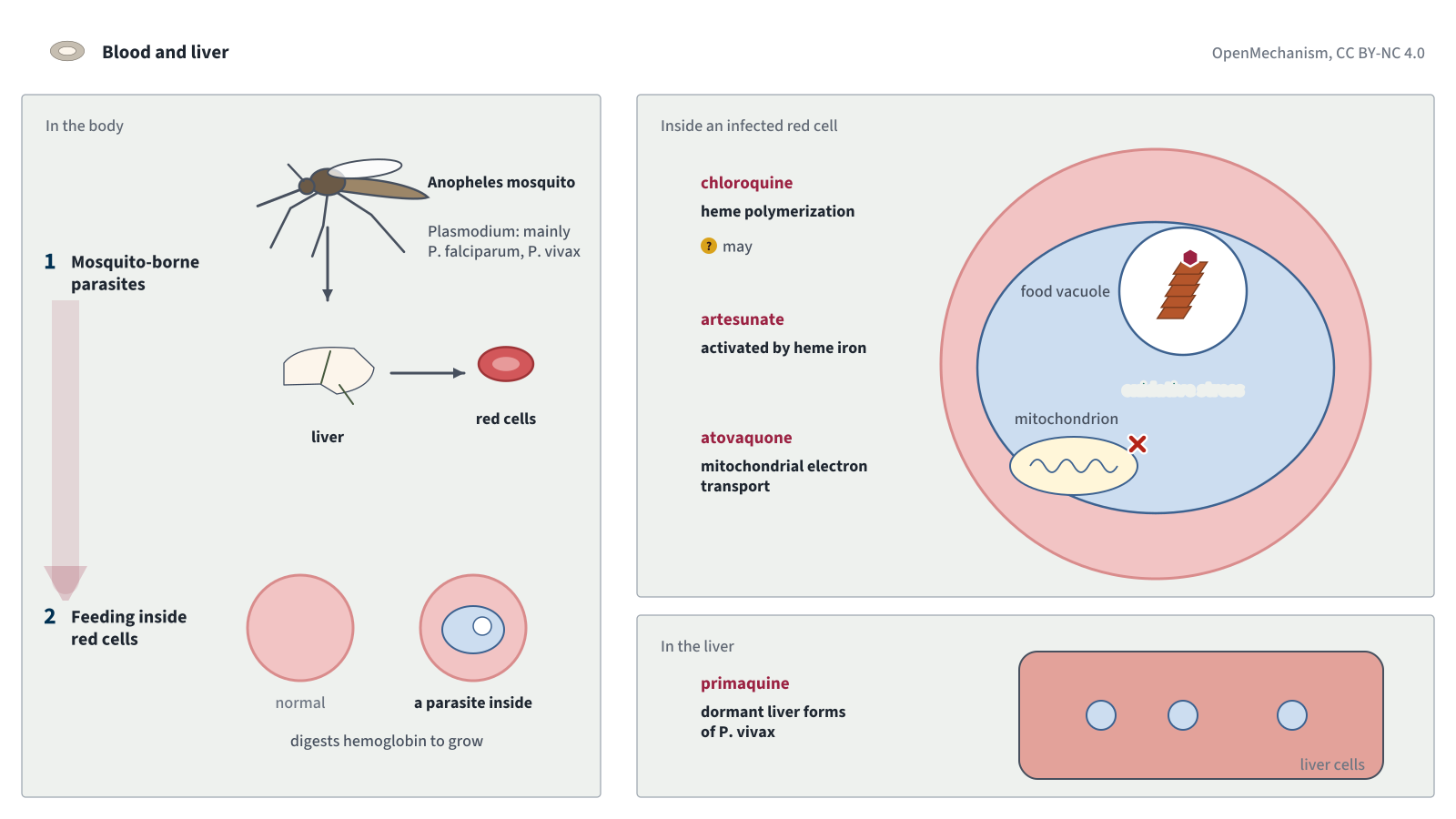
Malaria is caused by Plasmodium parasites spread by Anopheles mosquitoes; inside red blood cells they digest hemoglobin. It threatens nearly half the world's people and caused hundreds of thousands of deaths in 2015, mostly among children in Africa. Chloroquine may block heme polymerization; artesunate damages the parasite; atovaquone blocks its energy chain; primaquine acts on dormant P. vivax liver forms.
- Where
- Blood and liver
- Body systems
- Infections, Blood & clotting
- Medicines
- 4 medicines
May
The chloroquine label says: Chloroquine, may exert its effect against Plasmodium species by concentrating in the acid vesicles of the parasite and by inhibiting polymerization of heme.
Source 3: Chloroquine phosphate tablets: FDA label, Indications and Usage; Clinical Pharmacology
Clinical study: In a randomized, double-blind, placebo-controlled trial of weekly chloroquine in 1000 pregnant women; the trial measured episodes of malaria, not how chloroquine works: Chloroquine prophylaxis completely prevented P. vivax episodes; 10.1% (95%CI: 7.3-14.5) of women in the placebo group experienced at least one episode of vivax malaria but no episode occurred in women in the CQ group.
Villegas L et al., Trop Med Int Health 2007 (PMID 17300627)
This study was picked with a literature search and is not yet checked by our reviewer.
For teachers: download this drawing.
What goes wrong
Mosquito-borne parasites. Malaria is caused by Plasmodium parasites, mainly P. falciparum and P. vivax, spread by the bite of Anopheles mosquitoes.1
What the source says
“Malaria is caused in humans by five species of single-celled eukaryotic Plasmodium parasites (mainly Plasmodium falciparum and Plasmodium vivax) that are transmitted by the bite of Anopheles spp. mosquitoes.”
Source 1Feeding inside red cells. Inside red blood cells, the parasite's food vacuole digests hemoglobin for the amino acids it needs to grow.2
What the source says
“The primary function of the food vacuole is the proteolysis of ingested red cell haemoglobin to provide the growing parasite with essential amino acids.”
Source 2
Where medicines act
- A
Chloroquine: heme left toxic
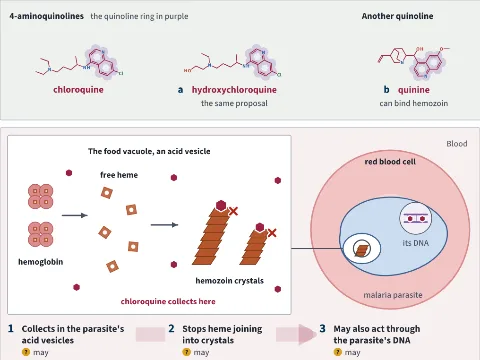
Chloroquine may work by gathering in the parasite's acid vesicles and blocking heme polymerization. It treats uncomplicated malaria from susceptible parasites.3
What the source says
“Chloroquine, may exert its effect against Plasmodium species by concentrating in the acid vesicles of the parasite and by inhibiting polymerization of heme.”
Source 3“Treatment of uncomplicated malaria due to susceptible strains of P. falciparum, P.malariae, P. ovale, and P.vivax .”
Source 3 - B
Artesunate: an iron-triggered bridge
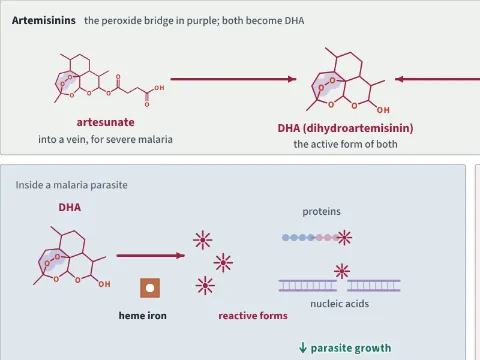
Artesunate's endoperoxide bridge is activated by heme iron, causing oxidative stress and stopping the parasite's protein and nucleic acid making. It is the first treatment for severe malaria.4
What the source says
“Artesunate and DHA, like other artemisinins contain an endoperoxide bridge that is activated by heme iron leading to oxidative stress, inhibition of protein and nucleic acid synthesis, ultrastructural changes as well as a decrease in parasite growth and survival.”
Source 4“Artesunate for Injection is indicated for the initial treatment of severe malaria in adult and pediatric patients.”
Source 4 - C
Atovaquone: the parasite's energy chain blocked
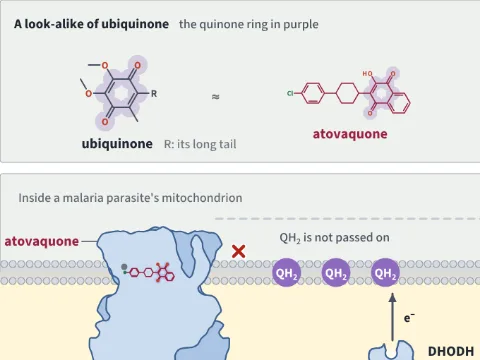
Atovaquone selectively blocks the parasite's mitochondrial electron transport. With proguanil, it prevents P. falciparum malaria.5
- D
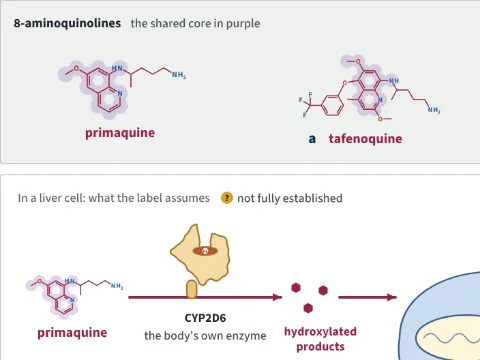
Primaquine: dormant liver forms cleared
Primaquine acts on the dormant liver forms () of P. vivax and prevents relapse.6
See also
Body systems: infections and blood & clotting.
Related medicines: doxycycline and hydroxychloroquine.
Other conditions: giardiasis and amebiasis; Pneumocystis pneumonia (PCP); syphilis; urinary tract infections; acne; and rheumatoid arthritis.
The medicine in the body: primaquine and G6PD deficiency.
Sources
- 1MalariaPhillips MA et al. Nat Rev Dis Primers 2017 (abstract). Saved copy
- 2Inhibition by chloroquine of a novel haem polymerase enzyme activity in malaria trophozoitesSlater AF, Cerami A. Nature 1992 (abstract). Saved copy
- 3Chloroquine phosphate tablets: FDA labelIndications and Usage; Clinical Pharmacology. Saved copy
- 4Artesunate for injection: FDA label1 Indications and Usage; 12.4 Mechanism of Action. Saved copy
- 5Malarone (atovaquone and proguanil): FDA label1 Indications and Usage; 12.1 Mechanism of Action. Saved copy
- 6Primaquine phosphate tablets: FDA labelIndications and Usage; Clinical Pharmacology. Saved copy
- 7Chloroquine prophylaxis against vivax malaria in pregnancy: a randomized, double-blind, placebo-controlled trialVillegas L et al. Trop Med Int Health 2007 (abstract). Saved copy
Notes and limits
- Drug resistance threatens the gains made with artemisinin combinations.1
- Chloroquine does not prevent vivax or ovale relapses, because it does not reach the liver forms.3
Notes that apply to every page are on How to read a page.
Spotted a mistake? Report an error (hello@openmechanism.com). Since launch, every published error we fix is listed on the corrections page.
Cite this page
Tran D. Malaria [Internet]. OpenMechanism; 2026 [updated 2026 Oct 20; cited 2026 Oct 20]. Available from: https://openmechanism.com/conditions/malaria