Cryptosporidiosis
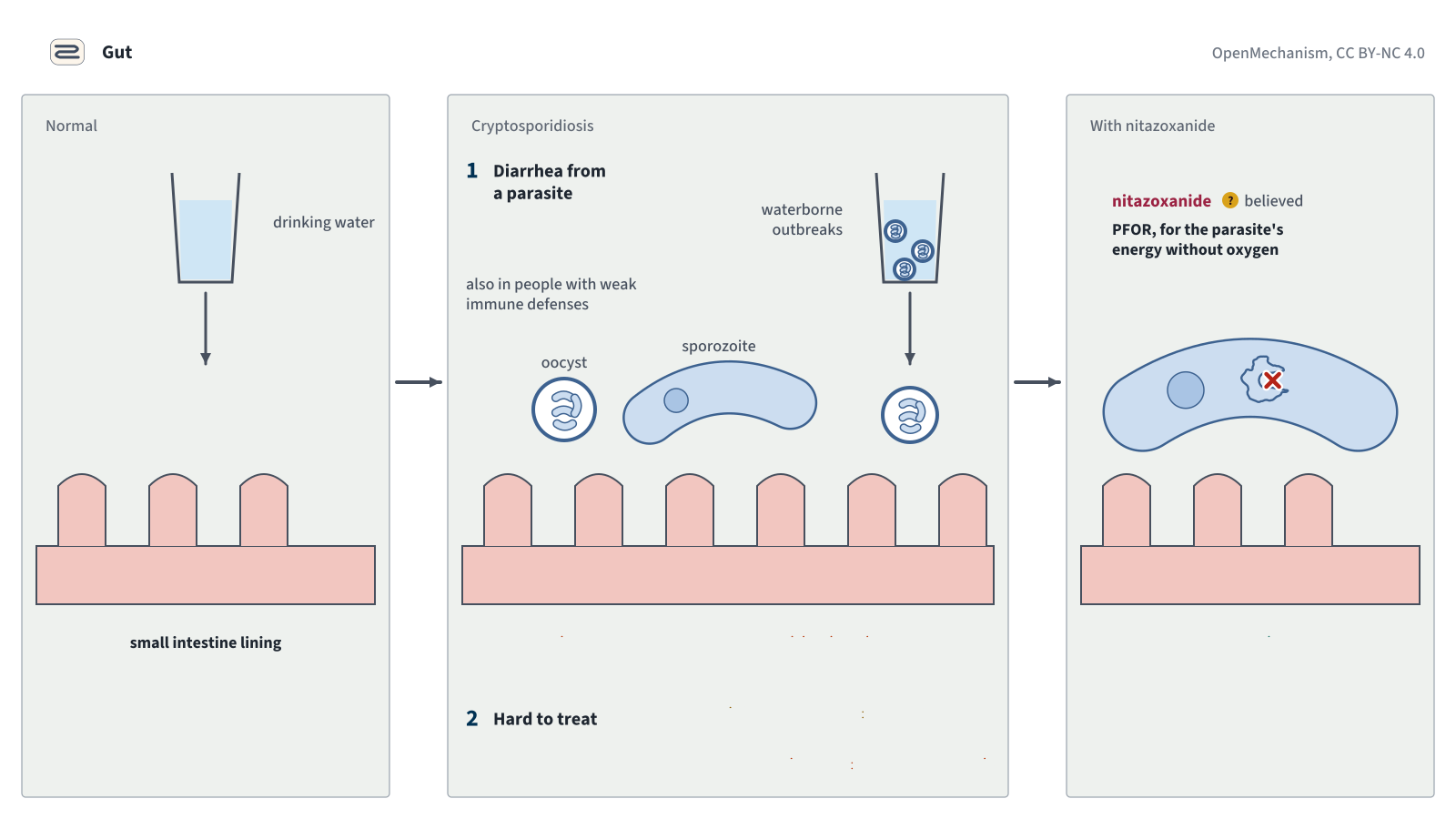
Cryptosporidium parasites cause diarrhea in waterborne outbreaks and in people with weak immune defenses; cryptosporidiosis is an increasingly recognized cause of illness and death worldwide, and of malnutrition in children. Treatment helps somewhat in healthy people and has no proven benefit in people with AIDS. Nitazoxanide is believed to interfere with PFOR, an enzyme the parasite's energy metabolism depends on.
- Where
- Gut
- Body systems
- Infections; Stomach, gut & liver
- Medicines
- 1 medicine
Believed
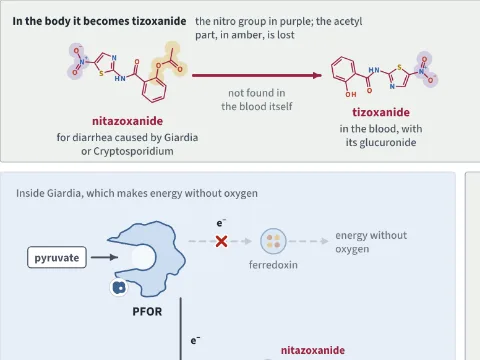
The nitazoxanide label says: The antiprotozoal activity of nitazoxanide is believed to be due to interference with the pyruvate:ferredoxin oxidoreductase (PFOR) enzyme-dependent electron transfer reaction which is essential to anaerobic energy metabolism.
Source 2: Nitazoxanide tablets: FDA label, 1 Indications and Usage; 12.4 Microbiology
Clinical study: In a randomized, placebo-controlled trial in 100 Zambian children with diarrhea from Cryptosporidium parvum; the trial measured whether the diarrhea and the parasite cleared, not how nitazoxanide works: A 3-day course of nitazoxanide significantly improved the resolution of diarrhoea, parasitological eradication, and mortality in HIV-seronegative, but not HIV-seropositive, children.
Amadi B et al., Lancet 2002 (PMID 12423984)
This study was picked with a literature search and is not yet checked by our reviewer.
For teachers: download this drawing.
Key terms in this drawing
- AIDS
- Acquired immune deficiency syndrome. Acquired immune deficiency syndrome; treatment that keeps HIV suppressed nearly removes the risk of developing it.
- PFOR
- Pyruvate:ferredoxin oxidoreductase. An energy enzyme of Giardia and Cryptosporidium that works without oxygen; nitazoxanide is believed to interfere with it.
What goes wrong
Diarrhea from a parasite. Cryptosporidium parasites cause diarrhea, in waterborne outbreaks and in people with weak immune defenses, and malnutrition in children.1
Hard to treat. Treatment helps somewhat in healthy people and has no proven benefit in people with .1
What the source says
“Therapy has some effect in healthy hosts and no proven efficacy in patients with AIDS.”
Source 1
Where medicines act
- A
Nitazoxanide: the parasite's energy enzyme
Nitazoxanide is believed to interfere with , an enzyme the parasite's anaerobic energy metabolism needs. It treats diarrhea caused by Cryptosporidium parvum or Giardia lamblia.2
What the source says
“The antiprotozoal activity of nitazoxanide is believed to be due to interference with the pyruvate:ferredoxin oxidoreductase (PFOR) enzyme-dependent electron transfer reaction which is essential to anaerobic energy metabolism.”
Source 2“indicated for the treatment of diarrhea caused by Giardia lamblia or Cryptosporidium parvum”
Source 2
See also
Body systems: infections; and stomach, gut & liver.
Other conditions: giardiasis and amebiasis; C. difficile infection; hepatitis B; hepatitis C; hepatitis D; and tapeworm larva infections.
Sources
- 1A review of the global burden, novel diagnostics, therapeutics, and vaccine targets for cryptosporidiumCheckley W et al. Lancet Infect Dis 2015 (abstract). Saved copy
- 2Nitazoxanide tablets: FDA label1 Indications and Usage; 12.4 Microbiology. Saved copy
- 3Effect of nitazoxanide on morbidity and mortality in Zambian children with cryptosporidiosis: a randomised controlled trialAmadi B et al. Lancet 2002 (abstract). Saved copy
- 4Desulfovibrio africanus pyruvate-ferredoxin oxidoreductase (PFOR) with its cofactorPDB 2C3M; Cavazza, C. et al. Structure 2006;14:217. The PFOR outline in the drawing is traced from this structure. Saved copy
Notes and limits
- It has not been shown to work for Cryptosporidium diarrhea in people with HIV or weak immune defenses, and PFOR may not be its only target.2
Notes that apply to every page are on How to read a page.
Spotted a mistake? Report an error (hello@openmechanism.com). Since launch, every published error we fix is listed on the corrections page.
Cite this page
Tran D. Cryptosporidiosis [Internet]. OpenMechanism; 2026 [updated 2026 Oct 18; cited 2026 Oct 18]. Available from: https://openmechanism.com/conditions/cryptosporidiosis