Influenza
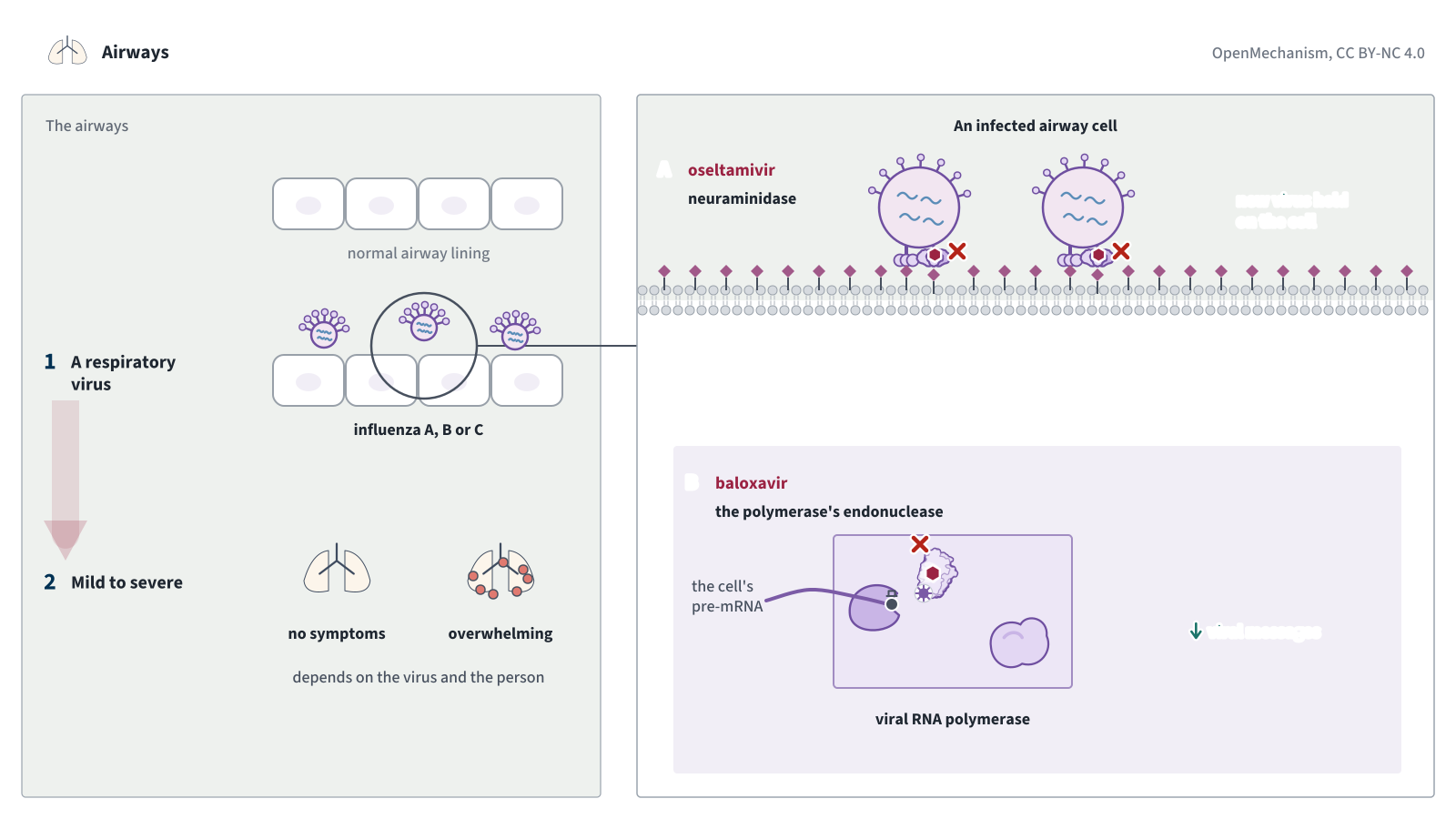
Influenza is an acute respiratory illness caused by influenza A, B and C viruses, in local outbreaks and seasonal epidemics; new influenza A strains from animals can cause worldwide pandemics. It ranges from no symptoms to overwhelming illness. Oseltamivir blocks neuraminidase, which releases new virus from cells; baloxavir blocks the endonuclease the virus needs to make its messages.
- Where
- Airways
- Body systems
- Infections, Lungs & airways
- Medicines
- 2 medicines
For teachers: download this drawing.
Key terms in this drawing
- RNA
- Ribonucleic acid. A molecule copied from DNA; messenger RNA carries a gene's instructions.
What goes wrong
A respiratory virus. Influenza is an acute respiratory illness caused by influenza A, B and C viruses, in local outbreaks or seasonal epidemics.1
What the source says
“Influenza is an acute respiratory illness, caused by influenza A, B, and C viruses, that occurs in local outbreaks or seasonal epidemics.”
Source 1Mild to severe. After a short incubation, illness ranges from no symptoms to overwhelming, depending on the virus and the person.1
What the source says
“Clinical illness follows a short incubation period and presentation ranges from asymptomatic to fulminant, depending on the characteristics of both the virus and the individual host.”
Source 1
Where medicines act
- A
Oseltamivir: new virus held on the cell
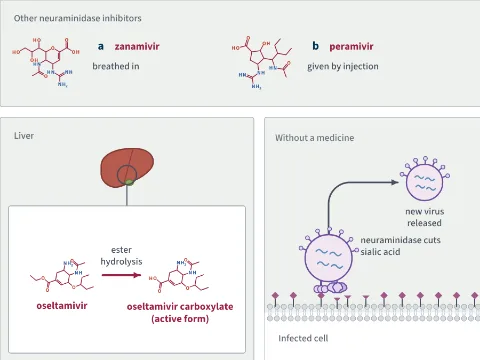
Oseltamivir's active form blocks neuraminidase and so the release of new virus particles. It treats uncomplicated influenza A and B within 48 hours of symptoms.2
What the source says
“Oseltamivir carboxylate is an inhibitor of influenza virus neuraminidase affecting release of viral particles.”
Source 2“TAMIFLU is indicated for the treatment of acute, uncomplicated illness due to influenza A and B infection in patients 2 weeks of age and older who have been symptomatic for no more than 48 hours.”
Source 2 - B
Baloxavir: the virus's messages stopped
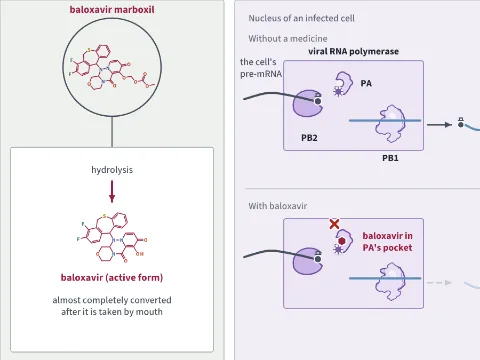
Baloxavir blocks the endonuclease of the viral polymerase, needed to make viral messages, so the virus cannot copy itself. It treats uncomplicated influenza within 48 hours of symptoms.3
What the source says
“Baloxavir inhibits the endonuclease activity of the polymerase acidic (PA) protein, an influenza virus-specific enzyme in the viral RNA polymerase complex required for viral gene transcription, resulting in inhibition of influenza virus replication.”
Source 3“Treatment of acute uncomplicated influenza in patients 5 years of age and older who have been symptomatic for no more than 48 hours”
Source 3
See also
Body systems: infections and lungs & airways.
Other conditions: COVID-19, Pneumocystis pneumonia (PCP), pneumonia, RSV infection and tuberculosis.
Sources
- 1InfluenzaPaules C, Subbarao K. Lancet 2017 (abstract). Saved copy
- 2Tamiflu (oseltamivir): FDA label1 Indications and Usage; 12.1 and 12.4 Mechanism of Action. Saved copy
- 3Xofluza (baloxavir): FDA label1 Indications and Usage; 12.1 and 12.4 Mechanism of Action. Saved copy
- 4Influenza A (N1) neuraminidase with oseltamivirPDB 2HU4; Russell, R.J. et al. Nature 2006;443:45-49. The neuraminidase outline in the drawing is traced from this structure. Saved copy
- 5Influenza A polymerase PA endonuclease with baloxavir acid, baloxavir marboxil's active formPDB 6FS6; Omoto, S. et al. Sci Rep 2018;8:9633. The PA endonuclease outline in the drawing is traced from this structure. Saved copy
Notes and limits
- Better ways to prevent and treat seasonal influenza and pandemics are still needed.1
Notes that apply to every page are on How to read a page.
Spotted a mistake? Report an error (hello@openmechanism.com). Since launch, every published error we fix is listed on the corrections page.
Cite this page
Tran D. Influenza [Internet]. OpenMechanism; 2026 [updated 2026 Oct 18; cited 2026 Oct 18]. Available from: https://openmechanism.com/conditions/influenza