Linezolid
Linezolid binds the bacterial ribosome ( in the subunit) and stops a working start complex forming, which the label says is essential for bacterial reproduction. A 2022 study says it inhibits translation, the protein making of bacterial ribosomes. The Zyvox label lists it, in adults and children, for infections caused by susceptible Gram-positive bacteria: pneumonia caught in hospital or in the community, complicated skin infections without bone infection (including diabetic foot infections), uncomplicated skin infections and vancomycin-resistant Enterococcus faecium infections; it says linezolid is not for Gram-negative infections and that its use for longer than 28 days has not been studied in controlled trials.
- Acts on
- 23S ribosomal RNA of bacterial 50S subunit
- Where
- Bacterial ribosomes
- Medicine type
- Small molecule
- Used for
- Infections
- Drug class
- Antibiotics
Also called Zyvox.
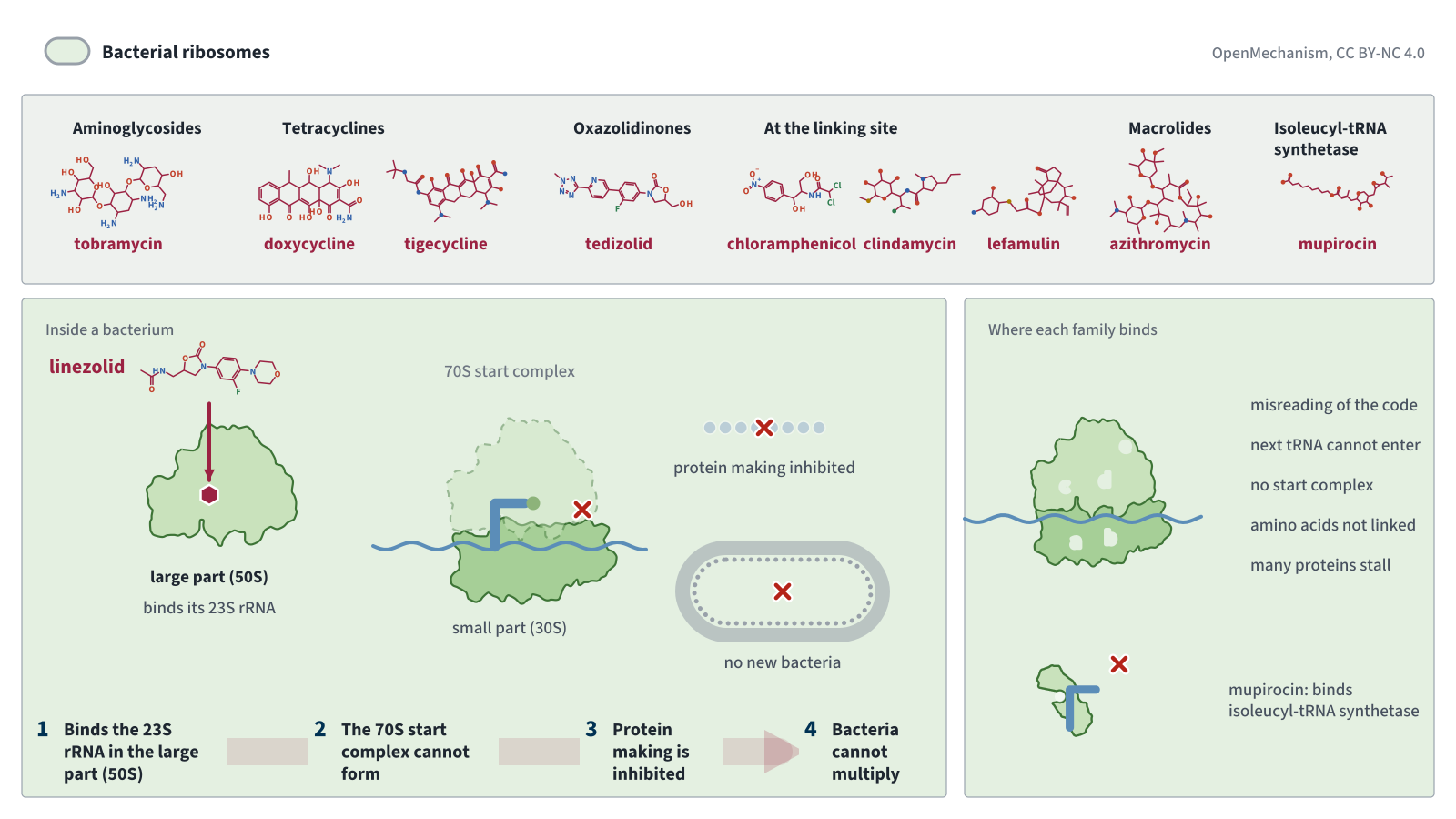
Key terms in this drawing (6)
- 30S
- 30S ribosomal subunit. The small part of the bacterial ribosome.
- 50S
- 50S ribosomal subunit. The large part of the bacterial ribosome.
- 70S
- 70S ribosome. The bacterial ribosome. The Zyvox label says linezolid prevents a functional 70S initiation complex from forming.
- rRNA
- Ribosomal RNA. RNA that is part of the ribosome, such as the bacterial ribosome's 16S and 23S rRNA.
- tRNA
- Transfer RNA. An RNA that carries an amino acid into the ribosome.
- tRNA synthetase
- Aminoacyl-tRNA synthetase. An enzyme the cell needs to make proteins; mupirocin binds and blocks the bacterial isoleucyl-tRNA synthetase.
How it works
Binds the 23S rRNA in the large part (50S). Linezolid binds a site on bacterial 23S rRNA in the 50S ribosomal subunit.1
The 70S start complex cannot form. The label says linezolid prevents a functional 70S initiation complex forming. A 2022 study of ribosome complexes stalled by linezolid says it binds the ribosome's peptidyl transferase center and does not inhibit peptide bond formation at all sequences: it acts when alanine is second to last in the growing chain.1,2
Protein making is inhibited. A 2022 study says linezolid inhibits translation, the protein making of bacterial ribosomes.2
Bacteria cannot multiply. The label says the 70S initiation complex is essential for bacterial reproduction. In the label's time-kill studies, linezolid was bacteriostatic against enterococci and staphylococci and bactericidal for most streptococcal isolates.1
For teachers: download this drawing or build a slide deck.
See also
Condition pages: antibiotic-resistant infections; pneumonia; skin and soft-tissue infections; and tuberculosis.
Other antibiotics: amoxicillin; amoxicillin and clavulanate; azithromycin; bedaquiline; ceftazidime and avibactam; ceftriaxone; cephalexin; ciprofloxacin; and 14 more.
Explained: why linezolid can cause lactic acidosis and nerve damage; linezolid and serotonergic medicines; and MAO inhibitors and tyramine.
Body system: infections.
Sources
- 1Zyvox (linezolid): FDA label1 Indications and Usage; 12.4 Microbiology: Mechanism of Action
- 2Structural basis for context-specific inhibition of translation by oxazolidinone antibioticsTsai K et al., Nat Struct Mol Biol 2022 (abstract)
- 3Structure of the 70S ribosome complexed with mRNA and tRNASelmer M et al., Science 2006 (abstract)
- 4Structure of the human 80S ribosomeKhatter H et al., Nature 2015 (abstract)
- 5Mitochondrial ribosomes in cancerKim HJ et al., Semin Cancer Biol 2017 (abstract)
- 6The complete structure of the 55S mammalian mitochondrial ribosomeGreber BJ et al., Science 2015 (abstract)
- 7Linezolid-induced inhibition of mitochondrial protein synthesisDe Vriese AS et al., Clin Infect Dis 2006 (abstract)
- 8Reversible inhibition of mitochondrial protein synthesis during linezolid-related hyperlactatemiaGarrabou G et al., Antimicrob Agents Chemother 2007 (abstract)
- 9ChEMBL CHEMBL126Target and action classification: Bacterial 70S ribosome inhibitor
Also used for the drawing
The drawing also shows where the other families of ribosome blockers bind, and mupirocin, which binds an enzyme, isoleucyl-tRNA synthetase. These sources support those parts; the steps above come from the sources listed above. The ribosome and isoleucyl-tRNA synthetase outlines are traced from the electron microscopy and crystal structures below.
- 10Sivextro (tedizolid): FDA label12.4 Microbiology: Mechanism of Action
- 11Zithromax (azithromycin): FDA label12.4 Microbiology: Mechanism of Action
- 12Cleocin Pediatric (clindamycin): FDA labelMicrobiology: Mechanism of Action
- 13Chloramphenicol sodium succinate: FDA labelMicrobiology: Mechanism of Action
- 14Doxycycline hyclate: FDA labelMicrobiology: Mechanism of Action
- 15Tygacil (tigecycline): FDA label12.4 Microbiology: Mechanism of Action
- 16Tobramycin injection: FDA labelMicrobiology: Mechanism of Action
- 17Mupirocin: FDA label12.4 Microbiology: Mechanism of Action
- 18Structure of the A site of Escherichia coli 16S ribosomal RNA complexed with an aminoglycoside antibioticFourmy D et al., Science 1996 (abstract)
- 19Structural basis for the interaction of antibiotics with the peptidyl transferase centre in eubacteriaSchlünzen F et al., Nature 2001 (abstract)
- 20Lefamulin: A Novel Oral and Intravenous Pleuromutilin for the Treatment of Community-Acquired Bacterial PneumoniaZhanel GG et al., Drugs 2021 (abstract)
- 21The general mode of translation inhibition by macrolide antibioticsKannan K et al., Proc Natl Acad Sci U S A 2014 (abstract)
- 22
- 23Escherichia coli stalled ribosome with linezolidPDB 7S1G; Tsai, K. et al. Nat.Struct.Mol.Biol. 2022; 29:162-171
- 24Isoleucyl-tRNA synthetase with its tRNA and mupirocinPDB 1QU2; Silvian, L.F. et al. Science 1999; 285:1074-1077
Spotted a mistake? Report an error (hello@openmechanism.com). Since launch, every published error we fix is listed on the corrections page.
Notes and limits
- A schematic teaching drawing: not to scale, not exact structures, binding poses or a complete pathway, and not a guide to dosing, treatment or how a person will respond.
- The steps are in the order that explains them; one step is said to cause the next only where the source says so.
- Bacterial ribosomes are 70S and human ribosomes outside mitochondria are 80S. Mitochondria descend from a bacterium and keep their own ribosomes (55S in mammals); small studies (one patient and animals, and 5 patients) conclude that linezolid inhibits protein making in mitochondria too.
- Bacteriostatic versus bactericidal behavior is organism-dependent.
All recorded limits are on the evidence page, and notes that apply to every page are on How to read a page. Version 1.0.2, medically reviewed by Daniel Tran, PharmD, on 13 November 2026.
Cite this page
Tran D. Linezolid [Internet]. OpenMechanism; 2026 [updated 2026 Nov 13; cited 2026 Nov 13]. Available from: https://openmechanism.com/medicines/linezolid