Clofazimine
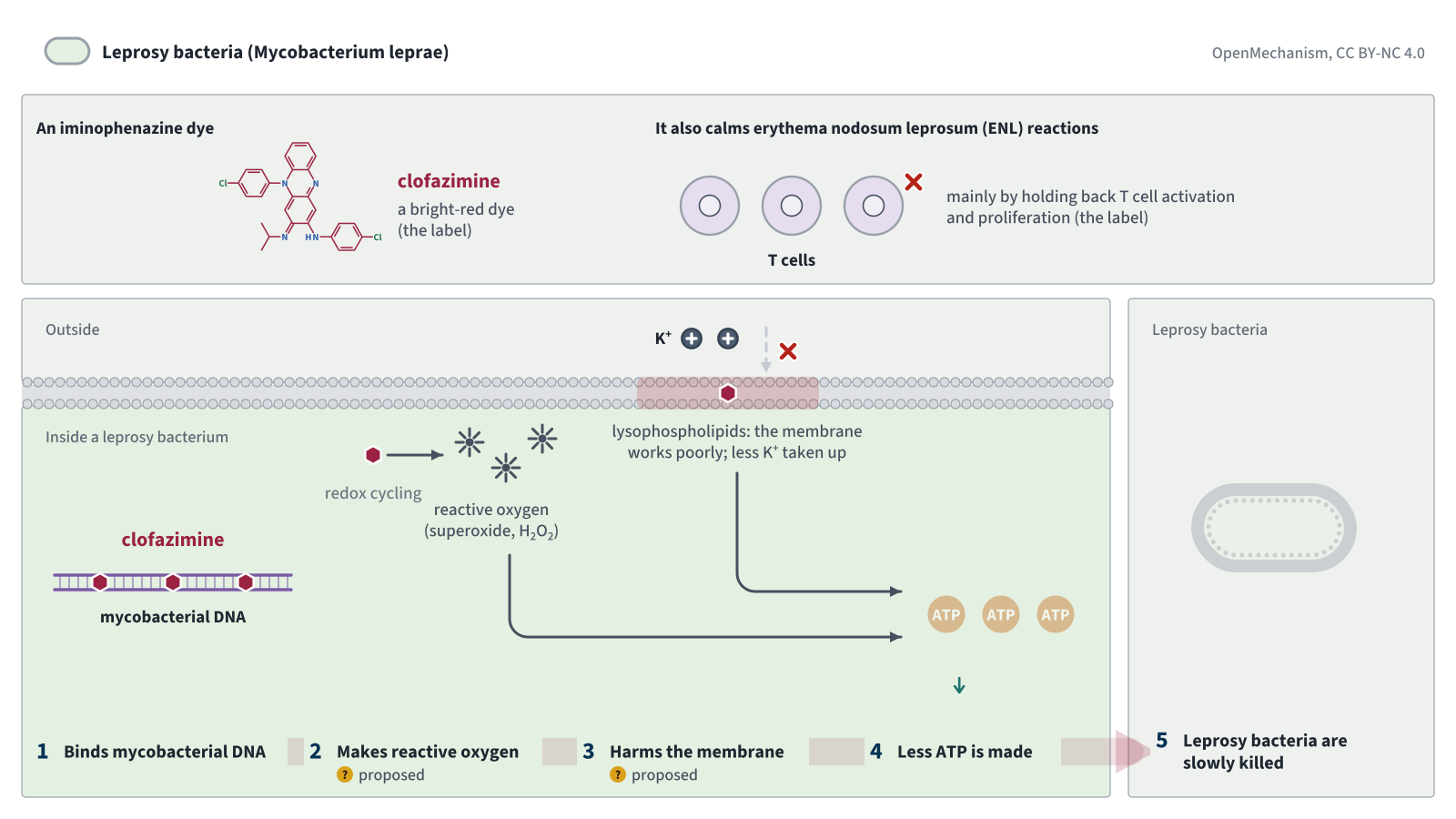
Clofazimine binds the of mycobacteria and inhibits their growth. The label proposes that it also makes reactive oxygen and harms the bacterial membrane, both cutting production, and it slowly kills leprosy bacteria. The label says its precise mechanisms are unknown.
- Acts on
- Mycobacterial DNA; the bacterial membrane and respiratory chain (postulated)
- Where
- Leprosy bacteria (Mycobacterium leprae)
- Medicine type
- Small molecule
- Used for
- Infections
- Drug class
- Antibiotics
Also called Lamprene.
Step 2: proposed
The Lamprene (clofazimine) label says: The mechanism of action for the anti-mycobacterial activity of clofazimine can be postulated through its membrane-directed activity including the bacterial respiratory chain and ion transporters. … Intracellular redox cycling, involving oxidation of reduced clofazimine, leads to the generation of antimicrobial reactive oxygen species (ROS)
Source 1: Lamprene (clofazimine): FDA label, 12.4 Microbiology: Mechanism of Action
Clinical study: A randomized trial gave 45 people with untreated lepromatous leprosy one of three clofazimine regimens for 24 weeks; it measured their clinical response and how many of their leprosy bacteria stayed alive, not how clofazimine works: The results of serial mouse foot pad inoculation demonstrated that the positivity rates of multiplication of Mycobacterium leprae in mice and the proportions of viable organisms reduced gradually in all groups.
Jamet P et al., Int J Lepr Other Mycobact Dis 1992 (PMID 1299709)
This study was picked with a literature search and is not yet checked by our reviewer.
Step 3: proposed
The Lamprene (clofazimine) label says: The mechanism of action for the anti-mycobacterial activity of clofazimine can be postulated through its membrane-directed activity including the bacterial respiratory chain and ion transporters. … Secondly, interaction of clofazimine with membrane phospholipids results in the generation of antimicrobial lysophospholipids, which promote membrane dysfunction, resulting in interference with K+ uptake.
Source 1: Lamprene (clofazimine): FDA label, 12.4 Microbiology: Mechanism of Action
Clinical study: A randomized trial gave 45 people with untreated lepromatous leprosy one of three clofazimine regimens for 24 weeks; it measured their clinical response and how many of their leprosy bacteria stayed alive, not how clofazimine works: The results of serial mouse foot pad inoculation demonstrated that the positivity rates of multiplication of Mycobacterium leprae in mice and the proportions of viable organisms reduced gradually in all groups.
Jamet P et al., Int J Lepr Other Mycobact Dis 1992 (PMID 1299709)
This study was picked with a literature search and is not yet checked by our reviewer.
Key terms in this drawing
- ATP
- Adenosine triphosphate. The molecule cells use to carry energy.
- DNA
- Deoxyribonucleic acid. The molecule that stores genes.
- ENL
- Erythema nodosum leprosum. An inflammatory reaction in leprosy; clofazimine also calms it, mainly by holding back T cells.
- T cell
- T lymphocyte. A white blood cell of the immune system.
How it works
Binds mycobacterial DNA. Clofazimine inhibits mycobacterial growth and binds preferentially to mycobacterial DNA.1
Makes reactive oxygen. Its anti-mycobacterial activity can be postulated through membrane-directed activity, including the bacterial respiratory chain: intracellular redox cycling, involving oxidation of reduced clofazimine, generates antimicrobial reactive oxygen species (superoxide, hydrogen peroxide).1
Harms the membrane. Interaction of clofazimine with membrane phospholipids generates antimicrobial lysophospholipids, which promote membrane dysfunction and interfere with K+ uptake.1
Less ATP is made. Both mechanisms interfere with cellular energy metabolism by disrupting ATP production.1
Leprosy bacteria are slowly killed. Clofazimine exerts a slow bactericidal effect on Mycobacterium leprae (Hansen's bacillus).1
For teachers: download this drawing.
See also
Condition pages: leprosy.
Other antibiotics: amoxicillin; amoxicillin and clavulanate; azithromycin; bedaquiline; ceftazidime and avibactam; ceftriaxone; cephalexin; ciprofloxacin; and 14 more.
Related drawings: bedaquiline (the same efflux pump that pushes it out also lowers clofazimine's effect).
Body system: infections.
Sources
- 1Lamprene (clofazimine): FDA label12.4 Microbiology: Mechanism of Action; 12.4 Microbiology: Mechanism of Action (anti-inflammatory activity)
- 2ChEMBL CHEMBL1292Target and action classification: DNA inhibitor
- 3Short-term trial of clofazimine in previously untreated lepromatous leprosyJamet P et al. Int J Lepr Other Mycobact Dis 1992 (abstract)
Also used for the drawing
Panel a of the drawing (calming erythema nodosum leprosum reactions) comes from the anti-inflammatory paragraph of the same label; the steps above come from its mechanism paragraph.
- 4Structure: ChEMBL (clofazimine CHEMBL1292)canonical structure
Spotted a mistake? Report an error (hello@openmechanism.com). Since launch, every published error we fix is listed on the corrections page.
Notes and limits
- A schematic teaching drawing: not to scale, not exact structures, binding poses or a complete pathway, and not a guide to dosing, treatment or how a person will respond.
- The label says clofazimine's precise mechanisms of action are unknown; the membrane-directed steps are postulated.
- The label also describes anti-inflammatory activity in erythema nodosum leprosum reactions, mainly by inhibiting T lymphocyte activation and proliferation.
- The label says its precise mechanisms of action are unknown.
- Postulated in the label.
All recorded limits are on the evidence page, and notes that apply to every page are on How to read a page. Version 1.0.0, not yet medically reviewed.
Cite this page
Tran D. Clofazimine [Internet]. OpenMechanism; 2026 [updated 2026 Nov 6; cited 2026 Nov 6]. Available from: https://openmechanism.com/medicines/clofazimine