Atovaquone
In malaria parasites (Plasmodium), atovaquone is thought to act at (cytochrome bc1) of the mitochondrial energy chain. This indirectly blocks linked enzymes and may reduce the parasite's ability to make nucleic acids and .
- Acts on
- Parasite cytochrome bc1 complex
- Where
- Malaria parasite mitochondria
- Medicine type
- Small molecule
- Used for
- Infections
Also called Mepron.
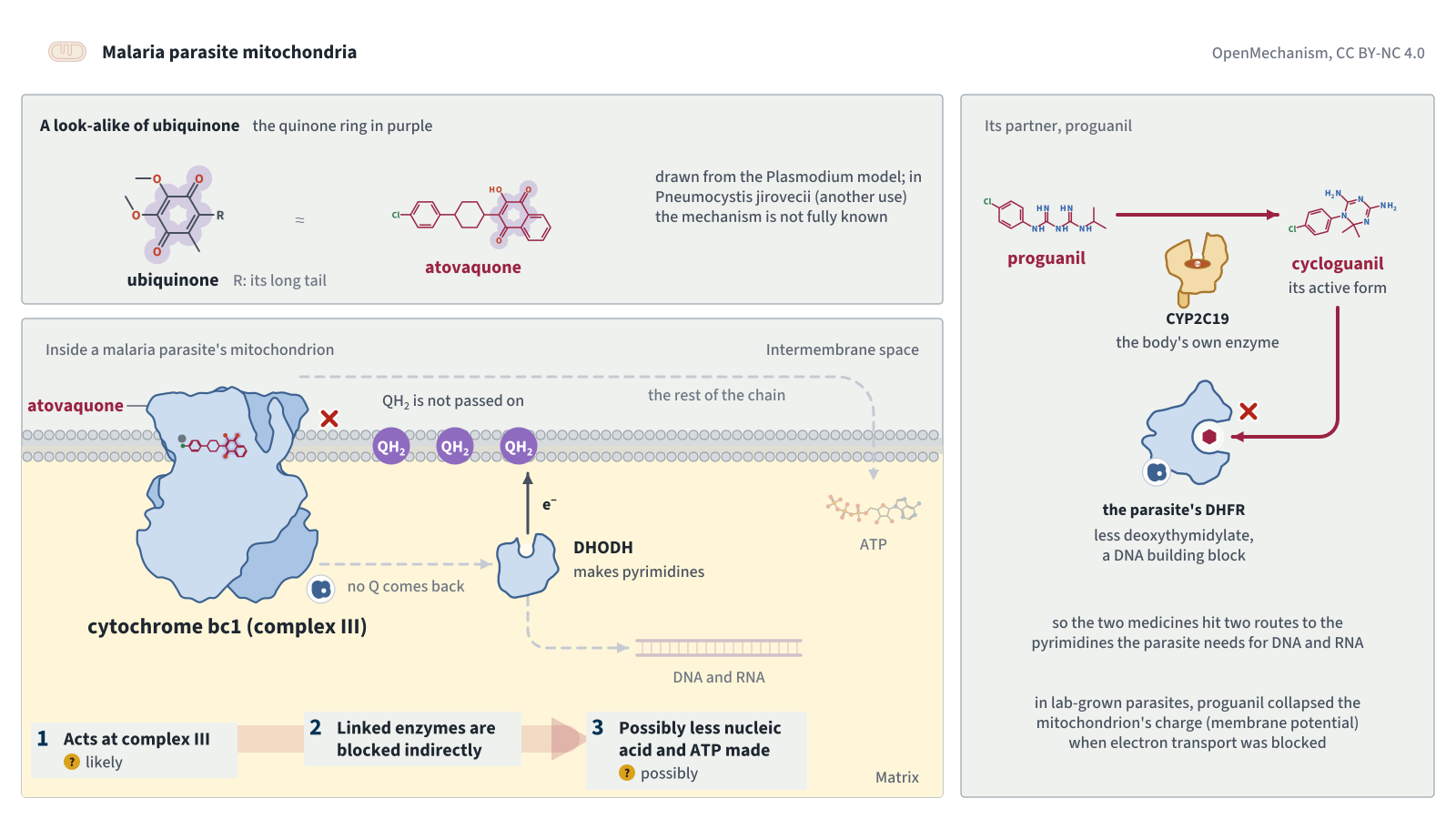
Step 1: likely
The Mepron (atovaquone) label says: In Plasmodium species, the site of action appears to be the cytochrome bc 1 complex (Complex III).
Source 1: Mepron (atovaquone): FDA label, 12.4 Microbiology: Mechanism of Action
Clinical study: In a randomized, double-blind trial in 976 nonimmune travelers, atovaquone-proguanil was compared with mefloquine for malaria prophylaxis; the trial measured side effects and malaria, not how atovaquone works: No confirmed diagnoses of malaria occurred in either group. … Atovaquone-proguanil was better tolerated than was mefloquine, and it was similarly effective for malaria prophylaxis in nonimmune travelers.
Overbosch D et al., Clin Infect Dis 2001 (PMID 11528574)
This study was picked with a literature search and is not yet checked by our reviewer.
Step 3: possibly
The Mepron (atovaquone) label says: The ultimate metabolic effects of such blockade may include inhibition of nucleic acid and adenosine triphosphate (ATP) synthesis.
Source 1: Mepron (atovaquone): FDA label, 12.4 Microbiology: Mechanism of Action
Clinical study: In a randomized, double-blind trial in 976 nonimmune travelers, atovaquone-proguanil was compared with mefloquine for malaria prophylaxis; the trial measured side effects and malaria, not how atovaquone works: No confirmed diagnoses of malaria occurred in either group. … Atovaquone-proguanil was better tolerated than was mefloquine, and it was similarly effective for malaria prophylaxis in nonimmune travelers.
Overbosch D et al., Clin Infect Dis 2001 (PMID 11528574)
This study was picked with a literature search and is not yet checked by our reviewer.
Key terms in this drawing (8)
- ATP
- Adenosine triphosphate. The molecule cells use to carry energy.
- CYP2C19
- Cytochrome P450 2C19. A liver enzyme that breaks down several medicines; for clopidogrel it makes most of the active metabolite.
- cytochrome bc1
- Cytochrome bc1 complex (complex III). Part of the electron transport chain in the mitochondrion's inner membrane; atovaquone acts here.
- DHFR
- Dihydrofolate reductase. The enzyme that makes tetrahydrofolic acid from dihydrofolic acid; tetrahydrofolic acid helps make the building blocks of nucleic acids.
- DHODH
- Dihydroorotate dehydrogenase. An enzyme needed to make pyrimidines; in malaria parasites it depends on the mitochondrion's electron transport.
- DNA
- Deoxyribonucleic acid. The molecule that stores genes.
- QH₂
- Ubiquinol. Ubiquinone after it has picked up electrons; it passes them on at complex III.
- RNA
- Ribonucleic acid. A molecule copied from DNA; messenger RNA carries a gene's instructions.
How it works
Acts at complex III. In Plasmodium species, the source identifies the likely action site as cytochrome bc1, complex III.1
Linked enzymes are blocked indirectly. Electron-transport inhibition indirectly inhibits ubiquinone-linked metabolic enzymes.1
Possibly less nucleic acid and ATP made. Possible downstream effects include inhibition of nucleic-acid and ATP synthesis.1
For teachers: download this drawing or build a slide deck.
See also
Condition pages: malaria and Pneumocystis pneumonia (PCP).
Related drawings: sulfamethoxazole and trimethoprim (the folate pathway in bacteria and parasites, with cycloguanil, proguanil's active form, at DHFR).
Body system: infections.
Sources
- 1Mepron (atovaquone): FDA label12.4 Microbiology: Mechanism of Action
- 2ChEMBL CHEMBL1450Target and action classification: Cytochrome b inhibitor
- 3Atovaquone-proguanil versus mefloquine for malaria prophylaxis in nonimmune travelers: results from a randomized, double-blind studyOverbosch D et al. Clin Infect Dis 2001 (abstract)
Also used for the drawing
The drawing also shows how ubiquinone links enzymes such as DHODH to complex III, and atovaquone's partner in Malarone, proguanil. These sources support those parts; the steps above and the ubiquinone look-alike come from the sources listed above. The cytochrome bc1, DHODH, CYP2C19 and parasite DHFR outlines are traced from the electron microscopy and crystal structures below.
- 4Malarone (atovaquone and proguanil): FDA label12.3 Pharmacokinetics; 12.4 Microbiology: Mechanism of Action
- 5Specific role of mitochondrial electron transport in blood-stage Plasmodium falciparumPainter HJ et al., Nature 2007 (abstract)
- 6
- 7Toxoplasma gondii cytochrome bc1 with atovaquonePDB 9I4X; MacLean, A.E. et al. Nat.Struct.Mol.Biol. 2025; 32:1424-1433
- 8Plasmodium falciparum dihydroorotate dehydrogenase with orotate, FMN and an inhibitor in its ubiquinone sitePDB 1TV5; Hurt, D.E. et al. Acta Crystallogr.,Sect.D 2006; 62:312-323
- 9Human CYP2C19PDB 4GQS; Reynald, R.L. et al. J.Biol.Chem. 2012; 287:44581-44591
- 10Plasmodium falciparum dihydrofolate reductase-thymidylate synthase with WR99210 (its DHFR part)PDB 1J3I; Yuvaniyama, J. et al. NAT.STRUCT.BIOL. 2003; 10:357-365
Spotted a mistake? Report an error (hello@openmechanism.com). Since launch, every published error we fix is listed on the corrections page.
Notes and limits
- A schematic teaching drawing: not to scale, not exact structures, binding poses or a complete pathway, and not a guide to dosing, treatment or how a person will respond.
- Other medicines in the same family may not follow every step or share the same clinical endpoint.
- The steps are in the order that explains them; one step is said to cause the next only where the source says so.
- The selected MEPRON product is used against P.jirovecii, whose mechanism is not fully elucidated; the detailed complex III branch is explicitly the source Plasmodium model.
- This is not a fully established organism-independent pathway or a claim of direct inhibition of all human respiratory-chain enzymes.
All recorded limits are on the evidence page, and notes that apply to every page are on How to read a page. Version 1.0.0, not yet medically reviewed.
Cite this page
Tran D. Atovaquone [Internet]. OpenMechanism; 2026 [updated 2026 Oct 16; cited 2026 Oct 16]. Available from: https://openmechanism.com/medicines/atovaquone