Amoxicillin and clavulanate
Amoxicillin stops bacteria building their cell wall, but beta-lactamases, enzymes many bacteria make, break it down. Clavulanic acid (in the medicine as clavulanate potassium, its salt), a related beta-lactam, inactivates some of these enzymes, so together they act on many bacteria that amoxicillin alone does not.
- Acts on
- Bacterial cell-wall building (amoxicillin) and some beta-lactamases (clavulanic acid)
- Where
- Bacteria, including many that make beta-lactamases
- Medicine type
- Small molecule
- Used for
- Infections
- Drug class
- Antibiotics
Also called Augmentin.
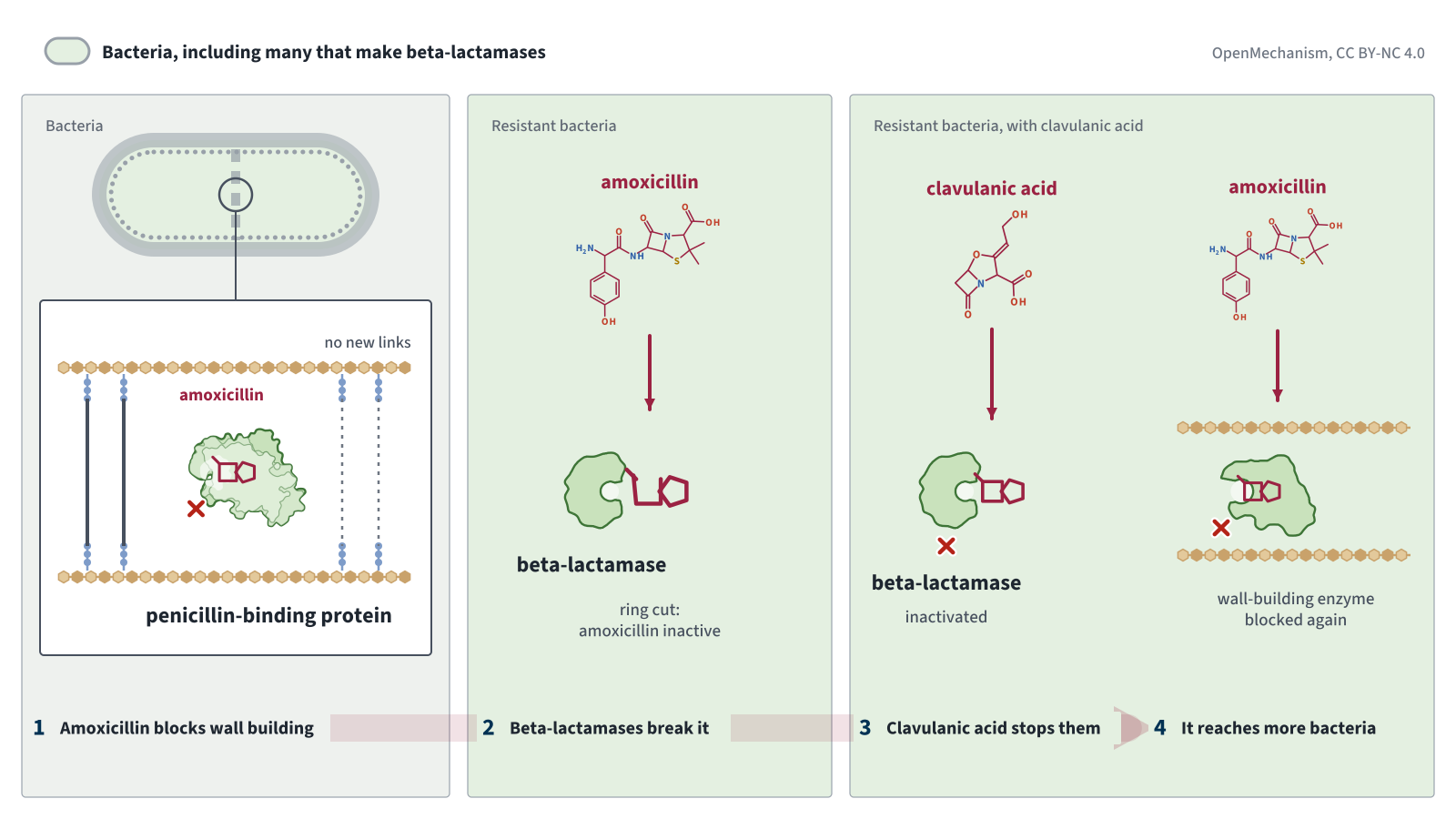
Key terms in this drawing
- PBP
- Penicillin-binding protein. A bacterial enzyme that builds the cell wall; beta-lactam antibiotics, such as penicillins and cephalosporins, bind it.
How it works
Amoxicillin blocks wall building. Amoxicillin kills bacteria (it is bactericidal against Gram-positive and Gram-negative bacteria in vitro) by inhibiting cell-wall biosynthesis.1,2
Beta-lactamases break it. Amoxicillin is susceptible to degradation by beta-lactamases, so on its own it does not act on bacteria that make these enzymes.1
Clavulanic acid stops them. Clavulanic acid, a beta-lactam related to the penicillins, can inactivate some beta-lactamases common in bacteria resistant to penicillins and cephalosporins, including the plasmid-mediated beta-lactamases that often transfer resistance.1
It reaches more bacteria. Protected from degradation by some beta-lactamases, amoxicillin acts on many bacteria normally resistant to it: its spectrum is extended.1
For teachers: download this drawing.
See also
Condition pages: skin and soft-tissue infections; and urinary tract infections.
Other antibiotics: amoxicillin; azithromycin; bedaquiline; ceftazidime and avibactam; ceftriaxone; cephalexin; ciprofloxacin; clindamycin; and 14 more.
Body system: infections.
Sources
- 1Augmentin (amoxicillin and clavulanate potassium): FDA label12.4 Microbiology
- 2Amoxicillin capsules: FDA label12.4 Microbiology
- 3ChEMBL CHEMBL1082Target and action classification: Bacterial penicillin-binding protein inhibitor
Also used for the drawing
The drawing names the wall-building enzymes that the medicine blocks, the penicillin-binding proteins. These sources support that part; the steps above come from the sources listed above. The penicillin-binding protein and beta-lactamase outlines are traced from the crystal structures below.
- 4The penicillin-binding proteins: structure and role in peptidoglycan biosynthesisSauvage E et al., FEMS Microbiol Rev 2008 (abstract)
- 5Structural and kinetic analysis of the monofunctional Staphylococcus aureus PBP1Bon CG et al., J Struct Biol 2024 (abstract)
- 6Streptococcus pneumoniae penicillin-binding protein 2x acyl-enzyme complexPDB 1QMF; Gordon, E.J. et al. J.Mol.Biol. 2000; 299:501
- 7TEM-1 beta-lactamase caught mid-reactionPDB 1FQG; Strynadka, N.C. et al. Nature 1992; 359:700-705
Spotted a mistake? Report an error (hello@openmechanism.com). Since launch, every published error we fix is listed on the corrections page.
Notes and limits
- A schematic teaching drawing: not to scale, not exact structures, binding poses or a complete pathway, and not a guide to dosing, treatment or how a person will respond.
All recorded limits are on the evidence page, and notes that apply to every page are on How to read a page. Version 1.0.0, not yet medically reviewed.
Cite this page
Tran D. Amoxicillin and clavulanate [Internet]. OpenMechanism; 2026 [updated 2026 Oct 12; cited 2026 Oct 12]. Available from: https://openmechanism.com/medicines/amoxicillin-plus-clavulanate