Amoxicillin
Amoxicillin survives stomach acid and is rapidly absorbed. Like penicillin, it blocks cell-wall building in bacteria while they multiply, and the bacteria die. Bacteria that make beta-lactamases, enzymes that cut its beta-lactam ring, resist it. Its label lists it, in adults and children, for infections of the ear, nose and throat, the genitourinary tract, the skin and the lower respiratory tract caused by susceptible strains of the bacteria it names that make no beta-lactamase, and, in adults only, with other medicines, to clear H. pylori in people with duodenal ulcer disease (an active duodenal ulcer or one in the past year).
- Acts on
- Bacterial cell-wall building (biosynthesis)
- Where
- Bacteria while they multiply
- Medicine type
- Small molecule
- Used for
- Infections
- Drug class
- Antibiotics
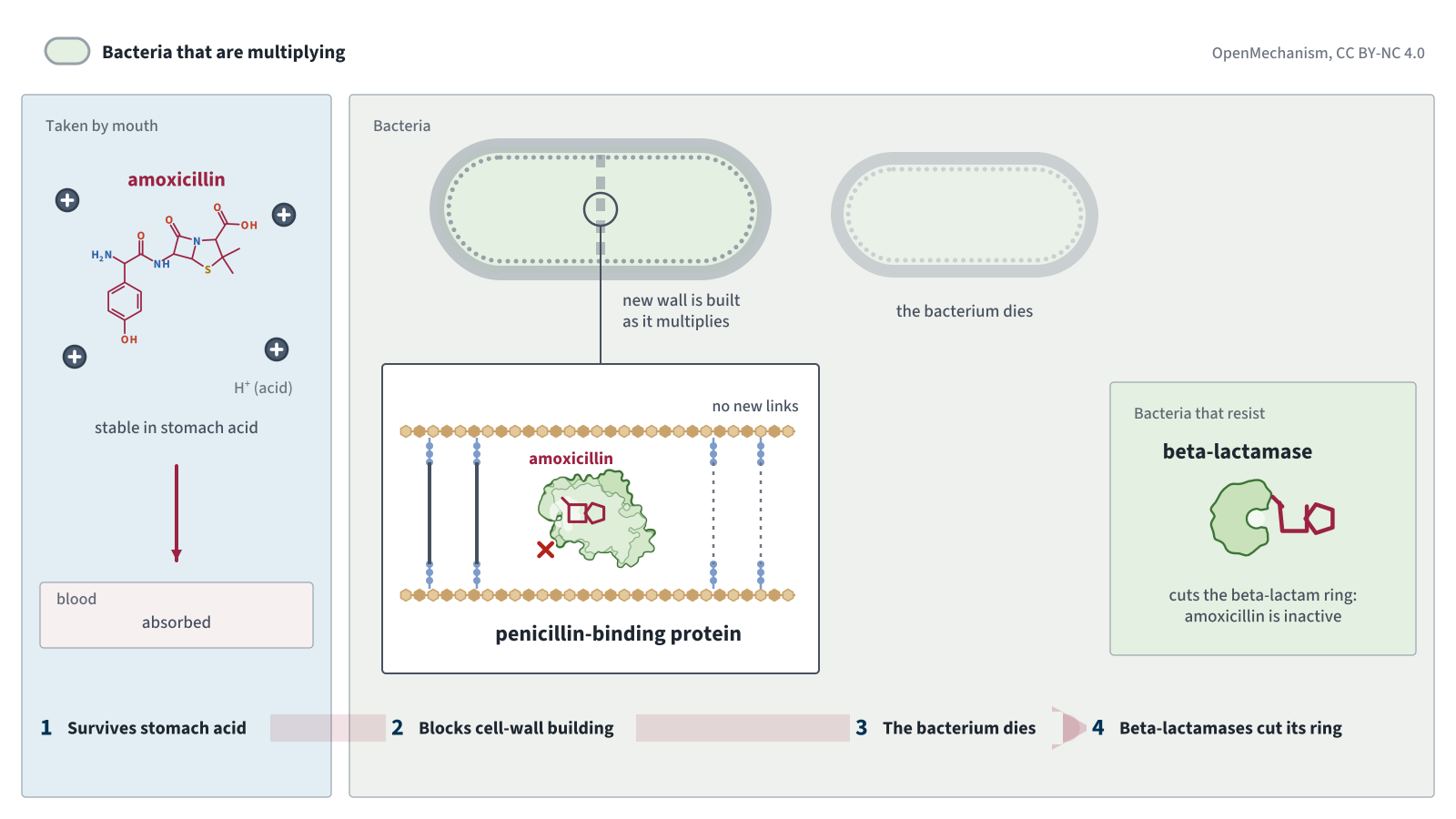
Key terms in this drawing
- PBP
- Penicillin-binding protein. A bacterial enzyme that builds the cell wall; beta-lactam antibiotics, such as penicillins and cephalosporins, bind it.
How it works
Survives stomach acid. Amoxicillin is stable in the presence of gastric acid and is rapidly absorbed after oral administration.1
Blocks cell-wall building. Like penicillin, amoxicillin acts on susceptible bacteria during the stage of active multiplication, by inhibiting cell-wall biosynthesis.1
The bacterium dies. Blocking cell-wall biosynthesis leads to the death of the bacteria: amoxicillin is bactericidal.1
Beta-lactamases cut its ring. Resistance to amoxicillin comes mainly from beta-lactamases, bacterial enzymes that cleave its beta-lactam ring and make it inactive.1
For teachers: download this drawing.
See also
Condition pages: peptic ulcers; skin and soft-tissue infections; and urinary tract infections.
Other antibiotics: amoxicillin and clavulanate; azithromycin; bedaquiline; ceftazidime and avibactam; ceftriaxone; cephalexin; ciprofloxacin; clindamycin; and 14 more.
Body system: infections.
Sources
- 1Amoxicillin capsules: FDA label1 Indications and Usage; 12.3 Pharmacokinetics; 12.4 Microbiology
- 2ChEMBL CHEMBL1082Target and action classification: Bacterial penicillin-binding protein inhibitor
Also used for the drawing
The drawing names the wall-building enzymes that the medicine blocks, the penicillin-binding proteins. These sources support that part; the steps above come from the sources listed above. The penicillin-binding protein and beta-lactamase outlines are traced from the crystal structures below.
- 3The penicillin-binding proteins: structure and role in peptidoglycan biosynthesisSauvage E et al., FEMS Microbiol Rev 2008 (abstract)
- 4Structural and kinetic analysis of the monofunctional Staphylococcus aureus PBP1Bon CG et al., J Struct Biol 2024 (abstract)
- 5Streptococcus pneumoniae penicillin-binding protein 2x acyl-enzyme complexPDB 1QMF; Gordon, E.J. et al. J.Mol.Biol. 2000; 299:501
- 6TEM-1 beta-lactamase caught mid-reactionPDB 1FQG; Strynadka, N.C. et al. Nature 1992; 359:700-705
Spotted a mistake? Report an error (hello@openmechanism.com). Since launch, every published error we fix is listed on the corrections page.
Notes and limits
- A schematic teaching drawing: not to scale, not exact structures, binding poses or a complete pathway, and not a guide to dosing, treatment or how a person will respond.
- The steps are in the order that explains them; one step is said to cause the next only where the source says so.
All recorded limits are on the evidence page, and notes that apply to every page are on How to read a page. Version 1.0.1, medically reviewed by Daniel Tran, PharmD, on 6 November 2026.
Cite this page
Tran D. Amoxicillin [Internet]. OpenMechanism; 2026 [updated 2026 Nov 6; cited 2026 Nov 6]. Available from: https://openmechanism.com/medicines/amoxicillin