Leprosy
Leprosy is a long-lasting infection of the skin and peripheral nerves with Mycobacterium leprae, forming granulomas. How it shows, from tuberculoid to lepromatous leprosy, depends on the strength of the cellular immune response. Damage to nerve function causes the disabilities of leprosy. Clofazimine slowly kills M. leprae and is used as part of combination treatment.
- Where
- Skin and nerves
- Body systems
- Infections; Skin, hair & nails
- Medicines
- 1 medicine
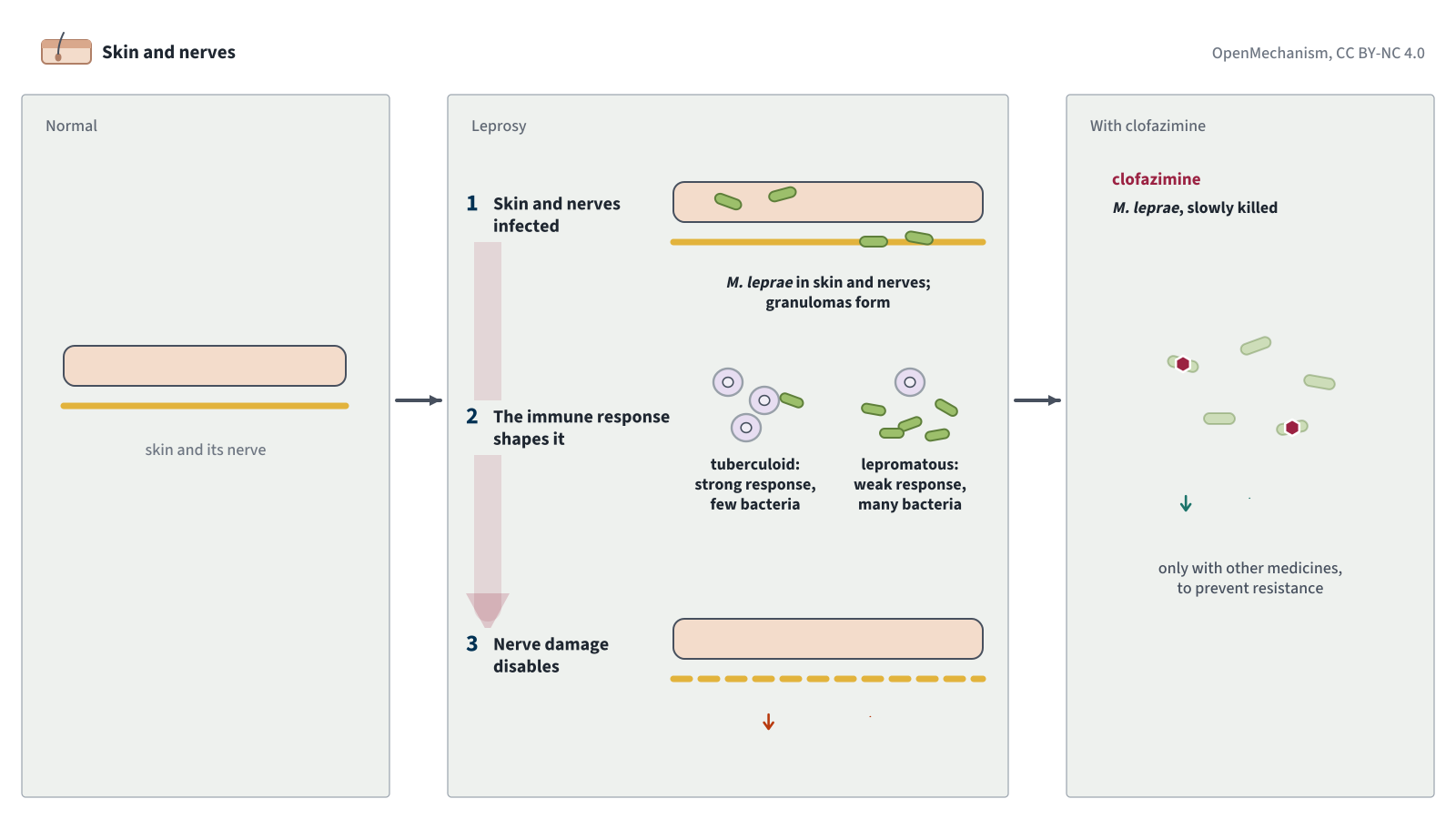
For teachers: download this drawing.
What goes wrong
Skin and nerves infected. Leprosy is a long-lasting granulomatous infection of the skin and peripheral nerves with Mycobacterium leprae.1
What the source says
“The disease is caused by a chronic granulomatous infection of the skin and peripheral nerves with Mycobacterium leprae.”
Source 1The immune response shapes it. Its range, from tuberculoid to lepromatous leprosy, comes from differences in the cellular immune response to the mycobacterium.1
What the source says
“The clinical range from tuberculoid to lepromatous leprosy is a result of variation in the cellular immune response to the mycobacterium.”
Source 1Nerve damage disables. The damage to nerve function causes the disabilities of leprosy.1
What the source says
“The resulting impairment of nerve function causes the disabilities associated with leprosy.”
Source 1
Where medicines act
- A
Clofazimine: M. leprae slowly killed
Clofazimine slowly kills Mycobacterium leprae. It treats lepromatous leprosy, only as part of combination treatment to prevent resistance.2
What the source says
“Clofazimine exerts a slow bactericidal effect on Mycobacterium leprae (Hansen’s bacillus).”
Source 2“indicated for the treatment of lepromatous leprosy, including dapsone-resistant lepromatous leprosy and lepromatous leprosy complicated by erythema nodosum leprosum.”
Source 2“To prevent the development of drug-resistance, LAMPRENE should be used only as a part of combination thera”
Source 2
See also
Body systems: infections; and skin, hair & nails.
Other conditions: herpes infections; nail fungus; ringworm (tinea); scabies and lice; and skin and soft-tissue infections.
Sources
- 1LeprosyBritton WJ, Lockwood DN. Lancet 2004 (abstract). Saved copy
- 2Lamprene (clofazimine): FDA label1 Indications and Usage; 12.4 Mechanism of Action. Saved copy
Notes and limits
- In 2004, treatment had cut the number of people with leprosy but not yet the number of new cases found each year, so control was expected to be needed for decades.1
Notes that apply to every page are on How to read a page.
Spotted a mistake? Report an error (hello@openmechanism.com). Since launch, every published error we fix is listed on the corrections page.
Cite this page
Tran D. Leprosy [Internet]. OpenMechanism; 2026 [updated 2026 Oct 18; cited 2026 Oct 18]. Available from: https://openmechanism.com/conditions/leprosy