Invasive fungal infections
Invasive fungal infections are common and deadly: an estimated 6.5 million a year and 3.8 million deaths. Fungal cells make ergosterol for their membranes and glucan for their walls; human cells have no glucan. Amphotericin B binds ergosterol; fluconazole blocks ergosterol making; caspofungin blocks glucan making; flucytosine is turned into fluorouracil inside the fungus.
- Where
- Fungi
- Body system
- Infections
- Medicines
- 4 medicines
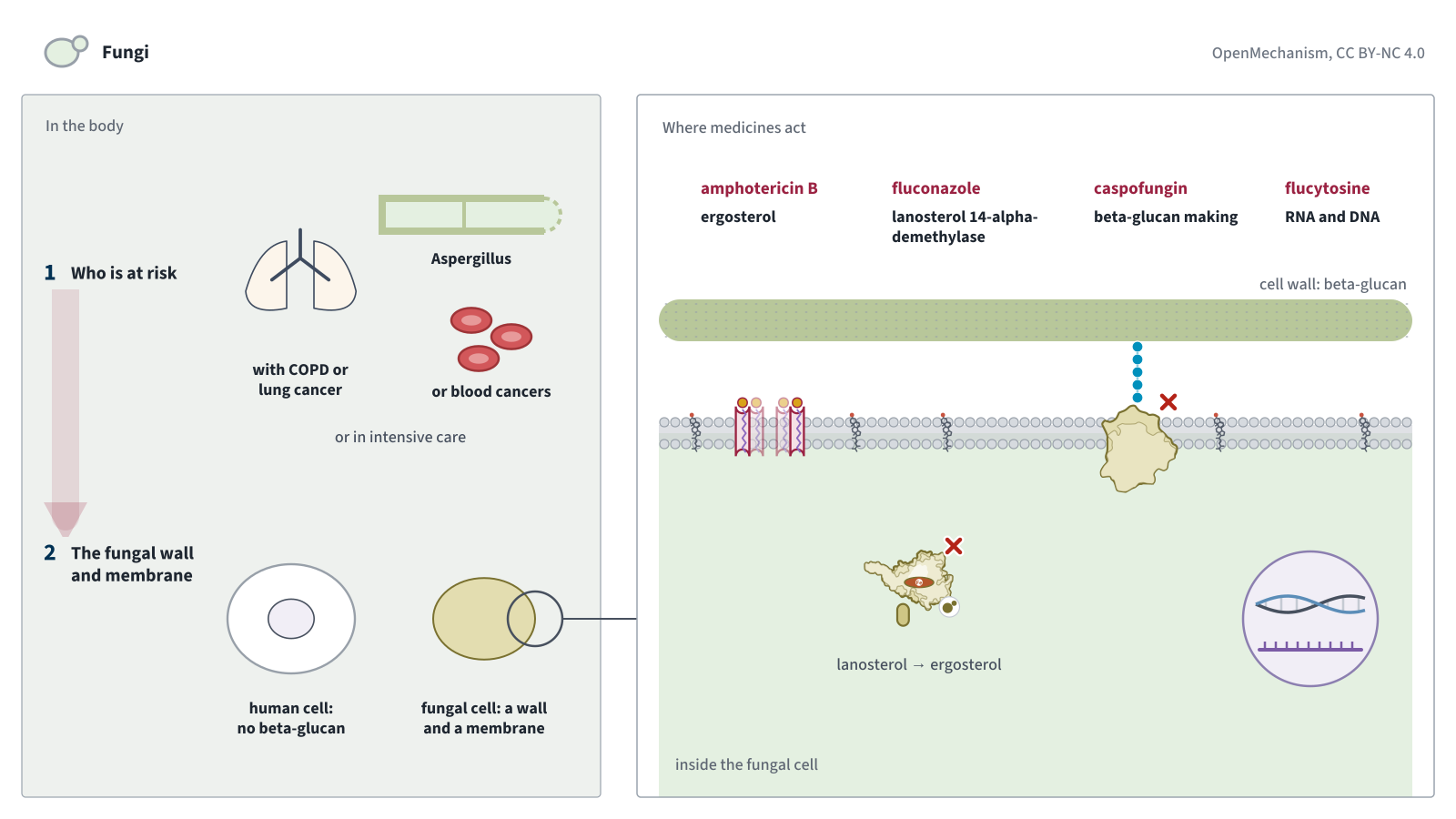
For teachers: download this drawing.
Key terms in this drawing
- COPD
- Chronic obstructive pulmonary disease. A long-term lung disease with poorly reversible airway obstruction; it includes obstruction of the small airways and emphysema, which lead to air trapping. As in asthma, the airways can also tighten (bronchoconstriction).
- DNA
- Deoxyribonucleic acid. The molecule that stores genes.
- RNA
- Ribonucleic acid. A molecule copied from DNA; messenger RNA carries a gene's instructions.
What goes wrong
Who is at risk. Invasive aspergillosis, for one, strikes people with (a long-term lung disease), in intensive care, or with lung or blood cancers.1
What the source says
“in the context of chronic obstructive pulmonary disease, intensive care, lung cancer, or haematological malignancy”
Source 1The fungal wall and membrane. Fungal cells make ergosterol for their membranes and beta-glucan for their walls; human cells have no beta-glucan.2,3
Where medicines act
- A
Amphotericin B: holes in the membrane
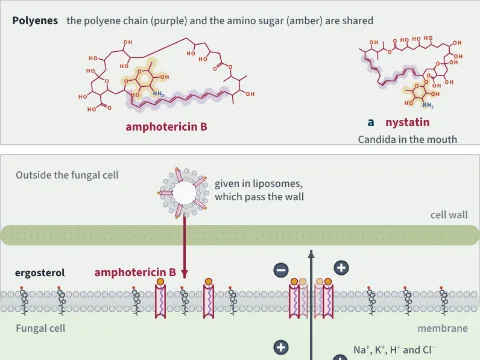
Amphotericin B binds ergosterol in the fungal membrane and forms channels through which ions leak out, killing the cell.4
What the source says
“acts by binding to the sterol component, ergosterol, of the cell membrane of susceptible fungi.”
Source 4“It forms transmembrane channels leading to alterations in cell permeability through which monovalent ions (NA+, K+, H+, and Cl-) leak out of the cell resulting in cell death.”
Source 4 - B
Fluconazole: ergosterol making blocked
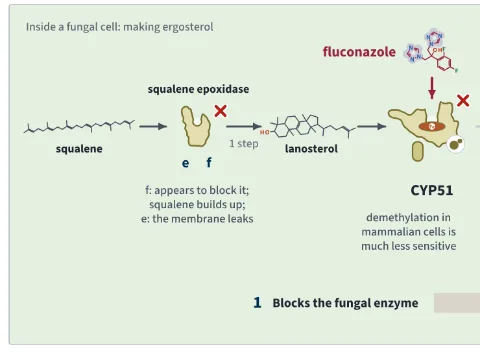
Fluconazole blocks the fungal enzyme lanosterol 14-alpha-demethylase, which makes ergosterol.2
What the source says
“Fluconazole is a highly selective inhibitor of fungal cytochrome P450 dependent enzyme lanosterol 14-α-demethylase.”
Source 2 - C
Caspofungin: the wall cannot be built
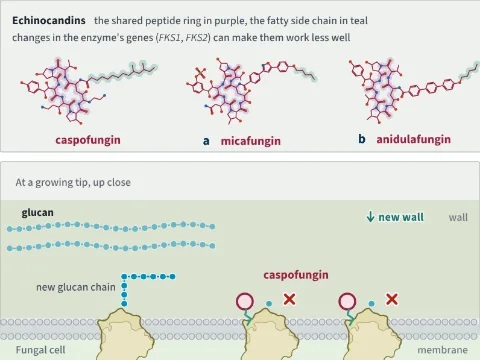
Caspofungin blocks the making of beta-glucan, an essential part of the cell wall of Aspergillus and Candida.3
What the source says
“Caspofungin, an echinocandin, inhibits the synthesis of beta (1,3)-D-glucan, an essential component of the cell wall of susceptible Aspergillus species and Candida species.”
Source 3 - D
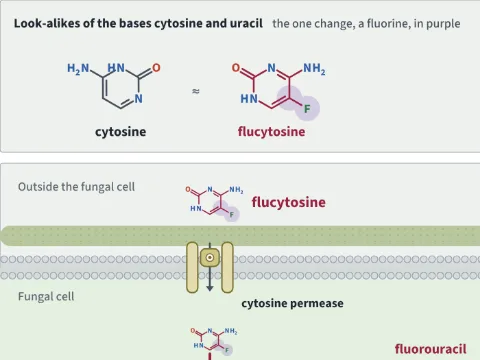
Flucytosine: turned into fluorouracil inside the fungus
Inside the fungal cell, flucytosine is turned into fluorouracil, whose products are wrongly built into the fungus's or block the making of its . It treats serious Candida and Cryptococcus infections.5
What the source says
“Inside the fungal cell, flucytosine is rapidly converted to fluorouracil by the enzyme cytosine deaminase.”
Source 5“which inhibit protein synthesis by being falsely incorporated into fungal RNA or interfere with the biosynthesis of fungal DNA through the inhibition of the enzyme thymidylate synthetase.”
Source 5“ANCOBON is indicated only in the treatment of serious infections caused by susceptible strains of Candida and/or Cryptococcus .”
Source 5
See also
Body system: infections.
Other conditions: leishmaniasis; and thrush and vaginal yeast infections.
Side effects: why amphotericin B can harm the kidneys.
Sources
- 1Global incidence and mortality of severe fungal diseaseDenning DW. Lancet Infect Dis 2024 (abstract). Saved copy
- 2Diflucan (fluconazole): FDA label12.1 Mechanism of Action. Saved copy
- 3Cancidas (caspofungin): FDA label12.4 Mechanism of Action. Saved copy
- 4AmBisome (amphotericin B liposome): FDA label12.1 Mechanism of Action; 14 Clinical Studies. Saved copy
- 5Ancobon (flucytosine): FDA labelIndications and Usage; Microbiology. Saved copy
- 6Yeast CYP51 with fluconazolePDB 4WMZ; Sagatova, A.A. et al. Antimicrob.Agents Chemother. 2015;59:4982-4989. The CYP51 outline in the drawing is traced from this structure. Saved copy
- 7Yeast glucan synthase Fks1 with caspofunginPDB 9PE1; Ren, Z. et al. Nature 2026;654:547-555. The glucan synthase outline in the drawing is traced from this structure. Saved copy
Notes and limits
- These figures are estimates, and estimates of fungal disease are imprecise.1
Notes that apply to every page are on How to read a page.
Spotted a mistake? Report an error (hello@openmechanism.com). Since launch, every published error we fix is listed on the corrections page.
Cite this page
Tran D. Invasive fungal infections [Internet]. OpenMechanism; 2026 [updated 2026 Oct 20; cited 2026 Oct 20]. Available from: https://openmechanism.com/conditions/invasive-fungal-infections