Hepatitis C
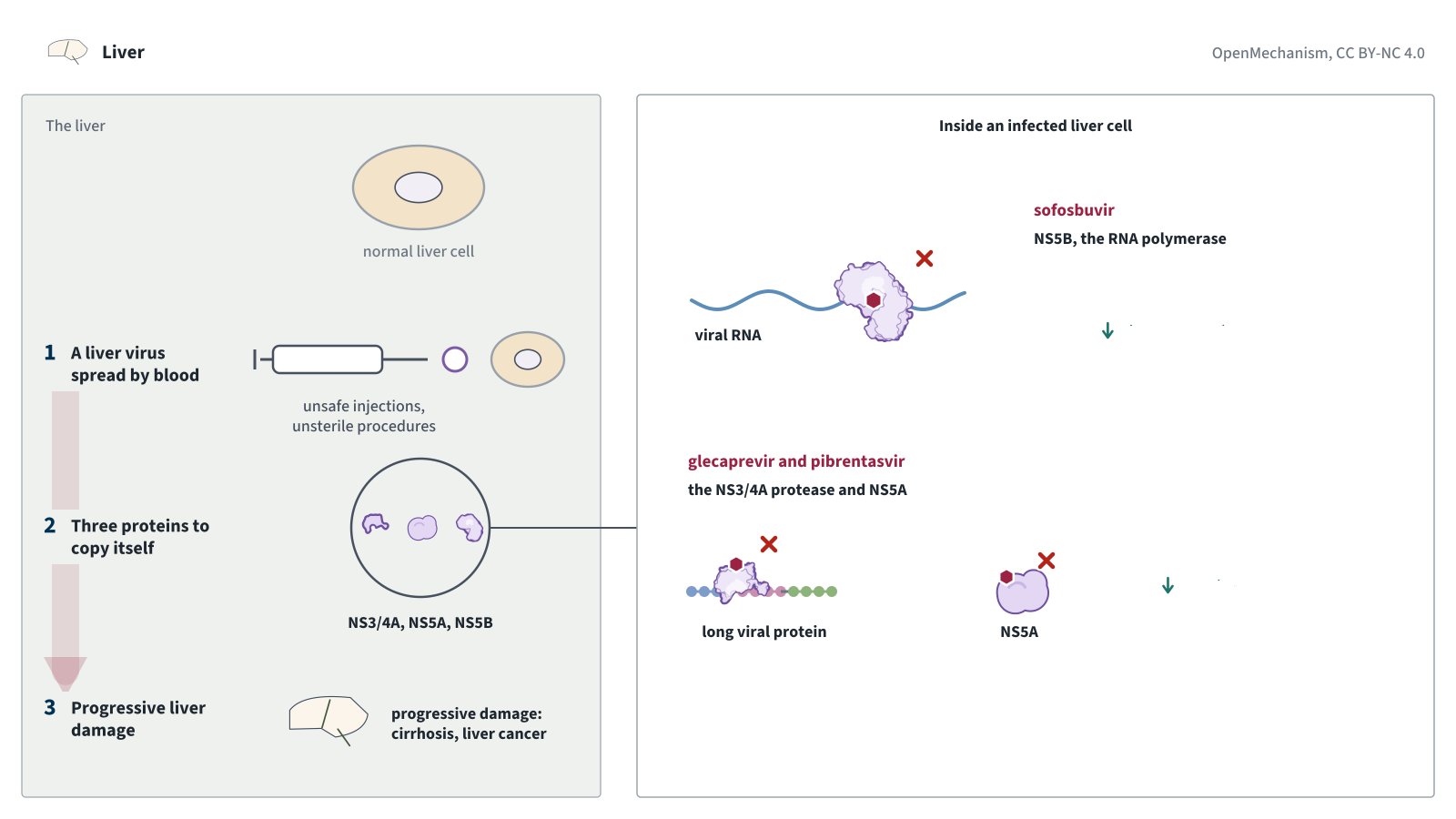
Hepatitis C virus is an RNA virus that infects the liver and causes progressive damage, which may lead to cirrhosis and liver cancer. It spreads through blood, mainly by unsafe drug injection and unsterile medical procedures. Direct-acting antivirals block three viral proteins it needs: sofosbuvir the NS5B polymerase, glecaprevir the NS3/4A protease and pibrentasvir NS5A.
- Where
- Liver
- Body systems
- Infections; Stomach, gut & liver
- Medicines
- 2 medicines
For teachers: download this drawing.
Key terms in this drawing
- NS3/4A
- Nonstructural protein 3/4A protease. The hepatitis C virus protease that cuts the viral polyprotein into working parts; glecaprevir blocks it.
- NS5A
- Nonstructural protein 5A. A hepatitis C virus protein needed for copying the viral RNA and assembling new virus; pibrentasvir blocks it.
- NS5B
- Nonstructural protein 5B (RNA polymerase). The hepatitis C virus enzyme that copies the viral RNA; sofosbuvir's active form stops it.
- RNA
- Ribonucleic acid. A molecule copied from DNA; messenger RNA carries a gene's instructions.
What goes wrong
A liver virus spread by blood. Hepatitis C is an virus that targets the liver; it spreads through blood, mainly by unsafe drug injection and unsterile medical procedures.1
Three proteins to copy itself. The virus needs three proteins at key steps of its life cycle: the protease, and the RNA polymerase.1
What the source says
“target three proteins involved in crucial steps of the HCV life cycle: the NS3/4A protease, the NS5A protein and the RNA-dependent RNA polymerase NS5B protein.”
Source 1Progressive liver damage. It causes progressive liver damage, which may lead to cirrhosis and liver cancer.1
What the source says
“causes progressive liver damage, which might result in liver cirrhosis and hepatocellular carcinoma.”
Source 1
Where medicines act
- A
Sofosbuvir: the polymerase stopped
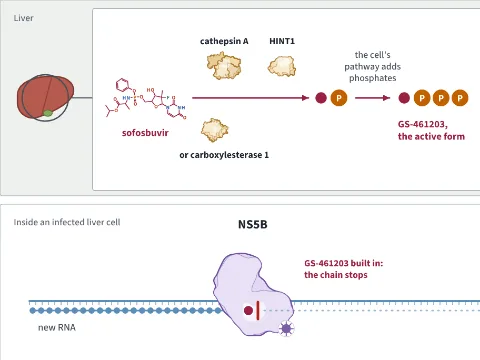
Sofosbuvir blocks NS5B, the RNA polymerase the virus needs to copy itself. It treats chronic hepatitis C as part of combination treatment.2
- B
Glecaprevir and pibrentasvir: protease and NS5A blocked
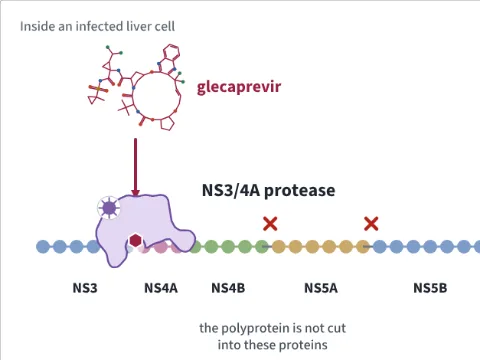
Glecaprevir blocks the NS3/4A protease that cuts the viral polyprotein; pibrentasvir blocks NS5A, needed for copying and assembly. Together they treat hepatitis C of all six genotypes.3
What the source says
“Glecaprevir is an inhibitor of the HCV NS3/4A protease, which is necessary for the proteolytic cleavage of the HCV encoded polyprotein”
Source 3“Pibrentasvir is an inhibitor of HCV NS5A, which is essential for viral RNA replication and virion assembly.”
Source 3“with acute or chronic hepatitis C virus (HCV) genotype 1, 2, 3, 4, 5 or 6 infection”
Source 3
See also
Body systems: infections; and stomach, gut & liver.
Other conditions: C. difficile infection; cryptosporidiosis; giardiasis and amebiasis; hepatitis B; hepatitis D; and tapeworm larva infections.
Sources
- 1Hepatitis C virus infectionManns MP et al. Nat Rev Dis Primers 2017 (abstract). Saved copy
- 2Sovaldi (sofosbuvir): FDA label1 Indications and Usage; 12.1 and 12.4 Mechanism of Action. Saved copy
- 3Mavyret (glecaprevir and pibrentasvir): FDA label1 Indications and Usage; 12.1 and 12.4 Mechanism of Action. Saved copy
- 4Hepatitis C virus NS3/4A protease (genotype 1a) with glecaprevirPDB 6P6L; Timm, J. et al. To Be Published. The NS3/4A outline in the drawing is traced from this structure. Saved copy
- 5Hepatitis C virus NS5B with sofosbuvir's active formPDB 4WTG; Appleby, T.C. et al. Science 2015;347:771-775. The NS5B outline in the drawing is traced from this structure. Saved copy
Notes and limits
- There is no vaccine; control depends on testing and access to treatment, which cures more than 90 percent.1
Notes that apply to every page are on How to read a page.
Spotted a mistake? Report an error (hello@openmechanism.com). Since launch, every published error we fix is listed on the corrections page.
Cite this page
Tran D. Hepatitis C [Internet]. OpenMechanism; 2026 [updated 2026 Oct 18; cited 2026 Oct 18]. Available from: https://openmechanism.com/conditions/hepatitis-c