Pneumocystis pneumonia (PCP)
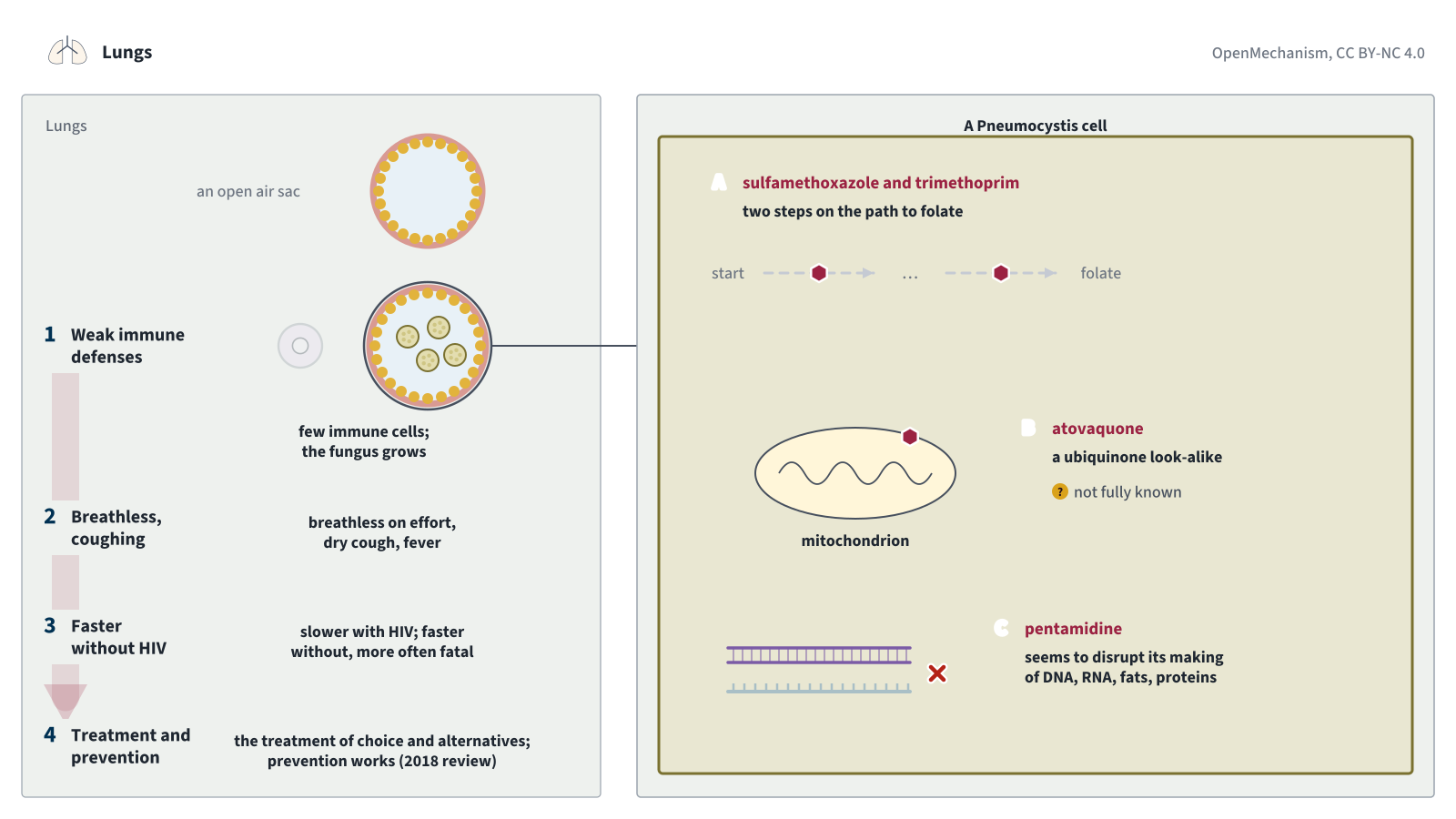
Pneumocystis pneumonia strikes people with weak immune defenses, causing breathlessness on effort, dry cough and fever. Fewer people with HIV get it since antiretroviral treatment; more with other immune weakness are at risk, and in them it moves faster and kills more often. A 2018 review calls sulfamethoxazole and trimethoprim the treatment of choice; atovaquone and pentamidine are alternatives and also prevent it.
- Where
- Lungs
- Body systems
- Infections, Lungs & airways
- Medicines
- 3 medicines
Not fully known
The Mepron (atovaquone) label says: The mechanism of action against Pneumocystis jirovecii has not been fully elucidated.
Source 3: Mepron (atovaquone): FDA label, 1 Indications and Usage; 12.4 Microbiology
Clinical study: In a double-blind trial in 322 people with AIDS and mild or moderate Pneumocystis pneumonia, atovaquone was compared with trimethoprim-sulfamethoxazole for 21 days; the trial measured response to treatment, not how atovaquone works: For the treatment of P. carinii pneumonia, atovaquone is less effective than trimethoprim-sulfamethoxazole, but it has fewer treatment-limiting adverse effects.
Hughes W et al., N Engl J Med 1993 (PMID 8479489)
This study was picked with a literature search and is not yet checked by our reviewer.
For teachers: download this drawing.
Key terms in this drawing
- DNA
- Deoxyribonucleic acid. The molecule that stores genes.
- HIV
- Human immunodeficiency virus. A virus that, left untreated, destroys CD4 T cells over time and raises the risk of infections and cancers.
- RNA
- Ribonucleic acid. A molecule copied from DNA; messenger RNA carries a gene's instructions.
What goes wrong
Weak immune defenses. PCP strikes people with weak immune defenses. Fewer people with get it since antiretroviral treatment, while more people with other immune weakness are at risk.1
What the source says
“The substantial decline in the Pneumocystis jirovecii pneumonia (PCP) incidence in HIV-infected patients after the introduction of antiretroviral therapy (ART) in resource-rich settings and the growing number of non-HIV-infected immunocompromised patients at risk”
Source 1Breathless, coughing. The main symptoms are breathlessness on effort, a dry cough and a mild or high fever.1
What the source says
“The main symptoms usually include exertional dyspnea, dry cough, and subfebrile temperature or fever.”
Source 1Faster without HIV. People with HIV usually get it slowly; people with other immune weakness worsen fast, with more breathing failure and deaths.1
What the source says
“HIV-infected patients usually develop a subacute course of disease, while non-HIV-infected immunocompromised patients are characterized by a rapid disease progression with higher risk of respiratory failure and higher mortality.”
Source 1Treatment and prevention. A 2018 review calls sulfamethoxazole and trimethoprim the treatment of choice in adults and children, with alternatives such as atovaquone or pentamidine, and says preventive treatment is effective and depends on the person's immune status and underlying illness.1
What the source says
“Trimeth-oprim/sulfamethoxazole for 21 days is the treatment of choice in adults and children.”
Source 1“Alternative treatment regimens include dapsone with trimethoprim, clindamycin with primaquine, atovaquone, or pentamidine.”
Source 1“PCP prophylaxis is effective and depends on the immune status of the patient and the underlying immunocompromising disease.”
Source 1
Where medicines act
- A
Sulfamethoxazole and trimethoprim: folate blocked twice
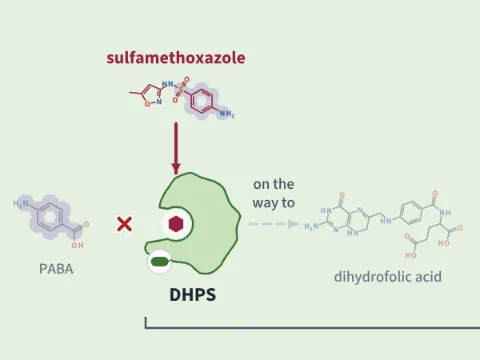
The two medicines block two steps in a row on the path to folate. They treat Pneumocystis pneumonia and prevent it in people with weak immune systems.2
What the source says
“Thus, sulfamethoxazole and trimethoprim blocks two consecutive steps in the biosynthesis of nucleic acids and proteins essential to many bacteria.”
Source 2“For the treatment of documented Pneumocystis jirovecii pneumonia and for prophylaxis against P. jirovecii pneumonia in individuals who are immunosuppressed and considered to be at an increased risk of developing P. jirovecii pneumonia.”
Source 2 - B
Atovaquone: a ubiquinone look-alike
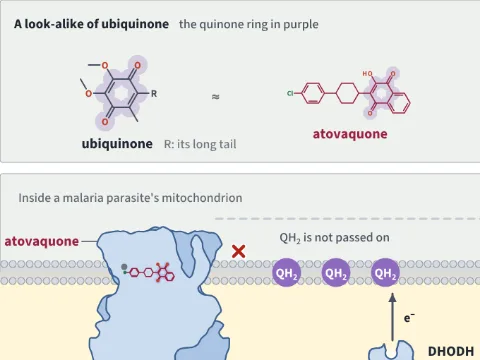
Atovaquone resembles ubiquinone, part of the mitochondria's energy chain; how it works against Pneumocystis is not fully known. It prevents PCP, and treats mild-to-moderate PCP, in people who cannot take sulfamethoxazole and trimethoprim.3
What the source says
“Atovaquone is a hydroxy-1,4-naphthoquinone, an analog of ubiquinone, with antipneumocystis activity.”
Source 3“Prevention of Pneumocystis jirovecii pneumonia (PCP) in adults and adolescents aged 13 years and older who cannot tolerate trimethoprim-sulfamethoxazole (TMP-SMX).”
Source 3“The mechanism of action against Pneumocystis jirovecii has not been fully elucidated.”
Source 3 - C
Pentamidine: the microbe's metabolism disrupted
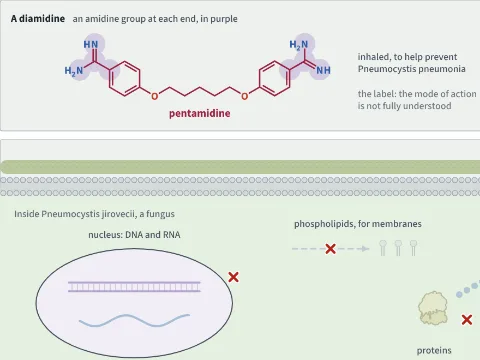
Pentamidine seems to disrupt the microbe's making of , , fats and proteins. Inhaled, it prevents Pneumocystis pneumonia in high-risk people with HIV.4
What the source says
“Studies suggest that the pentamidine isethionate interferes with microbial nuclear metabolism by inhibition of DNA, RNA, phospholipid and protein synthesis.”
Source 4“Pentamidine Isethionate is indicated for the prevention of Pneumocystis jiroveci pneumonia (PJP) in high-risk, HIV-infected patients”
Source 4
See also
Body systems: infections and lungs & airways.
Other conditions: antibiotic-resistant infections, malaria, sleeping sickness, urinary tract infections, COVID-19 and influenza.
Side effects: why trimethoprim can raise potassium.
Sources
- 1Clinical, diagnostic, and treatment disparities between HIV-infected and non-HIV-infected immunocompromised patients with Pneumocystis jirovecii pneumoniaSalzer HJF et al. Respiration 2018 (abstract). Saved copy
- 2Bactrim (sulfamethoxazole and trimethoprim): FDA labelIndications and Usage; Microbiology. Saved copy
- 3Mepron (atovaquone): FDA label1 Indications and Usage; 12.4 Microbiology. Saved copy
- 4Pentamidine isethionate (inhalation): FDA labelIndications and Usage; Mechanism of Action. Saved copy
- 5Comparison of atovaquone (566C80) with trimethoprim-sulfamethoxazole to treat Pneumocystis carinii pneumonia in patients with AIDSHughes W et al. N Engl J Med 1993 (abstract). Saved copy
Notes and limits
Notes that apply to every page are on How to read a page.
Spotted a mistake? Report an error (hello@openmechanism.com). Since launch, every published error we fix is listed on the corrections page.
Cite this page
Tran D. Pneumocystis pneumonia (PCP) [Internet]. OpenMechanism; 2026 [updated 2026 Nov 18; cited 2026 Nov 18]. Available from: https://openmechanism.com/conditions/pneumocystis-pneumonia