Chloroquine
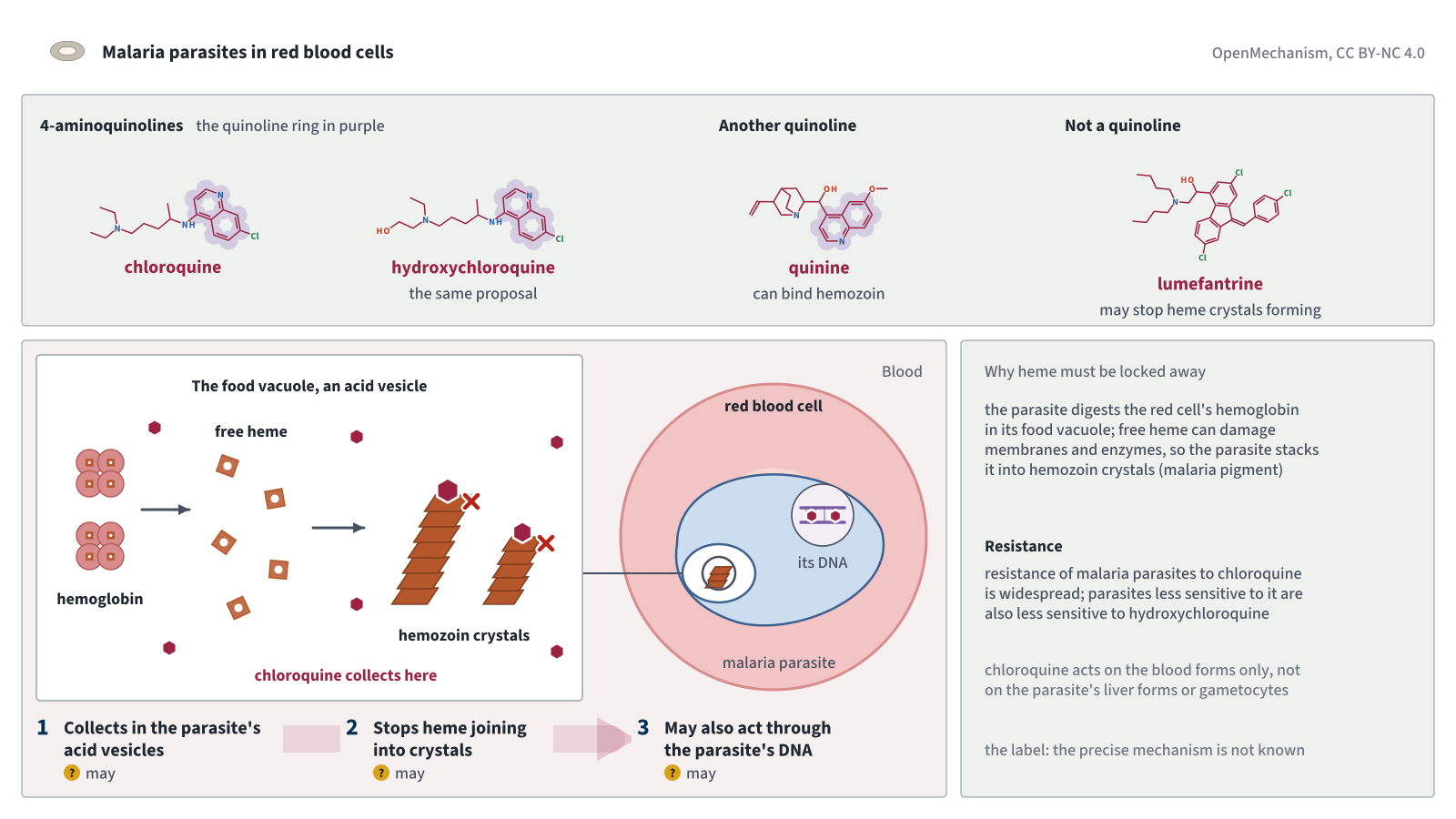
The label says the precise mechanism is not known. Chloroquine may act on malaria parasites by concentrating in their acid vesicles and stopping heme from joining into crystals (polymerizing); it can also inhibit certain enzymes by interacting with .
- Acts on
- Heme polymerization in the malaria parasite's acid vesicles, as the label proposes
- Where
- Malaria parasites in red blood cells
- Medicine type
- Small molecule
- Used for
- Infections
Step 1: may
The chloroquine label says: Chloroquine, may exert its effect against Plasmodium species by concentrating in the acid vesicles of the parasite and by inhibiting polymerization of heme.
Source 1: Chloroquine phosphate tablets: FDA label, Microbiology: Mechanism of Action
Clinical study: In a randomized, double-blind, placebo-controlled trial of weekly chloroquine in 1000 pregnant women; the trial measured episodes of malaria, not how chloroquine works: Chloroquine prophylaxis completely prevented P. vivax episodes; 10.1% (95%CI: 7.3-14.5) of women in the placebo group experienced at least one episode of vivax malaria but no episode occurred in women in the CQ group.
Villegas L et al., Trop Med Int Health 2007 (PMID 17300627)
This study was picked with a literature search and is not yet checked by our reviewer.
Step 2: may
The chloroquine label says: Chloroquine, may exert its effect against Plasmodium species by concentrating in the acid vesicles of the parasite and by inhibiting polymerization of heme.
Source 1: Chloroquine phosphate tablets: FDA label, Microbiology: Mechanism of Action
Clinical study: In a randomized, double-blind, placebo-controlled trial of weekly chloroquine in 1000 pregnant women; the trial measured episodes of malaria, not how chloroquine works: Chloroquine prophylaxis completely prevented P. vivax episodes; 10.1% (95%CI: 7.3-14.5) of women in the placebo group experienced at least one episode of vivax malaria but no episode occurred in women in the CQ group.
Villegas L et al., Trop Med Int Health 2007 (PMID 17300627)
This study was picked with a literature search and is not yet checked by our reviewer.
Step 3: may
The chloroquine label says: The precise mechanism by which chloroquine exhibits activity is not known. … It can also inhibit certain enzymes by its interaction with DNA.
Source 1: Chloroquine phosphate tablets: FDA label, Microbiology: Mechanism of Action
Clinical study: In a randomized, double-blind, placebo-controlled trial of weekly chloroquine in 1000 pregnant women; the trial measured episodes of malaria, not how chloroquine works: Chloroquine prophylaxis completely prevented P. vivax episodes; 10.1% (95%CI: 7.3-14.5) of women in the placebo group experienced at least one episode of vivax malaria but no episode occurred in women in the CQ group.
Villegas L et al., Trop Med Int Health 2007 (PMID 17300627)
This study was picked with a literature search and is not yet checked by our reviewer.
Key terms in this drawing
- DNA
- Deoxyribonucleic acid. The molecule that stores genes.
How it works
Collects in the parasite's acid vesicles. Chloroquine may exert its effect against Plasmodium species by concentrating in the acid vesicles of the parasite.1
Stops heme joining into crystals. It may also act by inhibiting the polymerization of heme.1
May also act through the parasite's DNA. Chloroquine can also inhibit certain enzymes by its interaction with DNA.1
For teachers: download this drawing.
See also
Condition pages: giardiasis and amebiasis; and malaria.
More medicines for infections: acyclovir; albendazole; amoxicillin; amoxicillin and clavulanate; amphotericin B; artesunate; atovaquone; azithromycin; and 51 more.
Body system: infections.
Sources
- 1Chloroquine phosphate tablets: FDA labelMicrobiology: Mechanism of Action
- 2ChEMBL CHEMBL76Target and action classification: Ferriprotoporphyrin IX binding agent; Ferriprotoporphyrin IX inhibitor
- 3Chloroquine prophylaxis against vivax malaria in pregnancy: a randomized, double-blind, placebo-controlled trialVillegas L et al. Trop Med Int Health 2007 (abstract)
Also used for the drawing
The drawing also shows why malaria parasites store heme as hemozoin, and three related antimalarials with what each label says about how it works. These sources support those parts; the steps above and the uncertainty come from the sources listed above.
- 4Inhibition by chloroquine of a novel haem polymerase enzyme activity in malaria trophozoitesSlater AF, Cerami A, Nature 1992 (abstract)
- 5Plaquenil (hydroxychloroquine): FDA label12.4 Microbiology: Mechanism of Action in Malaria; Drug Resistance
- 6Quinine sulfate capsules: FDA label12.4 Microbiology: Mechanism of Action
- 7Coartem (artemether and lumefantrine): FDA label12.4 Microbiology: Mechanism of Action
- 8Structures: ChEMBL (hydroxychloroquine CHEMBL1535, quinine CHEMBL170, lumefantrine CHEMBL38827)canonical structures from the Atlas catalog snapshot
Spotted a mistake? Report an error (hello@openmechanism.com). Since launch, every published error we fix is listed on the corrections page.
Notes and limits
- A schematic teaching drawing: not to scale, not exact structures, binding poses or a complete pathway, and not a guide to dosing, treatment or how a person will respond.
- The label says the precise mechanism by which chloroquine acts is not known.
- Chloroquine is active against the blood (erythrocytic) forms of susceptible Plasmodium, not against gametocytes or the liver forms, including hypnozoites.
- The label notes that resistance of Plasmodium parasites to chloroquine is widespread.
All recorded limits are on the evidence page, and notes that apply to every page are on How to read a page. Version 1.0.0, not yet medically reviewed.
Cite this page
Tran D. Chloroquine [Internet]. OpenMechanism; 2026 [updated 2026 Oct 16; cited 2026 Oct 16]. Available from: https://openmechanism.com/medicines/chloroquine