Hepatitis D
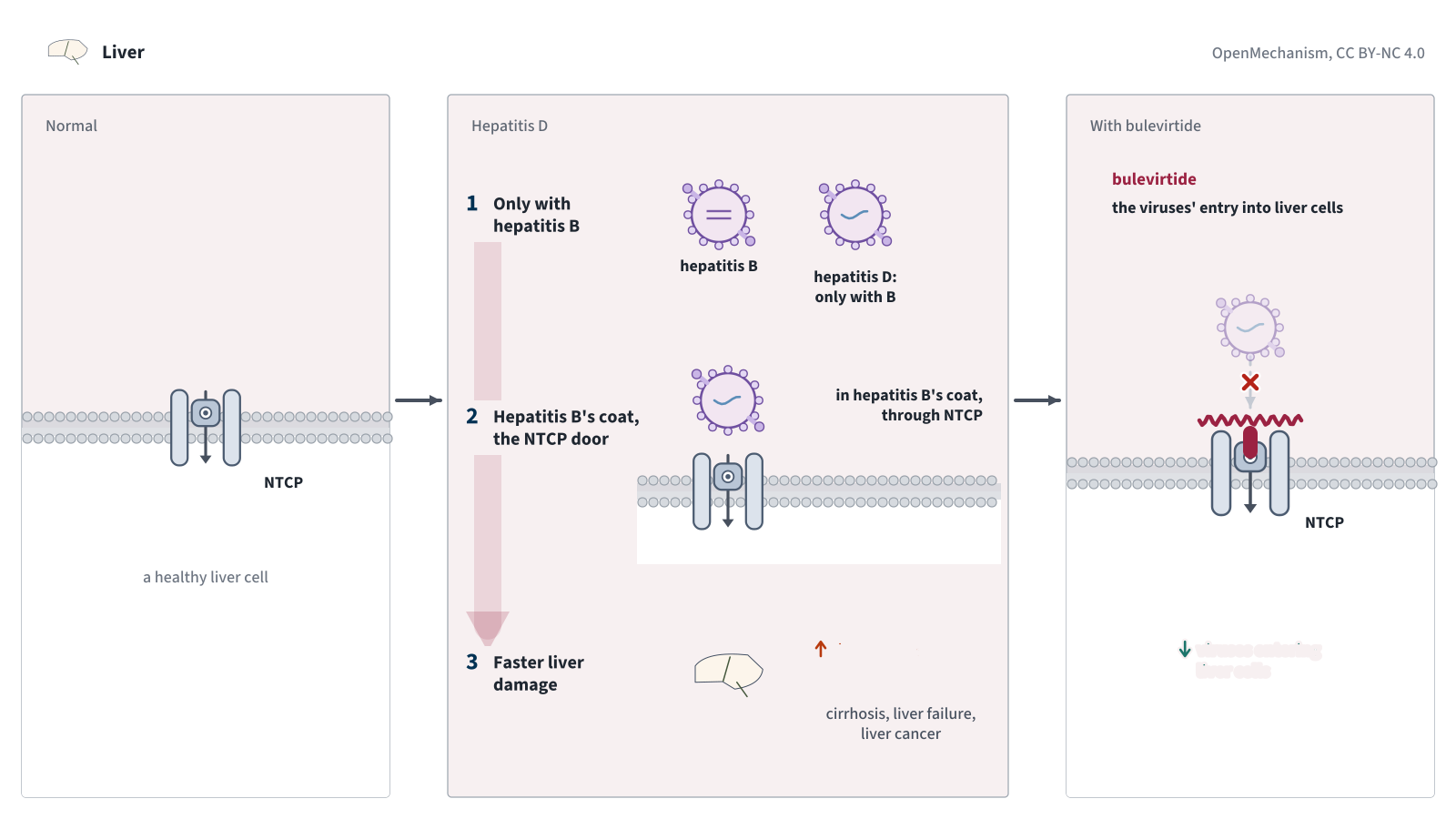
Hepatitis D virus infects only people who have hepatitis B. It uses hepatitis B's coat to enter liver cells through the receptor NTCP, and the two viruses together speed up liver disease. Bulevirtide blocks the virus's way into liver cells.
- Where
- Liver
- Body systems
- Infections; Stomach, gut & liver
- Medicines
- 1 medicine
For teachers: download this drawing.
Key terms in this drawing
- NTCP
- Sodium taurocholate co-transporting polypeptide. A liver cell protein that carries bile salts into the cell; hepatitis B and D viruses dock on it, and bulevirtide blocks it.
What goes wrong
Only with hepatitis B. Hepatitis D virus (HDV) infects only people who have hepatitis B: about 5% of them also carry HDV, an estimated 12 million people worldwide.1,2
What the source says
“hepatitis D, a viral infection that only affects people with hepatitis B.”
Source 1“Approximately 5% of individuals infected with hepatitis B virus (HBV) are coinfected with hepatitis D virus (HDV).”
Source 2“An estimated 12 million people worldwide have experienced HDV infection”
Source 1Hepatitis B's coat, the NTCP door. Both viruses enter liver cells using hepatitis B's envelope proteins, through a receptor called .3
Faster liver damage. Together the viruses speed up liver disease: many people develop cirrhosis, liver failure and finally liver cancer within 5 to 10 years.2,4
What the source says
“Coinfection with hepatitis D virus (HDV) accelerates the progression of liver disease associated with chronic hepatitis B.”
Source 4“Chronic HBV/HDV coinfection is associated with an unfavourable outcome, with many patients developing liver cirrhosis, liver failure and eventually hepatocellular carcinoma within 5-10 years.”
Source 2
Where medicines act
- A
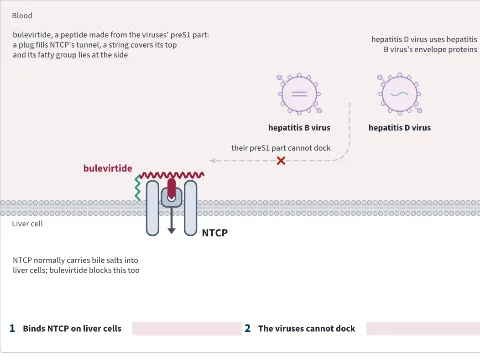
Bulevirtide: the way in blocked
Bulevirtide stops HDV entering liver cells. In a phase 3 trial, 48 weeks of treatment lowered HDV and ALT (a liver enzyme) levels. It has conditional approval in the European Union (2020).2,4
What the source says
“Bulevirtide inhibits the entry of HDV into hepatocytes.”
Source 4“After 48 weeks of bulevirtide treatment, HDV RNA and ALT levels were reduced in patients with chronic hepatitis D.”
Source 4“the entry-inhibitor bulevirtide (formerly known as myrcludex B) received conditional marketing authorisation in the European Union (EU) in 2020 (Hepcludex).”
Source 2
See also
Body systems: infections; and stomach, gut & liver.
Other conditions: hepatitis B; C. difficile infection; cryptosporidiosis; giardiasis and amebiasis; hepatitis C; and tapeworm larva infections.
Sources
- 1The global prevalence of hepatitis D virus infection: systematic review and meta-analysisStockdale AJ et al. J Hepatol 2020 (abstract). Saved copy
- 2Hepatitis D virus in 2021: virology, immunology and new treatment approaches for a difficult-to-treat diseaseUrban S et al. Gut 2021 (abstract). Saved copy
- 3Sodium taurocholate cotransporting polypeptide is a functional receptor for human hepatitis B and D virusYan H et al. eLife 2012 (abstract). Saved copy
- 4A phase 3, randomized trial of bulevirtide in chronic hepatitis DWedemeyer H et al. N Engl J Med 2023 (abstract). Saved copy
Notes and limits
- The older treatment, interferon, gives only limited lasting responses.2
- How many people have it is uncertain; better data are needed.1
Notes that apply to every page are on How to read a page.
Spotted a mistake? Report an error (hello@openmechanism.com). Since launch, every published error we fix is listed on the corrections page.
Cite this page
Tran D. Hepatitis D [Internet]. OpenMechanism; 2026 [updated 2026 Oct 18; cited 2026 Oct 18]. Available from: https://openmechanism.com/conditions/hepatitis-d