Flucytosine
Flucytosine enters fungi through their cytosine permease. Inside, the fungal enzyme cytosine deaminase turns it into fluorouracil. Its active forms are built into fungal by mistake, which inhibits protein making, and block the enzyme thymidylate synthetase, which interferes with making.
- Acts on
- Fungal RNA and DNA making, after fungal enzymes turn the medicine into fluorouracil
- Where
- Candida and Cryptococcus fungi
- Medicine type
- Small molecule
- Used for
- Infections
Also called Ancobon.
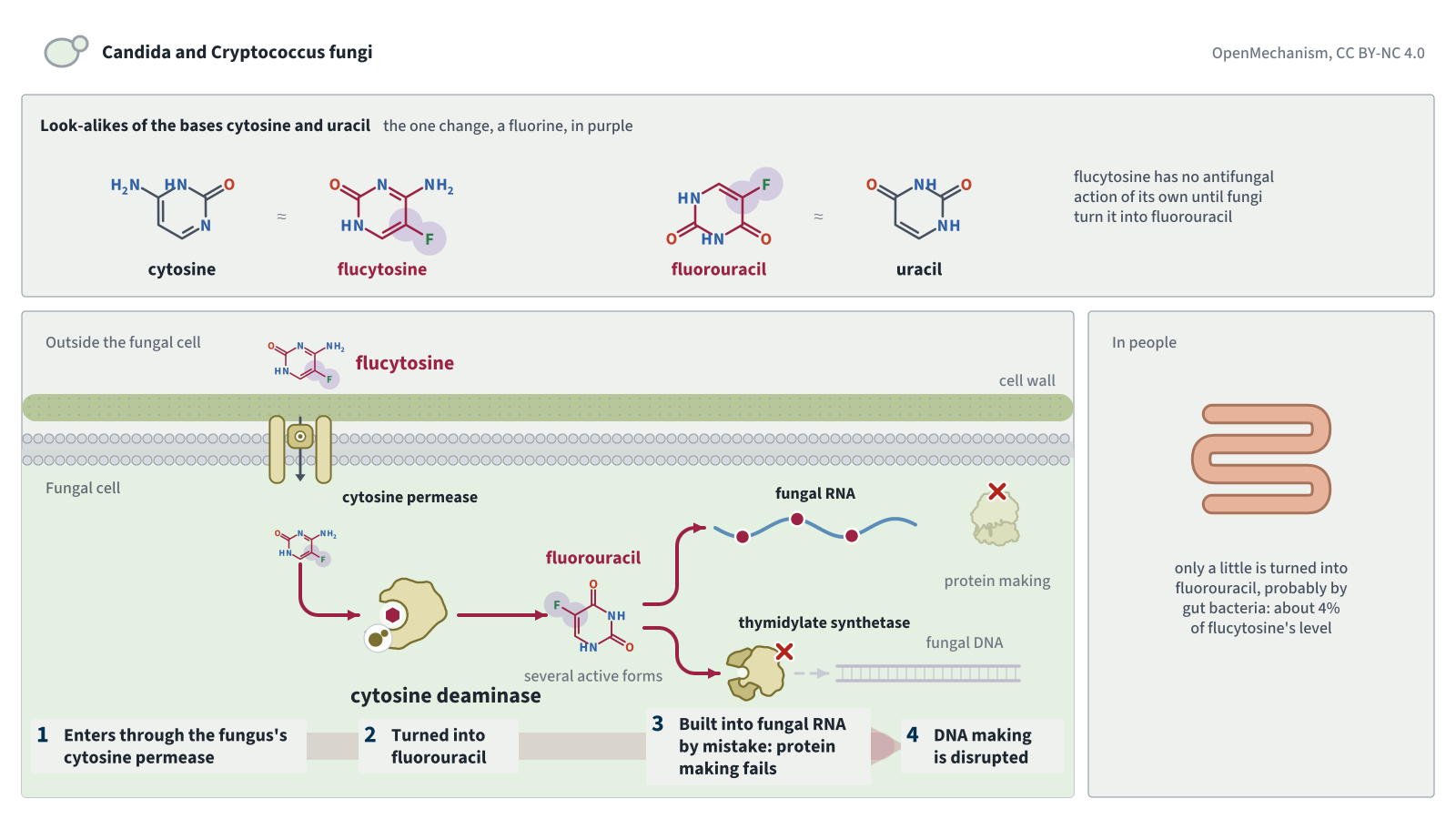
Key terms in this drawing
- DNA
- Deoxyribonucleic acid. The molecule that stores genes.
- RNA
- Ribonucleic acid. A molecule copied from DNA; messenger RNA carries a gene's instructions.
How it works
Enters through the fungus's cytosine permease. Flucytosine is taken up by fungal organisms via the enzyme cytosine permease.1
Turned into fluorouracil. Inside the fungal cell, flucytosine is rapidly converted to fluorouracil by the enzyme cytosine deaminase.1
Built into fungal RNA by mistake: protein making fails. Fluorouracil is converted into several active metabolites, which inhibit protein synthesis by being falsely incorporated into fungal RNA.1
DNA making is disrupted. The active metabolites also interfere with the biosynthesis of fungal DNA through the inhibition of the enzyme thymidylate synthetase.1
For teachers: download this drawing.
See also
Condition pages: invasive fungal infections.
Related drawings: fluorouracil (the medicine fungal cells make from flucytosine, given itself for cancer).
Body system: infections.
Sources
- 1Ancobon (flucytosine): FDA labelMicrobiology: Mechanism of Action
- 2ChEMBL CHEMBL1463Target and action classification: Thymidylate synthase inhibitor
Also used for the drawing
The drawing also shows the natural molecules flucytosine and fluorouracil imitate, and that flucytosine has no antifungal action of its own until fungi convert it. These sources support those parts; the steps above, and the small conversion in people, come from the sources listed above. The cytosine deaminase, fungal ribosome and thymidylate synthase outlines are traced from the crystal and electron microscopy structures below.
- 3Flucytosine: a review of its pharmacology, clinical indications, pharmacokinetics, toxicity and drug interactionsVermes A et al., J Antimicrob Chemother 2000 (abstract)
- 4
- 5Yeast cytosine deaminase with a reaction-intermediate analoguePDB 1P6O; Ireton, G.C. et al. Structure 2003; 11:961-972
- 6Yeast 80S ribosome on an mRNA, with tRNAs in its P and E sitesPDB 6T4Q; Tesina, P. et al. Embo J. 2020; 39:e103365
- 7Cryptococcus neoformans thymidylate synthase with its substrate (dUMP) and an antifolatePDB 2AAZ; Finer-Moore, J.S. et al. Acta Crystallogr.,Sect.D 2005; 61:1320-1334
Spotted a mistake? Report an error (hello@openmechanism.com). Since launch, every published error we fix is listed on the corrections page.
Notes and limits
- A schematic teaching drawing: not to scale, not exact structures, binding poses or a complete pathway, and not a guide to dosing, treatment or how a person will respond.
- The label notes the emergence of resistance to flucytosine.
All recorded limits are on the evidence page, and notes that apply to every page are on How to read a page. Version 1.0.0, not yet medically reviewed.
Cite this page
Tran D. Flucytosine [Internet]. OpenMechanism; 2026 [updated 2026 Oct 16; cited 2026 Oct 16]. Available from: https://openmechanism.com/medicines/flucytosine