Metronidazole
Metronidazole diffuses into microbes. Inside anaerobic bacteria, their own electron carriers change it into a short-lived reactive form that can damage , and the bacteria die. The label notes that the precise mechanism is unclear. The Flagyl label lists it for trichomoniasis once laboratory tests confirm the infection (in women without symptoms, when it goes with inflammation or erosion of the cervix); for acute amebiasis of the gut (amebic dysentery) and amebic liver abscess; and for serious infections caused by susceptible anaerobic bacteria, among them infections of the abdomen, skin, female reproductive organs, blood, bones and joints (alongside other treatment), brain and spinal cord, lungs and heart lining (endocarditis).
- Acts on
- DNA of anaerobic bacteria, after the medicine is activated inside them
- Where
- Anaerobic bacteria and some protozoa
- Medicine type
- Small molecule
- Used for
- Infections
- Drug class
- Antibiotics
Also called Flagyl.
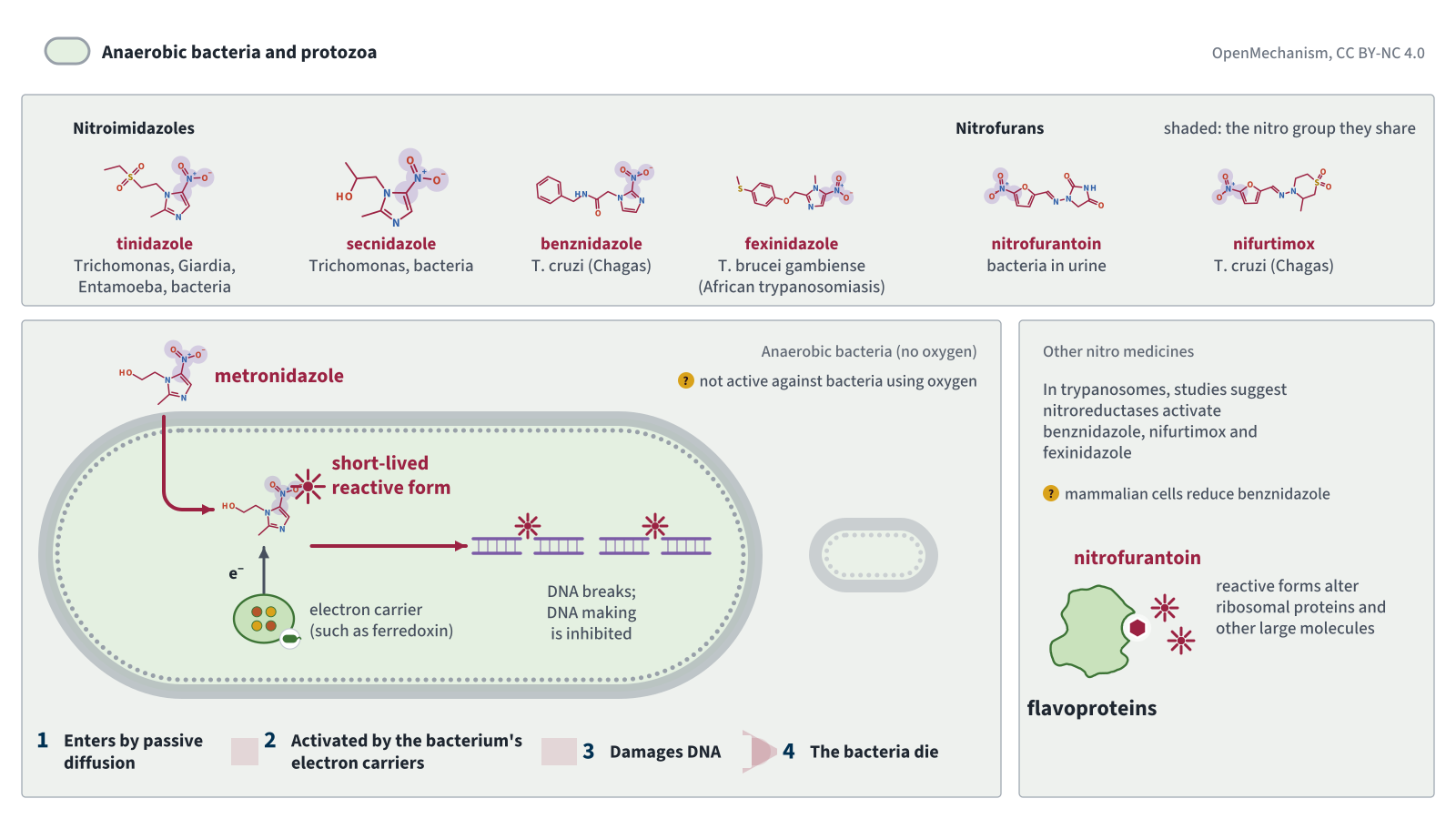
Not active against bacteria using oxygen
The Flagyl (metronidazole) label says: Metronidazole does not possess any clinically relevant activity against facultative anaerobes or obligate aerobes.
Study: In Citron and colleagues' 2012 laboratory study, the MIC90s of CB-183,315, then a new lipopeptide antibiotic, vancomycin and metronidazole were compared for intestinal anaerobes and for 56 Enterobacteriaceae: The MIC(90)s for Gram-negative anaerobes were >8,192, 8,192, and 4 μg/ml for CB-183,315, vancomycin, and metronidazole, respectively. Against Enterobacteriaceae, the MIC(90)s were >8,192 μg/ml, 1,024 μg/ml, and 1,024 μg/ml, respectively.
Citron DM et al., Antimicrob Agents Chemother 2012 (PMID 22183166)
Mammalian cells reduce benznidazole
The benznidazole label says: Studies suggest that benznidazole is reduced by a Type I nitroreductase (NTR) enzyme of T. cruzi producing a series of short-lived intermediates that may promote damage to several macromolecules including DNA. In mammalian cells, however, benznidazole is metabolized by reduction of the nitro group to an amino group by a Type II NTR enzyme.
Source 7: Benznidazole: FDA label, 1 Indications and Usage; 12.4 Microbiology: Mechanism of Action
Study: In Walton and Workman's 1987 study in mice, benznidazole (BENZO) and its amine were measured in tissues, tumors and urine after one 2.5 mmol/kg dose injected into the abdomen (i.p.): Three per cent of the BENZO dose was recovered as amine in the 24 hr urine, compared to 5% for the parent compound.
Walton MI, Workman P, Biochem Pharmacol 1987 (PMID 3105539)
Key terms in this drawing
- DNA
- Deoxyribonucleic acid. The molecule that stores genes.
How it works
Enters by passive diffusion. Metronidazole enters the microbe by passive diffusion.1
Activated by the bacterium's electron carriers. In the cytoplasm of susceptible anaerobic bacteria it is reduced: electron transport proteins such as ferredoxin transfer an electron to its nitro group, forming a short-lived nitroso free radical. This change keeps a concentration gradient that draws more metronidazole in.1
Damages DNA. The reduced form of metronidazole and free radicals can interact with DNA, inhibiting DNA synthesis and degrading DNA.1
The bacteria die. This leads to the death of the bacteria.1
For teachers: download this drawing.
See also
Condition pages: C. difficile infection; giardiasis and amebiasis; skin and soft-tissue infections; and trichomoniasis and bacterial vaginosis.
Other antibiotics: amoxicillin; amoxicillin and clavulanate; azithromycin; bedaquiline; ceftazidime and avibactam; ceftriaxone; cephalexin; ciprofloxacin; and 14 more.
Body system: infections.
Sources
- 1Flagyl (metronidazole): FDA labelIndications and Usage; Microbiology: Mechanism of Action; Resistance
- 2ChEMBL CHEMBL137Target and action classification: DNA inhibitor
- 3In vitro activities of CB-183,315, vancomycin, and metronidazole against 556 strains of Clostridium difficile, 445 other intestinal anaerobes, and 56 Enterobacteriaceae speciesCitron DM et al. Antimicrob Agents Chemother 2012 (abstract)
- 4Nitroimidazole bioreductive metabolism. Quantitation and characterisation of mouse tissue benznidazole nitroreductases in vivo and in vitroWalton MI, Workman P. Biochem Pharmacol 1987 (abstract)
Also used for the drawing
The drawing also shows the other nitroimidazoles and the nitrofurans, and how trypanosomes and bacteria activate them. These sources support those parts; the steps above come from the sources listed above. The flavoproteins outline is traced from the crystal structure below.
- 5Tinidazole: FDA label12.4 Microbiology: Mechanism of Action
- 6Solosec (secnidazole): FDA label12.4 Microbiology: Mechanism of Action
- 7Benznidazole: FDA label1 Indications and Usage; 12.4 Microbiology: Mechanism of Action
- 8Lampit (nifurtimox): FDA label1 Indications and Usage; 12.4 Microbiology: Mechanism of Action
- 9Fexinidazole: FDA label1 Indications and Usage; 12.4 Microbiology: Mechanism of Action
- 10Macrobid (nitrofurantoin): FDA labelClinical Pharmacology: Mechanism of Action
- 11Structures: ChEMBL (tinidazole CHEMBL1220, secnidazole CHEMBL498847, benznidazole CHEMBL110, fexinidazole CHEMBL1631694, nitrofurantoin CHEMBL572, nifurtimox CHEMBL290960)canonical structures from the Atlas catalog snapshot
- 12Escherichia coli nitroreductase NfsA with nitrofurantoinPDB 7NB9; Day, M.A. et al. Biochem.J. 2021; 478:2601-2617
Spotted a mistake? Report an error (hello@openmechanism.com). Since launch, every published error we fix is listed on the corrections page.
Notes and limits
- A schematic teaching drawing: not to scale, not exact structures, binding poses or a complete pathway, and not a guide to dosing, treatment or how a person will respond.
- The label says the precise mechanism of action of metronidazole is unclear.
- The label reports no clinically relevant activity against facultative anaerobes or obligate aerobes.
All recorded limits are on the evidence page, and notes that apply to every page are on How to read a page. Version 1.0.1, medically reviewed by Daniel Tran, PharmD, on 6 November 2026.
Cite this page
Tran D. Metronidazole [Internet]. OpenMechanism; 2026 [updated 2026 Nov 6; cited 2026 Nov 6]. Available from: https://openmechanism.com/medicines/metronidazole