Caspofungin
Caspofungin blocks the making of beta-1,3-D-glucan, a key part of the cell wall in Candida and Aspergillus fungi. Growing parts of the fungus cannot build their wall properly, which limits fungal growth.
- Acts on
- beta-1,3-D-glucan synthesis
- Where
- Growing fungal cell walls
- Medicine type
- Small molecule
- Used for
- Infections
- Drug class
- Antifungals
Also called Cancidas.
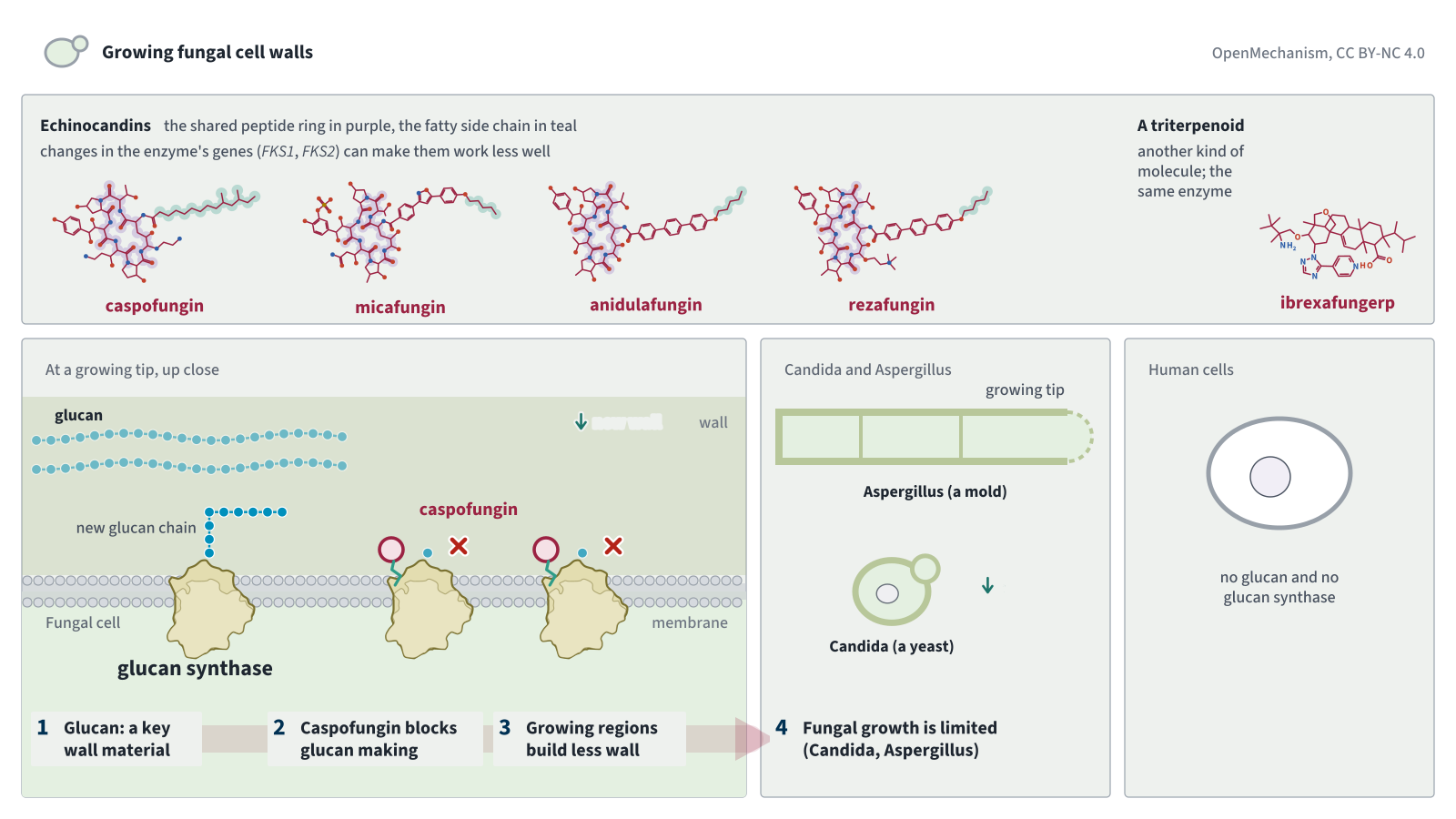
Key terms in this drawing
- FKS1
- FKS1 gene. A fungal gene for part of glucan synthase; changes in it can make echinocandins work less well.
- FKS2
- FKS2 gene. A second fungal gene for part of glucan synthase; changes in it can also make echinocandins work less well.
How it works
Glucan: a key wall material. Beta1,3-D-glucan is a key wall component in susceptible Candida and Aspergillus.1
Caspofungin blocks glucan making. Caspofungin inhibits beta-1,3-D-glucan synthesis.1
Growing regions build less wall. The reduced synthesis affects regions of active fungal growth.1
Fungal growth is limited (Candida, Aspergillus). The label describes antifungal activity in susceptible Candida and Aspergillus growth regions.1
For teachers: download this drawing or build a slide deck.
See also
Condition pages: invasive fungal infections.
Other antifungals: amphotericin B, fluconazole and ketoconazole.
More medicines for infections: acyclovir; albendazole; amoxicillin; amoxicillin and clavulanate; artesunate; atovaquone; azithromycin; baloxavir marboxil; and 49 more.
Body system: infections.
Sources
- 1Cancidas (caspofungin acetate): FDA label12.4 Microbiology: Mechanism of Action
- 2ChEMBL CHEMBL1630575Target and action classification: 1,3-beta-glucan synthase inhibitor
Also used for the drawing
The drawing also shows the other echinocandins (micafungin, anidulafungin, rezafungin) and ibrexafungerp, which block the same enzyme, and how changes in the enzyme lower their effect. These sources support those parts; the steps above come from the sources listed above. The glucan synthase outline is traced from the electron microscopy structure below.
- 3Micafungin for injection: FDA label12.1 Mechanism of Action; 12.4 Microbiology
- 4Eraxis (anidulafungin): FDA label12.4 Microbiology: Mechanism of Action; Resistance
- 5Rezzayo (rezafungin): FDA label12.4 Microbiology: Mechanism of Action; Resistance
- 6Brexafemme (ibrexafungerp): FDA label11 Description; 12.4 Microbiology: Mechanism of Action
- 7Structures: ChEMBL (micafungin CHEMBL457547, anidulafungin CHEMBL264241, rezafungin CHEMBL3989945, ibrexafungerp CHEMBL4297513)canonical structures from the Atlas catalog snapshot
- 8Yeast glucan synthase Fks1 with caspofunginPDB 9PE1; Ren, Z. et al. Nature 2026; 654:547-555
Spotted a mistake? Report an error (hello@openmechanism.com). Since launch, every published error we fix is listed on the corrections page.
Notes and limits
- A schematic teaching drawing: not to scale, not exact structures, binding poses or a complete pathway, and not a guide to dosing, treatment or how a person will respond.
- The steps are in the order that explains them; one step is said to cause the next only where the source says so.
- Beta1,3-D-glucan is not present in mammalian cells.
- No glucan-synthase isoform or exact catalytic pocket is supplied by this label.
All recorded limits are on the evidence page, and notes that apply to every page are on How to read a page. Version 1.0.0, not yet medically reviewed.
Cite this page
Tran D. Caspofungin [Internet]. OpenMechanism; 2026 [updated 2026 Oct 15; cited 2026 Oct 15]. Available from: https://openmechanism.com/medicines/caspofungin