Vancomycin
Vancomycin kills susceptible bacteria mainly by blocking cell-wall building. Taken by mouth as capsules, it is labeled for C. difficile-associated diarrhea and for enterocolitis caused by Staphylococcus aureus, including methicillin-resistant strains, in adults and children; the capsule label says injected vancomycin is not effective for these two and capsules are not effective for other infections. Given into a vein, it is labeled for serious or severe infections caused by susceptible methicillin-resistant (beta-lactam-resistant) staphylococci.
- Acts on
- Cell-wall peptidoglycan precursor
- Where
- Staphylococcus aureus and C. difficile bacteria
- Medicine type
- Small molecule
- Used for
- Infections
- Drug class
- Antibiotics
Also called Vancocin (vancomycin capsules taken by mouth).
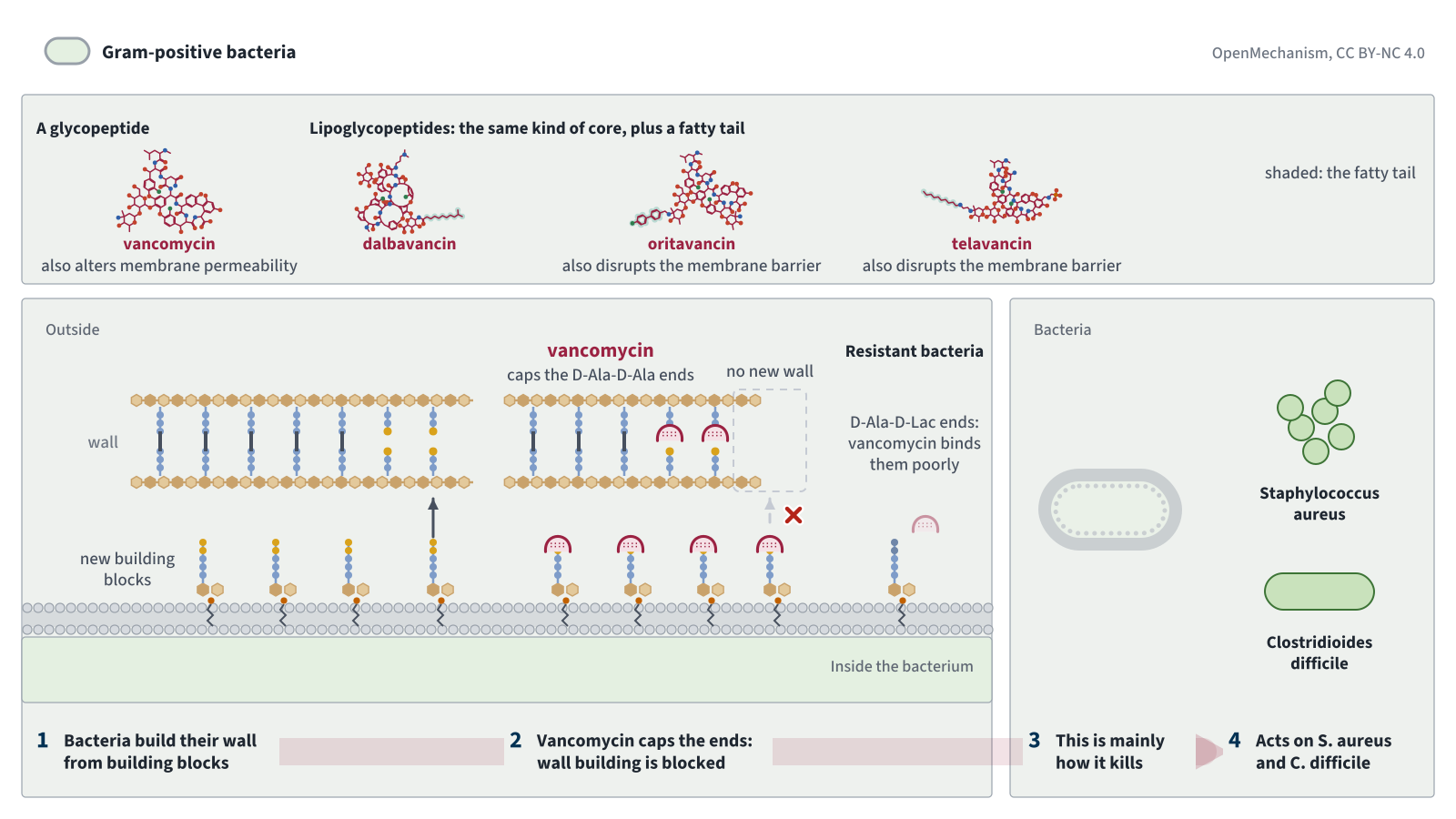
Key terms in this drawing
- D-Ala-D-Ala
- D-alanyl-D-alanine. The two-unit end of the bacterial wall's building block (lipid II); vancomycin binds it.
- D-Ala-D-Lac
- D-Ala-D-Lac. The changed end that some resistant bacteria make instead; vancomycin binds it poorly.
How it works
Bacteria build their wall from building blocks. The wall's peptidoglycan layer is built from precursors, including lipid II.1,2
Vancomycin caps the ends: wall building is blocked. Vancomycin binds the region of lipid II and inhibits cell-wall biosynthesis.2,3
This is mainly how it kills. Vancomycin's killing of susceptible bacteria results mainly from this inhibition.3,4
Acts on S. aureus and C. difficile. The label describes activity against Staphylococcus aureus and vegetative C. difficile.3
For teachers: download this drawing or build a slide deck.
See also
Condition pages: antibiotic-resistant infections; bloodstream infections and endocarditis; C. difficile infection; and skin and soft-tissue infections.
Other antibiotics: amoxicillin; amoxicillin and clavulanate; azithromycin; bedaquiline; ceftazidime and avibactam; ceftriaxone; cephalexin; ciprofloxacin; and 14 more.
Explained: why antibiotics can cause C. difficile diarrhea, why vancomycin can harm the kidneys and why fast vancomycin infusions cause flushing.
Body system: infections.
Sources
- 1Vibativ (telavancin): FDA label12.4 Microbiology
- 2Molecular mechanisms of vancomycin resistanceStogios PJ, Savchenko A, Protein Sci 2020 (abstract)
- 3Vancocin (vancomycin hydrochloride): FDA label12.4 Microbiology: Mechanism of action
- 4Vancomycin hydrochloride for injection: FDA labelIndications and Usage; Microbiology
- 5Vancomycin hydrochloride capsules: FDA label1 Indications and Usage; 12.4 Microbiology
- 6ChEMBL CHEMBL262777Target and action classification: Peptidoglycan inhibitor
Also used for the drawing
The drawing also shows the lipoglycopeptides (dalbavancin, oritavancin, telavancin) and how the family blocks the wall's building blocks. These sources support those parts; the steps above, what telavancin does to the membrane and how resistant bacteria escape come from the sources listed above.
- 7Dalvance (dalbavancin): FDA label12.4 Microbiology
- 8Kimyrsa (oritavancin): FDA label12.4 Microbiology
- 9Structures: ChEMBL (vancomycin CHEMBL262777, dalbavancin CHEMBL3301669, oritavancin CHEMBL1688530, telavancin CHEMBL507870)canonical structures from the Atlas catalog snapshot
Spotted a mistake? Report an error (hello@openmechanism.com). Since launch, every published error we fix is listed on the corrections page.
Notes and limits
- A schematic teaching drawing: not to scale, not exact structures, binding poses or a complete pathway, and not a guide to dosing, treatment or how a person will respond.
- The steps are in the order that explains them; one step is said to cause the next only where the source says so.
- The sources do not show exactly how vancomycin sits on the wall's building block, atom by atom.
- The label adds that vancomycin also alters the bacterial membrane's permeability and RNA synthesis; the steps leave these out.
- The Vancocin label says the exact mechanism of vancomycin resistance in S. aureus is not clear but is believed to be due to cell wall thickening and potentially the transfer of genetic material, and that the mechanism of C. difficile's decreased susceptibility has not been fully elucidated; the D-Ala-D-Lac swap the drawing shows comes from a 2020 review (Stogios).
All recorded limits are on the evidence page, and notes that apply to every page are on How to read a page. Version 1.0.1, medically reviewed by Daniel Tran, PharmD, on 6 November 2026.
Cite this page
Tran D. Vancomycin [Internet]. OpenMechanism; 2026 [updated 2026 Nov 6; cited 2026 Nov 6]. Available from: https://openmechanism.com/medicines/vancomycin