Ivermectin
Ivermectin binds tightly to glutamate-gated chloride channels in the nerve and muscle cells of worms. More chloride gets in, the cells are hyperpolarized, and the parasite is paralyzed and dies. People are spared because some mammals lack these channels, the avermectins bind mammalian ligand-gated chloride channels only weakly, and it does not readily cross the blood-brain barrier in humans.
- Acts on
- Glutamate-gated chloride channels in invertebrate nerve and muscle cells
- Where
- Nematode worms
- Medicine type
- Small molecule
- Used for
- Infections
Also called Stromectol.
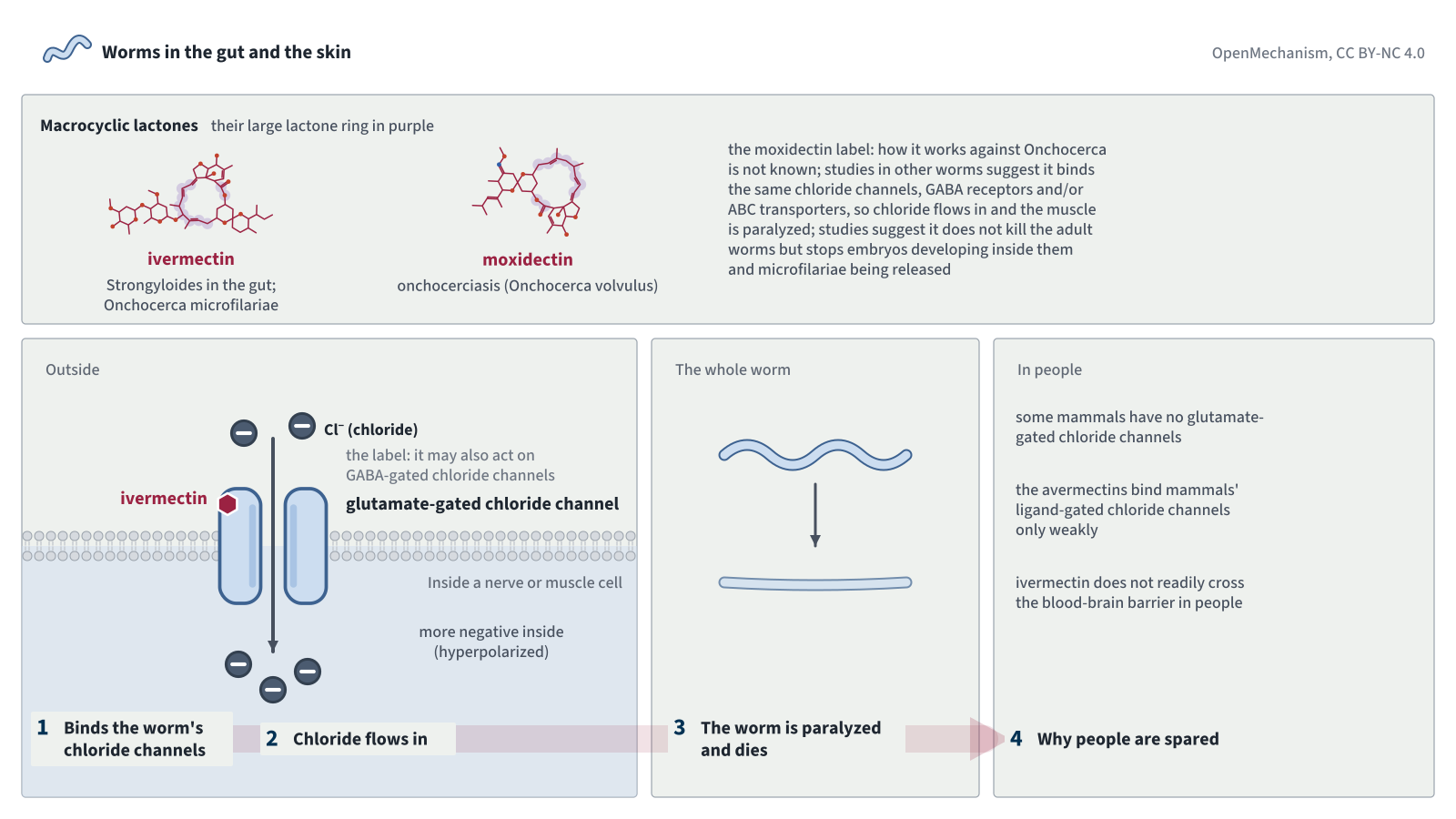
Key terms in this drawing
- ABC transporters
- ATP-binding cassette transporters. Membrane pumps that use ATP to move substances out of cells.
- GABA
- Gamma-aminobutyric acid. The main inhibitory messenger in the central nervous system.
How it works
Binds the worm's chloride channels. Ivermectin, an avermectin, binds selectively and with high to glutamate-gated chloride ion channels, which occur in invertebrate nerve and muscle cells.1
Chloride flows in. This leads to an increase in the permeability of the cell membrane to chloride ions, with hyperpolarization of the nerve or muscle cell.1
The worm is paralyzed and dies. This results in paralysis and death of the parasite.1
Why people are spared. The selective activity is attributed to the facts that some mammals do not have glutamate-gated chloride channels and that the avermectins have a low affinity for mammalian ligand-gated chloride channels; in addition, ivermectin does not readily cross the blood-brain barrier in humans.1
For teachers: download this drawing.
See also
Condition pages: scabies and lice; and worm infections.
Related drawings: levamisole (also paralyzes worms, through the nicotinic receptors of their muscle).
Body system: infections.
Sources
- 1Stromectol (ivermectin): FDA labelMicrobiology
- 2ChEMBL CHEMBL6067487Target and action classification: Glutamate-gated chloride channel modulator
Also used for the drawing
The drawing also shows moxidectin, a related macrocyclic lactone. This source supports that part; the steps above come from the sources listed above.
- 3Moxidectin tablets: FDA label1 Indications and Usage; 12.4 Microbiology
- 4
Spotted a mistake? Report an error (hello@openmechanism.com). Since launch, every published error we fix is listed on the corrections page.
Notes and limits
- A schematic teaching drawing: not to scale, not exact structures, binding poses or a complete pathway, and not a guide to dosing, treatment or how a person will respond.
- Ivermectin acts on various life-cycle stages of many but not all nematodes: the tissue microfilariae of Onchocerca volvulus but not the adult form, and only the intestinal stages of Strongyloides stercoralis (label).
- The label notes that compounds of this class may also interact with other ligand-gated chloride channels, such as those gated by GABA.
All recorded limits are on the evidence page, and notes that apply to every page are on How to read a page. Version 1.0.0, not yet medically reviewed.
Cite this page
Tran D. Ivermectin [Internet]. OpenMechanism; 2026 [updated 2026 Oct 16; cited 2026 Oct 16]. Available from: https://openmechanism.com/medicines/ivermectin