RSV infection
Respiratory syncytial virus (RSV) is the main cause of hospital stays in the first year of life, and nearly every child is infected by age 2 or 3. Its fusion (F) and attachment (G) proteins let it enter airway cells; illness ranges from a cold to bronchiolitis and pneumonia. Nirsevimab, an antibody, binds the F protein and stops fusion.
- Where
- Airways
- Body systems
- Infections, Lungs & airways
- Medicines
- 1 medicine
For teachers: download this drawing.
Key terms in this drawing
- RNA
- Ribonucleic acid. A molecule copied from DNA; messenger RNA carries a gene's instructions.
- RSV
- Respiratory syncytial virus. A virus of the airways; its F protein is the target of RSV vaccines and of nirsevimab.
What goes wrong
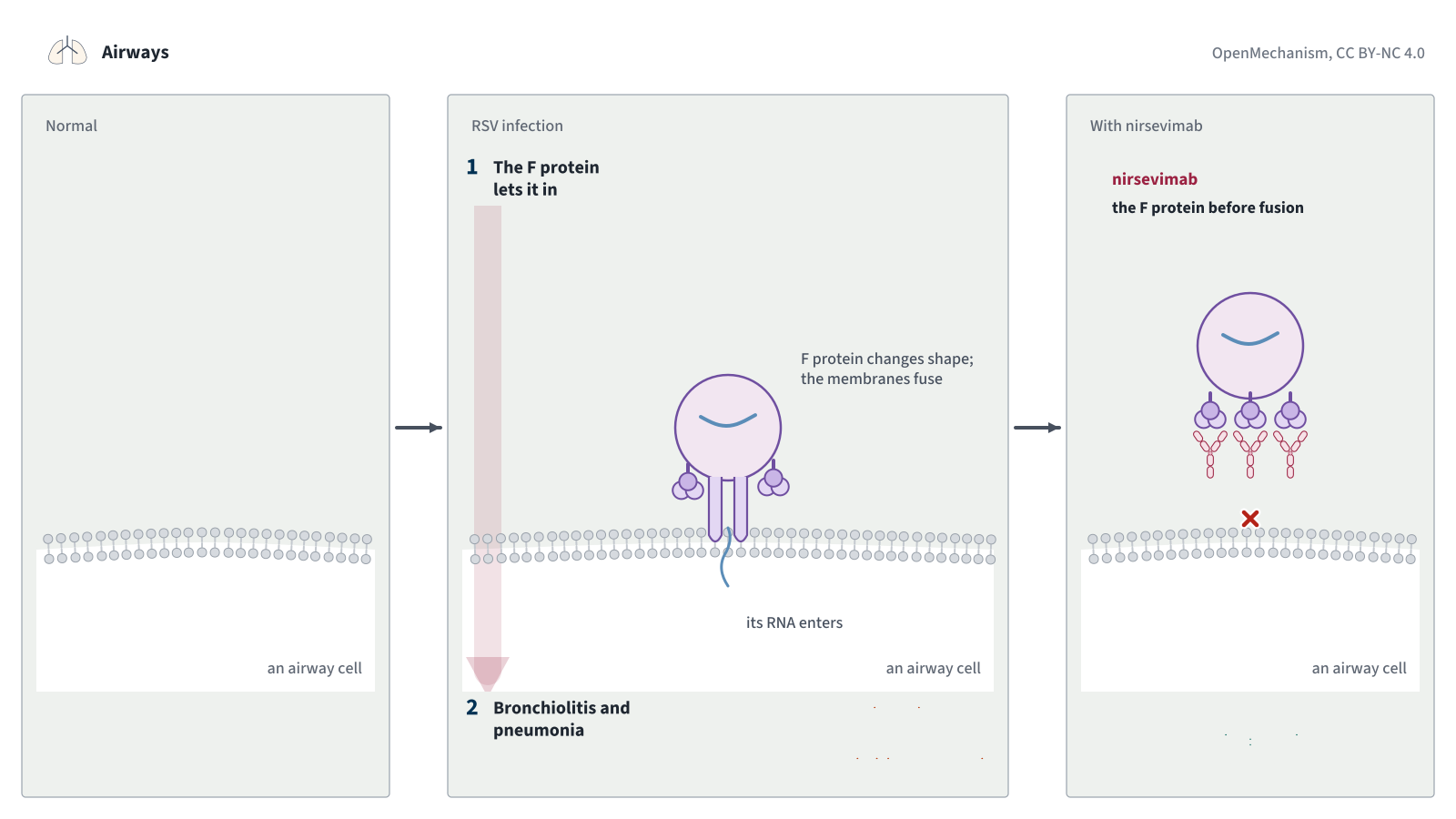
The F protein lets it in. The fusion (F) and attachment (G) proteins are essential for the virus to attach to and enter airway cells.1
What the source says
“Important structural proteins include the fusion (F) protein and the attachment (G) protein which are essential for viral penetration and attachment to the host cells.”
Source 1Bronchiolitis and pneumonia. Illness ranges from a mild cold and ear infection to croup, pauses in breathing in premature babies, pneumonia and bronchiolitis.1
What the source says
“The spectrum of clinical manifestations ranges from mild upper tract illness, infection in middle ear which progresses to acute otitis media, croup, to apnoea in premature infants, pneumonia and bronchiolitis.”
Source 1
Where medicines act
- A
Nirsevimab: fusion blocked
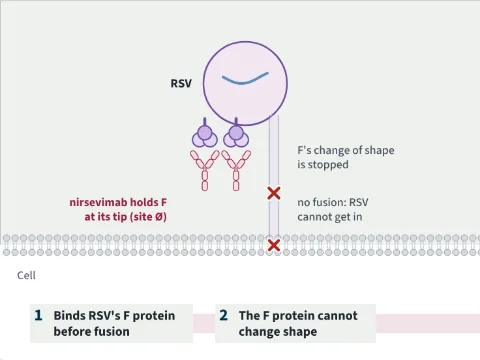
Nirsevimab is an antibody that gives ready-made protection by binding the F protein in its pre-fusion shape, stopping the shape change needed to fuse and enter. It prevents lung disease in babies in their first RSV season.2
What the source says
“Nirsevimab-alip is a recombinant human IgG1κ monoclonal antibody that provides passive immunity by targeting the prefusion conformation of the RSV F protein.”
Source 2“it neutralizes RSV by inhibiting conformation changes in the F protein necessary for fusion of the viral and cellular membranes and viral entry.”
Source 2“Neonates and infants born during or entering their first RSV season.”
Source 2
See also
Body systems: infections and lungs & airways.
Other conditions: COVID-19, influenza, Pneumocystis pneumonia (PCP), pneumonia and tuberculosis.
Sources
- 1Respiratory syncytial virus: the virus, the disease and the immune responseOgra PL. Paediatr Respir Rev 2004 (abstract). Saved copy
- 2Beyfortus (nirsevimab): FDA label1 Indications and Usage; 12.1 and 12.4 Mechanism of Action. Saved copy
Notes and limits
- Premature babies, infants with some heart diseases and people with weak immune systems are at higher risk.1
Notes that apply to every page are on How to read a page.
Spotted a mistake? Report an error (hello@openmechanism.com). Since launch, every published error we fix is listed on the corrections page.
Cite this page
Tran D. RSV infection [Internet]. OpenMechanism; 2026 [updated 2026 Oct 18; cited 2026 Oct 18]. Available from: https://openmechanism.com/conditions/rsv