Nitrofurantoin
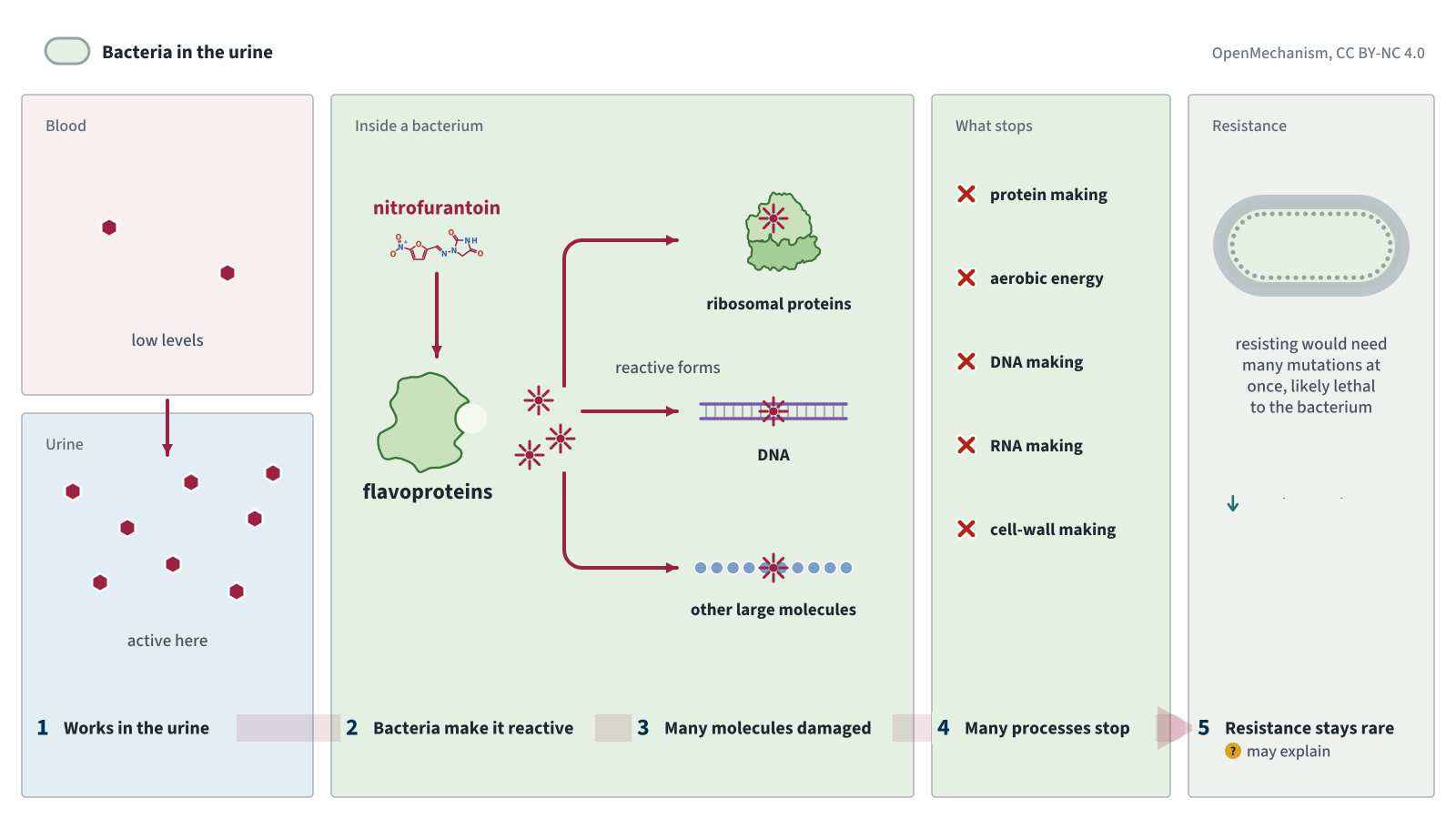
Nitrofurantoin stays low in the blood but is active in the urine. Bacterial flavoproteins turn it into reactive forms that damage ribosomal proteins and other large molecules, so making proteins, energy, , and cell wall all stop and the bacteria die. This broad attack may explain why resistance is rare.
- Acts on
- Bacterial ribosomal proteins and other large molecules, after bacterial flavoproteins reduce it
- Where
- Bacteria in the urine
- Medicine type
- Small molecule
- Used for
- Infections
- Drug class
- Antibiotics
Also called Macrobid.
Step 5: may explain
The Macrobid label says: The broad-based nature of this mode of action may explain the lack of acquired bacterial resistance to nitrofurantoin, as the necessary multiple and simultaneous mutations of the target macromolecules would likely be lethal to the bacteria.
Source 1: Macrobid (nitrofurantoin): FDA label, Clinical Pharmacology; Mechanism of Action
Clinical study: In US laboratory surveillance of urinary E. coli from 1998 through 2001, among isolates already resistant to trimethoprim-sulfamethoxazole: 1.9% (1214 of 63,817) were resistant to nitrofurantoin
Karlowsky JA et al., Clin Infect Dis 2003 (PMID 12522750)
This study was picked with a literature search and is not yet checked by our reviewer.
Key terms in this drawing
- DNA
- Deoxyribonucleic acid. The molecule that stores genes.
- RNA
- Ribonucleic acid. A molecule copied from DNA; messenger RNA carries a gene's instructions.
How it works
Works in the urine. Blood levels stay low (peaks usually under 1 mcg/mL); about 20 to 25% of a dose is recovered unchanged in the urine, where nitrofurantoin is bactericidal at therapeutic doses.1
Bacteria make it reactive. Bacterial flavoproteins reduce nitrofurantoin to reactive intermediates.1
Many molecules damaged. The reactive intermediates inactivate or alter bacterial ribosomal proteins and other large molecules (macromolecules).1
Many processes stop. As a result, protein synthesis, aerobic energy metabolism, DNA synthesis, RNA synthesis and cell-wall synthesis are inhibited.1
Resistance stays rare. This broad mode of action may explain why acquired bacterial resistance is lacking: the many simultaneous mutations needed would likely kill the bacteria.1
For teachers: download this drawing.
See also
Condition pages: urinary tract infections.
Other antibiotics: amoxicillin; amoxicillin and clavulanate; azithromycin; bedaquiline; ceftazidime and avibactam; ceftriaxone; cephalexin; ciprofloxacin; and 14 more.
Body system: infections.
Sources
- 1Macrobid (nitrofurantoin): FDA labelClinical Pharmacology; Mechanism of Action
- 2ChEMBL CHEMBL572Target and action classification: DNA inhibitor
- 3Susceptibility of antimicrobial-resistant urinary Escherichia coli isolates to fluoroquinolones and nitrofurantoinKarlowsky JA et al. Clin Infect Dis 2003 (abstract)
Also used for the drawing
The flavoproteins and ribosome outlines are traced from the crystal and electron microscopy structures below.
- 4Escherichia coli nitroreductase NfsA with nitrofurantoinPDB 7NB9; Day, M.A. et al. Biochem.J. 2021; 478:2601-2617
- 5Escherichia coli stalled ribosome with linezolidPDB 7S1G; Tsai, K. et al. Nat.Struct.Mol.Biol. 2022; 29:162-171
Spotted a mistake? Report an error (hello@openmechanism.com). Since launch, every published error we fix is listed on the corrections page.
Notes and limits
- A schematic teaching drawing: not to scale, not exact structures, binding poses or a complete pathway, and not a guide to dosing, treatment or how a person will respond.
- The label says the broad-based nature of this mode of action may explain the lack of acquired bacterial resistance to nitrofurantoin.
All recorded limits are on the evidence page, and notes that apply to every page are on How to read a page. Version 1.0.0, not yet medically reviewed.
Cite this page
Tran D. Nitrofurantoin [Internet]. OpenMechanism; 2026 [updated 2026 Oct 11; cited 2026 Oct 11]. Available from: https://openmechanism.com/medicines/nitrofurantoin