Fluconazole
Fluconazole blocks a fungal enzyme, lanosterol 14α-demethylase, needed to make ergosterol. Normal sterols fall and 14α-methyl sterols build up instead; the label says the loss of normal sterols may be responsible for stopping fungal growth. The Diflucan label lists it for vaginal yeast infections (vaginal candidiasis), Candida infections of the mouth, throat and esophagus, and cryptococcal meningitis, and for lowering how often candidiasis occurs in people having a bone marrow transplant who receive chemotherapy, radiation or both; it adds that in open studies of relatively few patients, with no comparison group, it also worked for Candida infections of the urinary tract, of the abdominal lining (peritonitis) and of the whole body, including candidemia.
- Acts on
- Lanosterol 14α demethylase
- Where
- Fungal cells
- Medicine type
- Small molecule
- Used for
- Infections
- Drug class
- Antifungals
Also called Diflucan.
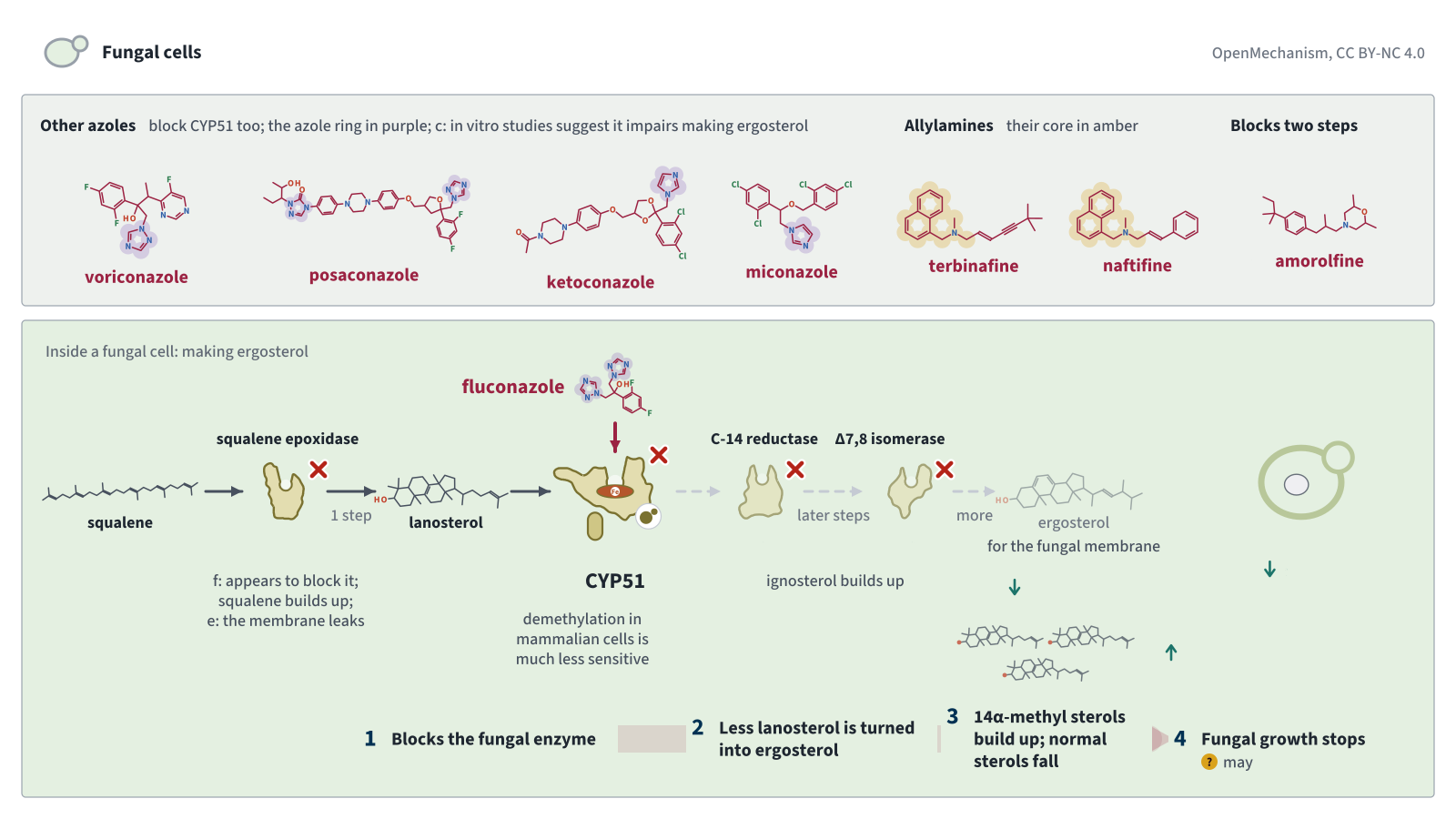
Step 4: may
The Diflucan (fluconazole) label says: The subsequent loss of normal sterols correlates with the accumulation of 14-α-methyl sterols in fungi and may be responsible for the fungistatic activity of fluconazole.
Source 1: Diflucan (fluconazole): FDA label, Indications and Usage; Microbiology: Mechanism of Action
Clinical study: In Rex and colleagues' 1994 multicenter randomized trial in people with candidemia and without neutropenia, fluconazole 400 mg a day was compared with amphotericin B 0.5 to 0.6 mg per kilogram of body weight a day, each for at least 14 days after the last positive blood culture; 206 of the 237 people enrolled met all entry criteria. The trial measured treatment success, not how fluconazole works: treatment succeeded in 72 of 103 people given fluconazole (70 percent) and 81 of 103 given amphotericin B (79 percent; P = 0.22), and the authors concluded: In patients without neutropenia and without major immunodeficiency, fluconazole and amphotericin B are not significantly different in their effectiveness in treating candidemia.
Rex JH et al., N Engl J Med 1994 (PMID 7935701)
Key terms in this drawing
- CYP51
- Lanosterol 14α-demethylase. The fungal enzyme that azoles block. It removes the 14α-methyl group from lanosterol (14α-demethylation), an early step in making ergosterol, a sterol that fungal cell membranes need.
How it works
Blocks the fungal enzyme. Fluconazole inhibits the fungal cytochrome P450-dependent lanosterol 14α-demethylase.1
Less lanosterol is turned into ergosterol. Inhibition interferes with conversion of lanosterol to ergosterol.1
14α-methyl sterols build up; normal sterols fall. Normal sterols decrease and 14α-methyl sterols accumulate.1
Fungal growth stops. The label says the loss of normal sterols, which goes with the build-up of 14α-methyl sterols, may be responsible for fluconazole's fungistatic activity.1
For teachers: download this drawing or build a slide deck.
See also
Condition pages: invasive fungal infections; and thrush and vaginal yeast infections.
Other antifungals: amphotericin B, caspofungin and ketoconazole.
Body system: infections.
Sources
- 1Diflucan (fluconazole): FDA labelIndications and Usage; Microbiology: Mechanism of Action
- 2ChEMBL CHEMBL106Target and action classification: Cytochrome P450 51 inhibitor
- 3A randomized trial comparing fluconazole with amphotericin B for the treatment of candidemia in patients without neutropeniaRex JH et al. N Engl J Med 1994 (abstract)
Also used for the drawing
The drawing also shows the other azoles, which block CYP51 too, and the allylamines and amorolfine, which block other steps of the same pathway to ergosterol. These sources support those parts; the steps above come from the sources listed above. The squalene epoxidase, CYP51, C-14 reductase and Δ7,8 isomerase outlines are traced from the crystal structures below.
- 4Vfend (voriconazole): FDA label12.4 Microbiology: Mechanism of Action
- 5Noxafil (posaconazole): FDA label12.4 Microbiology: Mechanism of Action
- 6Ketoconazole cream: FDA labelMode of Action; Microbiology
- 7Oravig (miconazole): FDA label11 Description; 12.4 Microbiology: Mechanism of Action
- 8Vivjoa (oteseconazole): FDA label12.4 Microbiology: Mechanism of Action
- 9Terbinafine tablets: FDA label12.4 Microbiology
- 10Naftin (naftifine): FDA label12.4 Microbiology: Mechanism of Action
- 11Cloning of the late genes in the ergosterol biosynthetic pathway of Saccharomyces cerevisiae: a reviewLees ND et al., Lipids 1995 (abstract)
- 12Ergosterol biosynthesis inhibition: a target for antifungal agentsBarrett-Bee K, Dixon G, Acta Biochim Pol 1995 (abstract)
- 13Preclinical data and mode of action of amorolfinePolak A, Dermatology 1992 (abstract)
- 14
- 15Human squalene epoxidase (its catalytic domain) with FAD and the inhibitor NB-598PDB 6C6P; Padyana, A.K. et al. Nat Commun 2019; 10:97
- 16Yeast CYP51 with fluconazolePDB 4WMZ; Sagatova, A.A. et al. Antimicrob.Agents Chemother. 2015; 59:4982-4989
- 17Methylomicrobium alcaliphilum delta-14 sterol reductase with NADPHPDB 4QUV; Li, X. et al. Nature 2015; 517:104-107
- 18Human sterol delta-8 to delta-7 isomerase (EBP) with U18666APDB 6OHT; Long, T. et al. Nat Commun 2019; 10:2452
Spotted a mistake? Report an error (hello@openmechanism.com). Since launch, every published error we fix is listed on the corrections page.
Notes and limits
- A schematic teaching drawing: not to scale, not exact structures, binding poses or a complete pathway, and not a guide to dosing, treatment or how a person will respond.
- The steps are in the order that explains them; one step is said to cause the next only where the source says so.
- The label says only that the loss of normal sterols may be responsible for stopping fungal growth.
All recorded limits are on the evidence page, and notes that apply to every page are on How to read a page. Version 1.0.1, medically reviewed by Daniel Tran, PharmD, on 6 November 2026.
Cite this page
Tran D. Fluconazole [Internet]. OpenMechanism; 2026 [updated 2026 Nov 6; cited 2026 Nov 6]. Available from: https://openmechanism.com/medicines/fluconazole