Multidrug-resistant Gram-negative infections are rising fast and are among the most urgent global health threats; most of the priority pathogens the WHO named in 2017 are Gram-negative. A changeable envelope, enzymes that destroy or change the antibiotic, changed entry pores, stronger pumps and altered targets let bacteria resist. Ceftazidime with avibactam acts on Gram-negative bacteria; vancomycin, daptomycin and linezolid on Gram-positive ones, including methicillin-resistant Staphylococcus aureus (MRSA); linezolid's label also lists vancomycin-resistant Enterococcus faecium (VRE) infections.
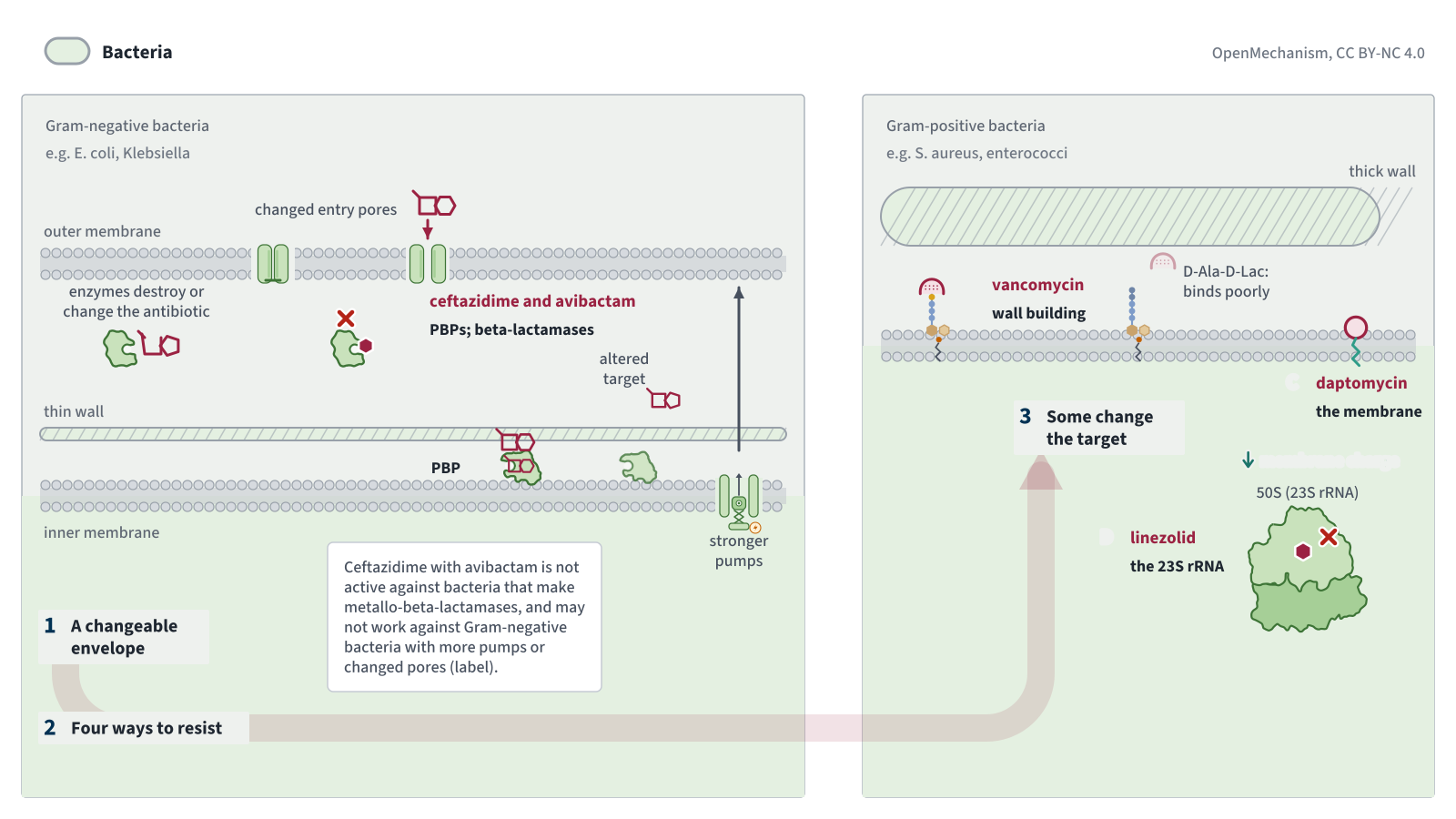
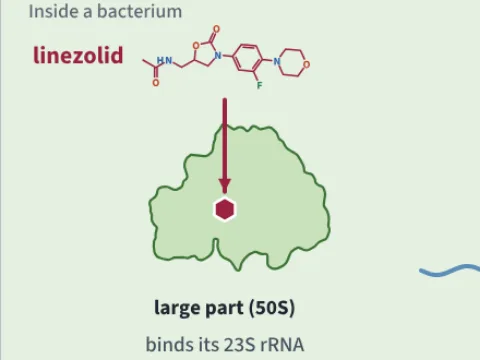
What goes wrong in antibiotic-resistant infections, and where medicines act. Schematic, not to scale. Beta-lactamase outline from KPC-2, as an example. Penicillin-binding protein outline from pneumococcal PBP2x, as an example. Ribosome outline from an Escherichia coli structure, as an example. License CC BY-NC 4.0.
50S ribosomal subunit. The large part of the bacterial ribosome.
D-Ala-D-Lac
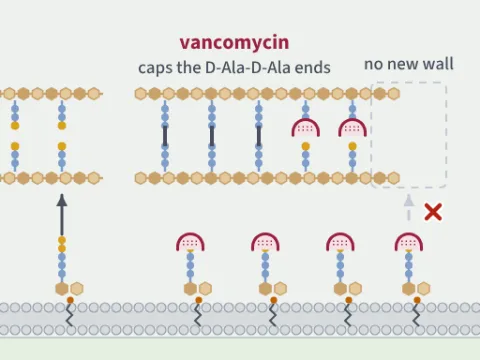
D-Ala-D-Lac. The changed end that some resistant bacteria make instead; vancomycin binds it poorly.
PBP
Penicillin-binding protein. A bacterial enzyme that builds the cell wall; beta-lactam antibiotics, such as penicillins and cephalosporins, bind it.
rRNA
Ribosomal RNA. RNA that is part of the ribosome, such as the bacterial ribosome's 16S and 23S rRNA.
What goes wrong
A changeable envelope. Multidrug-resistant Gram-negative infections are rising fast, and most of the priority pathogens the WHO named in 2017 are Gram-negative; these bacteria have a changeable cell envelope that lets them resist several antibiotics.1
What the source says
“Multidrug-resistant Gram-negative bacterial infections are exponentially increasing, posing one of the most urgent global healthcare and economic threats. Due to the lack of new therapies, the World Health Organization classified these bacterial species as priority pathogens in 2017, known as ESKAPE pathogens.”
“The majority of these priority pathogens are Gram-negative species, which possess a structurally dynamic cell envelope enabling them to resist multiple antibiotics, thereby leading to increased mortality rates.”
Four ways to resist. Gram-negative bacteria resist with enzymes that destroy or change the antibiotic, changed entry pores, stronger pumps and altered targets.1
What the source says
“These mechanisms include antibiotic inactivating/modifying enzymes, outer membrane porin remodelling, enhanced efflux pump action, and alteration of antibiotic target sites.”
Some change the target. Some Gram-positive bacteria resist vancomycin by replacing the end of their wall building blocks with or D-Ala-D-Ser, which vancomycin binds poorly; in laboratory studies, linezolid resistance goes with point mutations in the ribosome's .2,3
What the source says
“However, two types of complex resistance mechanisms, each comprised of a multi-enzyme pathway, emerged and are now widely disseminated in pathogenic species, thus threatening the clinical efficiency of vancomycin.”
“Resistance to vancomycin involves degradation of this natural precursor and its replacement with d-Ala-d-lac or d-Ala-d-Ser alternatives to which vancomycin has low affinity”
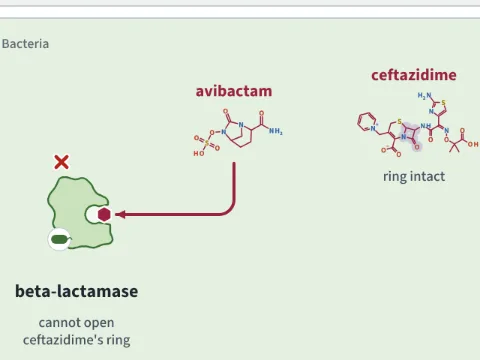
Avibactam blocks certain beta-lactamases that would destroy ceftazidime; ceftazidime then binds essential , and that binding is how it kills the bacteria.4
Used for, in adults and children from 31 weeks' gestational age, when caused by susceptible Gram-negative bacteriaComplicated abdominal infections: with metronidazoleComplicated urinary tract infections, including kidney infectionPneumonia caught in hospital or on a ventilator
What the label says
“The bactericidal action of ceftazidime is mediated through binding to essential penicillin-binding proteins (PBPs).”
“indicated for the treatment of the following infections caused by designated susceptible Gram-negative microorganisms in adult and pediatric patients (at least 31 weeks gestational age)”
“AVYCAZ is not active against bacteria that produce metallo-beta lactamases and may not have activity against gram-negative bacteria that overexpress efflux pumps or have porin mutations.”
“Vancomycin Hydrochloride for Injection is indicated for the treatment of serious or severe infections caused by susceptible strains of methicillin-resistant (β-lactam-resistant) staphylococci.”
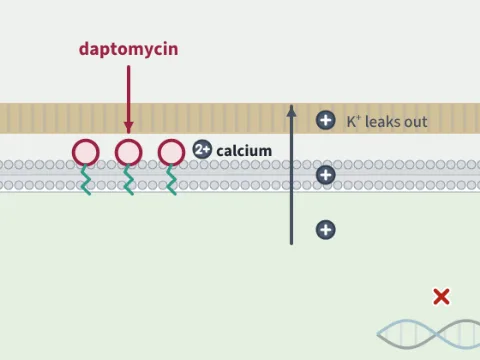
Binds the bacterial membrane and drains its electrical charge, so , and protein making are inhibited and the bacteria die; it works on aerobic Gram-positive bacteria.6,7
Used for, in adultsComplicated skin infections caused by susceptible isolates of the Gram-positive bacteria its label lists, including MRSAS. aureus bloodstream infections, including MRSA
What the label says
“Daptomycin binds to bacterial cell membranes and causes a rapid depolarization of membrane potential. This loss of membrane potential causes inhibition of DNA, RNA, and protein synthesis, which results in bacterial cell death.”
“Daptomycin for Injection is indicated for the treatment of adult patients with complicated skin and skin structure infections (cSSSI) caused by susceptible isolates of the following Gram-positive bacteria: Staphylococcus aureus (including methicillin-resistant isolates), Streptococcus pyogenes, Streptococcus agalactiae, Streptococcus dysgalactiae subsp. equisimilis, and Enterococcus faecalis (vancomycin-susceptible isolates only).”
“Daptomycin for Injection is indicated for the treatment of adult patients with Staphylococcus aureus bloodstream infections (bacteremia), including adult patients with right-sided infective endocarditis, caused by methicillin-susceptible and methicillin-resistant isolates.”
Binds the 23S rRNA of the ribosome's large part and stops a working start complex forming, which the label says is essential for bacterial reproduction.3,8
Used for, in adults and children, when caused by susceptible Gram-positive bacteriaPneumonia and skin infections, including MRSA in pneumonia caught in hospital and in complicated skin infectionsVancomycin-resistant Enterococcus faecium infections
What the label says
“Linezolid binds to a site on the bacterial 23S ribosomal RNA of the 50S subunit and prevents the formation of a functional 70S initiation complex, which is essential for bacterial reproduction.”
“ZYVOX is an oxazolidinone-class antibacterial indicated in adults and children for the treatment of the following infections caused by susceptible Gram-positive bacteria”
“ZYVOX is indicated for the treatment of complicated skin and skin structure infections, including diabetic foot infections, without concomitant osteomyelitis, caused by Staphylococcus aureus (methicillin-susceptible and -resistant isolates)”
A 2023 review of resistance in Gram-negative bacteria says new treatments have come too slowly, and that how resistance works in each species needs more study.1
Ceftazidime with avibactam is not active against bacteria that make metallo-beta-lactamases, and may not work against Gram-negative bacteria with more pumps or changed pores.4
Claude Opus 5.5 (AI source check), 6 November 2026: 46 statements compared with their sources, 16 flagged for the reviewer. An automated check, not a medical review.
Conflict of interest
Daptomycin: Pfizer, the reviewer's former employer, makes or markets this medicine. Linezolid: Pfizer, the reviewer's former employer, makes or markets this medicine. Penicillin G: Pfizer, the reviewer's former employer, makes or markets this medicine. Details
Key terms
Definitions reworded since this review: rRNA. Definitions are shared across pages, so a later rewording does not take the review line off (what a review covers).
Next review due
7 May 2028
Cite this page
Tran D. Antibiotic-resistant infections [Internet]. OpenMechanism; 2026 [updated 2026 Nov 6; cited 2026 Nov 6]. Available from: https://openmechanism.com/conditions/antibiotic-resistant-infections