Eflornithine
Eflornithine irreversibly blocks ornithine decarboxylase (), the first enzyme in making polyamines. The trypanosome replaces this enzyme slowly, which may explain why the parasite is hit harder. In trypanosomes from treated rats, polyamines and trypanothione fell; losing trypanothione may weaken the parasite's defenses against peroxides.
- Acts on
- Ornithine decarboxylase (ODC), the first enzyme of polyamine making
- Where
- African trypanosomes in the blood
- Medicine type
- Small molecule
- Used for
- Infections
Also called Iwilfin.
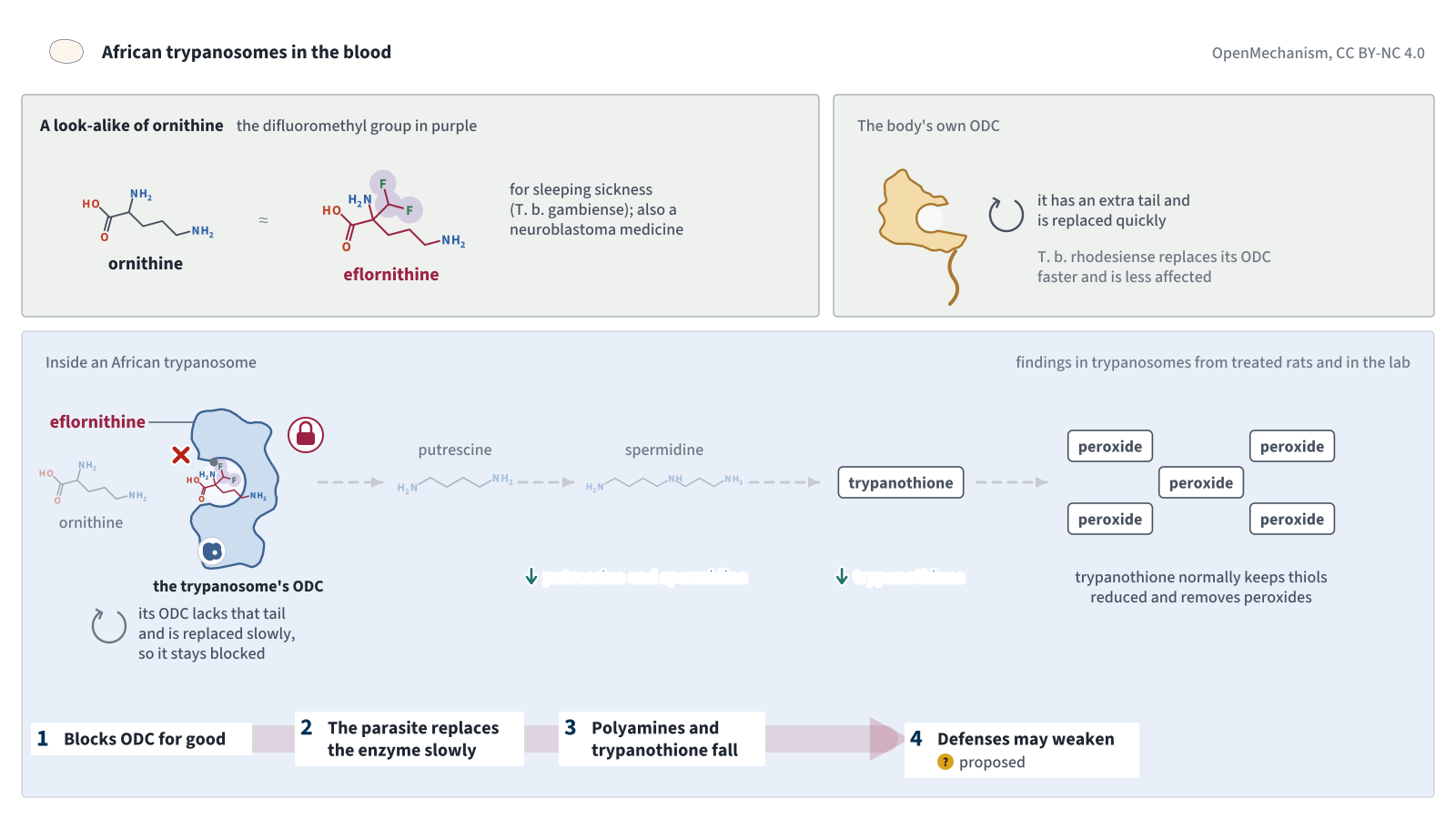
Step 4: proposed
A study of trypanosomes in infected rats (Fairlamb 1987) says: Trypanothione is thought to have two important roles in trypanosomatid metabolism: the maintenance of intracellular thiols in the correct redox state and in the removal of hydrogen peroxide and other hydroperoxides. … Thus, it is proposed that depletion of this metabolite may be an important contributory factor to the selective toxic effect of DFMO, particularly in its synergistic effect with other trypanocidal drugs.
Clinical study: In a randomized, open-label trial in 287 people with second-stage gambiense sleeping sickness in the Republic of the Congo and the Democratic Republic of the Congo, eflornithine alone was compared with eflornithine plus nifurtimox; the trial measured cure at 18 months, not how eflornithine works: In the ITT population, 131 (91.6%) of 143 patients assigned to eflornithine and 138 (96.5%) of 143 patients assigned to NECT were cured at 18 months
Priotto G et al., Lancet 2009 (PMID 19559476)
This study was picked with a literature search and is not yet checked by our reviewer.
Key terms in this drawing
- ODC
- Ornithine decarboxylase. The enzyme that starts making polyamines from ornithine; eflornithine blocks it for good.
How it works
Blocks ODC for good. Eflornithine is an irreversible inhibitor of ornithine decarboxylase (ODC), the first and rate-limiting enzyme in the biosynthesis of polyamines; ODC is a recognized drug target against African sleeping sickness, caused by Trypanosoma brucei, and eflornithine (DFMO) is a suicide inhibitor of it.1,2
The parasite replaces the enzyme slowly. The T. brucei enzyme lacks a C-terminal peptide associated with the rapid turnover of the mammalian enzyme, and it turns over slowly; this lack of turnover may be the basis of eflornithine's selective action against trypanosomes.3
Polyamines and trypanothione fall. In trypanosomes from infected rats treated with eflornithine, putrescine was undetectable after 12 hours, and after 48 hours spermidine was decreased by 76% and trypanothione (dihydrotrypanothione) by 66%.4
Defenses may weaken. Trypanothione is thought to keep the parasite's thiols in the correct redox state and to remove hydrogen peroxide and other hydroperoxides; its depletion may be an important contributory factor to eflornithine's selective toxic effect.4
For teachers: download this drawing.
See also
Condition pages: neuroblastoma and sleeping sickness.
Related drawings: sodium stibogluconate (also upsets trypanothione, in Leishmania).
Body system: infections.
Sources
- 1Iwilfin (eflornithine): FDA label12.1 Mechanism of Action
- 2X-ray structure of ornithine decarboxylase from Trypanosoma brucei: the native structure and the structure in complex with alpha-difluoromethylornithineGrishin NV et al., Biochemistry 1999 (abstract)
- 3Cloning and sequencing of the ornithine decarboxylase gene from Trypanosoma brucei. Implications for enzyme turnover and selective difluoromethylornithine inhibitionPhillips MA et al., J Biol Chem 1987 (abstract)
- 4In vivo effects of difluoromethylornithine on trypanothione and polyamine levels in bloodstream forms of Trypanosoma bruceiFairlamb AH et al., Mol Biochem Parasitol 1987 (abstract)
- 5ChEMBL CHEMBL830Target and action classification: Ornithine decarboxylase inhibitor
- 6
Also used for the drawing
The drawing also shows the medicine's use against sleeping sickness, why T. b. rhodesiense is less affected, and that it stops trypanosomes multiplying rather than killing them. This source supports those parts; the steps above come from the sources listed above. The ODC and trypanosome ODC outlines are traced from the crystal structures below.
- 7Eflornithine for the treatment of human African trypanosomiasisBurri C, Brun R, Parasitol Res 2003 (abstract)
- 8
- 9Human ornithine decarboxylase (ODC) with its cofactor and an inhibitorPDB 2OO0; Dufe, V.T. et al. Biochem.J. 2007; 405:261-268
- 10Trypanosoma brucei ornithine decarboxylase (a crystallized variant) with eflornithine (DFMO)PDB 2TOD; Grishin, N.V. et al. Biochemistry 1999; 38:15174-15184
Spotted a mistake? Report an error (hello@openmechanism.com). Since launch, every published error we fix is listed on the corrections page.
Notes and limits
- A schematic teaching drawing: not to scale, not exact structures, binding poses or a complete pathway, and not a guide to dosing, treatment or how a person will respond.
- The parasite findings come from laboratory studies and from trypanosomes in infected rats (Phillips 1987; Fairlamb 1987).
- The eflornithine label describes the medicine in human neuroblastoma; the trypanosome steps come from published studies.
- Proposed by Phillips et al. 1987 ('may constitute the basis').
- Proposed by Fairlamb et al. 1987.
All recorded limits are on the evidence page, and notes that apply to every page are on How to read a page. Version 1.0.0, not yet medically reviewed.
Cite this page
Tran D. Eflornithine [Internet]. OpenMechanism; 2026 [updated 2026 Oct 16; cited 2026 Oct 16]. Available from: https://openmechanism.com/medicines/eflornithine