Tenofovir
Tenofovir is given as tenofovir disoproxil or tenofovir alafenamide, which the body turns into tenofovir. Cell enzymes then make tenofovir diphosphate, which competes with , a natural building block, at the reverse transcriptase of and of hepatitis B virus. Once built into the viral DNA, it stops the chain growing. The Viread label lists tenofovir disoproxil for HIV-1 infection, together with other antiretroviral medicines, and for chronic hepatitis B, each in adults and in children 2 years and older who weigh at least 10 kg; the Vemlidy label lists tenofovir alafenamide for chronic hepatitis B with compensated liver disease, in adults and in children 6 years and older who weigh at least 25 kg.
- Acts on
- HIV-1 reverse transcriptase and hepatitis B virus reverse transcriptase
- Where
- Cells infected with HIV-1 or hepatitis B virus
- Medicine type
- Small molecule
- Used for
- Infections
- Drug class
- Antivirals
Also called Viread (tenofovir disoproxil fumarate) and Vemlidy (tenofovir alafenamide).
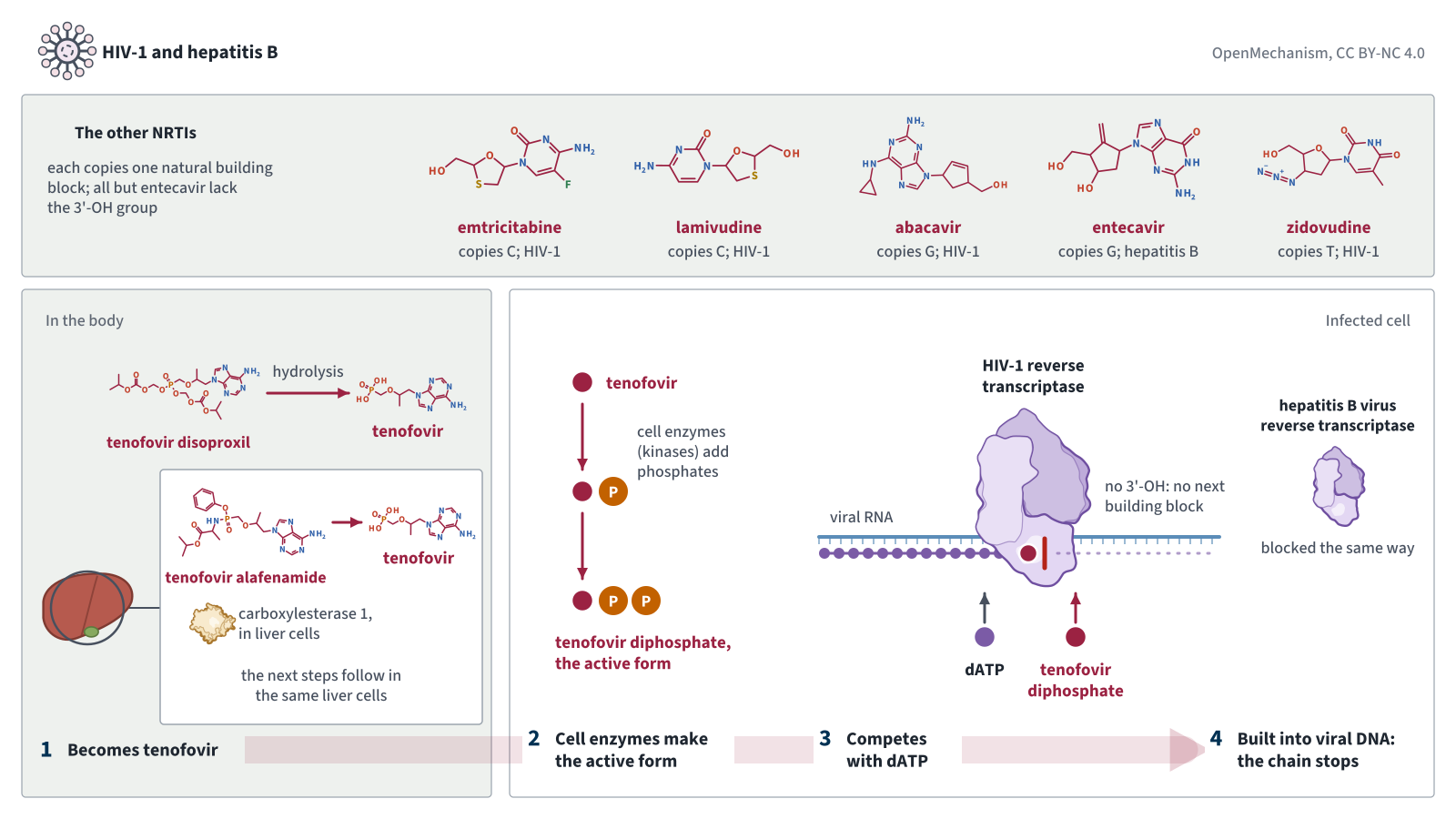
Key terms in this drawing
- dATP
- Deoxyadenosine triphosphate. The A building block of DNA; tenofovir's active form competes with it.
- HIV-1
- Human immunodeficiency virus type 1. A retrovirus. Its capsid encloses the viral genome and helps deliver it into new host cells.
- NRTI
- Nucleoside or nucleotide reverse transcriptase inhibitor. A medicine that looks like a DNA building block and stops the new viral DNA chain.
- RNA
- Ribonucleic acid. A molecule copied from DNA; messenger RNA carries a gene's instructions.
How it works
Becomes tenofovir. Tenofovir disoproxil fumarate needs its diester removed by hydrolysis to become tenofovir; tenofovir alafenamide is converted to tenofovir by hydrolysis, mainly by carboxylesterase 1 in liver cells, as lab studies show.1,2
Cell enzymes make the active form. Cellular enzymes (kinases) then add phosphates to form tenofovir diphosphate, an obligate chain terminator.1,2
Competes with dATP. Tenofovir diphosphate inhibits HIV-1 reverse transcriptase and hepatitis B virus reverse transcriptase by competing with the natural building block deoxyadenosine 5'-triphosphate (dATP).1
Built into viral DNA: the chain stops. Once it is built into the viral DNA, the DNA chain stops growing (chain termination).1,2
For teachers: download this drawing.
See also
Condition pages: hepatitis B and HIV infection.
Other antivirals: acyclovir; baloxavir marboxil; bulevirtide; darunavir; doravirine; enfuvirtide; glecaprevir and pibrentasvir; lenacapavir; and 6 more.
Related drawings: doravirine (NNRTIs, which bind a pocket near the copying site of HIV-1 reverse transcriptase).
Body system: infections.
Sources
- 1Viread (tenofovir disoproxil fumarate): FDA label1 Indications and Usage; 12.4 Microbiology: Mechanism of Action
- 2Vemlidy (tenofovir alafenamide): FDA label1 Indications and Usage; 12.4 Microbiology: Mechanism of Action
- 3ChEMBL CHEMBL1538Target and action classification: DNA polymerase/reverse transcriptase inhibitor; Human immunodeficiency virus type 1 reverse transcriptase inhibitor
Also used for the drawing
The drawing also shows the other NRTIs, grouped by the natural building block each copies, and hepatitis B virus's reverse transcriptase. These sources support those parts; the steps above come from the sources listed above. The carboxylesterase 1, reverse transcriptase and hepatitis B virus reverse transcriptase outlines are traced from the crystal structures below.
- 4Emtriva (emtricitabine): FDA label12.4 Microbiology: Mechanism of Action
- 5Lamivudine tablets: FDA label11 Description; 12.4 Microbiology: Mechanism of Action
- 6Ziagen (abacavir): FDA label12.4 Microbiology
- 7Baraclude (entecavir): FDA label12.4 Microbiology: Mechanism of Action
- 8Zidovudine tablets: FDA label11 Description; 12.4 Microbiology: Mechanism of Action
- 9Molecular mechanisms of HIV-1 resistance to nucleoside reverse transcriptase inhibitors (NRTIs)Sluis-Cremer N et al., Cell Mol Life Sci 2000 (abstract)
- 10Intracellular metabolism of nucleoside/nucleotide analogues: a bottleneck to reach active drugs on HIV reverse transcriptaseVarga A et al., Curr Drug Metab 2016 (abstract)
- 11Crystal structure at 3.5 Å resolution of HIV-1 reverse transcriptase complexed with an inhibitorKohlstaedt LA et al., Science 1992 (abstract)
- 12Current medicinal chemistry strategies in the discovery of novel HIV-1 ribonuclease H inhibitorsZhang L et al., Eur J Med Chem 2022 (abstract)
- 13Structures: PubChem (tenofovir CID 464205) and ChEMBL (tenofovir disoproxil CHEMBL1538, tenofovir alafenamide CHEMBL2107825, emtricitabine CHEMBL885, lamivudine CHEMBL141, abacavir CHEMBL1380, entecavir CHEMBL713, zidovudine CHEMBL129)canonical structures from the Atlas catalog snapshot; PubChem isomeric SMILES
- 14Human liver carboxylesterase 1 with ethyl acetatePDB 1YAH; Fleming, C.D. et al. J.Mol.Biol. 2005; 352:165-177
- 15HIV-1 reverse transcriptase (p66 with p51) on DNA, with tenofovir's active form (tenofovir diphosphate)PDB 1T05; Tuske, S. et al. Nat.Struct.Mol.Biol. 2004; 11:469-474
Spotted a mistake? Report an error (hello@openmechanism.com). Since launch, every published error we fix is listed on the corrections page.
Notes and limits
- A schematic teaching drawing: not to scale, not exact structures, binding poses or a complete pathway, and not a guide to dosing, treatment or how a person will respond.
- Tenofovir diphosphate is a weak inhibitor of mammalian DNA polymerases α and β and of mitochondrial DNA polymerase γ (per the label).
All recorded limits are on the evidence page, and notes that apply to every page are on How to read a page. Version 1.0.1, medically reviewed by Daniel Tran, PharmD, on 6 November 2026.
Cite this page
Tran D. Tenofovir [Internet]. OpenMechanism; 2026 [updated 2026 Nov 6; cited 2026 Nov 6]. Available from: https://openmechanism.com/medicines/tenofovir