Tuberculosis
Tuberculosis is an airborne infection with Mycobacterium tuberculosis, mainly of the lungs but possible almost anywhere in the body. The body can contain the bacteria inside granulomas (latent infection), or the disease can become active and contagious. Isoniazid blocks the making of the mycobacterial cell wall; rifampin blocks bacterial RNA polymerase; bedaquiline blocks the bacterium's energy-making ATP synthase.
- Where
- Lungs
- Body systems
- Infections, Lungs & airways
- Medicines
- 3 medicines
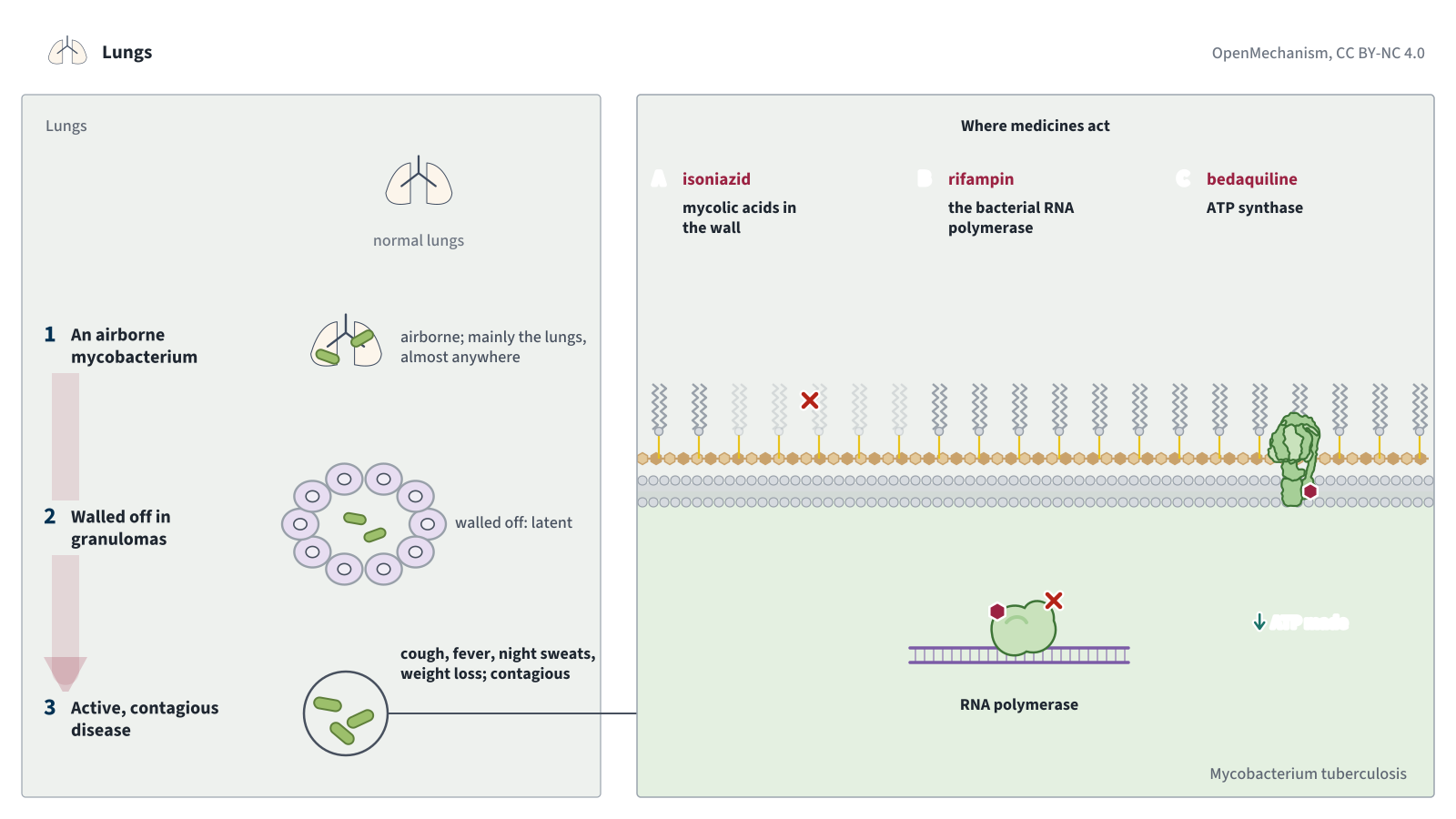
For teachers: download this drawing.
Key terms in this drawing
- ATP
- Adenosine triphosphate. The molecule cells use to carry energy.
- RNA
- Ribonucleic acid. A molecule copied from DNA; messenger RNA carries a gene's instructions.
What goes wrong
An airborne mycobacterium. Tuberculosis is an airborne infection with Mycobacterium tuberculosis; it mainly affects the lungs but can affect almost any part of the body.1
What the source says
“Tuberculosis (TB) is an airborne infectious disease caused by organisms of the Mycobacterium tuberculosis complex. Although primarily a pulmonary pathogen, M. tuberculosis can cause disease in almost any part of the body.”
Source 1Walled off in granulomas. The body can contain the bacteria inside granulomas, as latent infection.1
What the source says
“Infection with M. tuberculosis can evolve from containment in the host, in which the bacteria are isolated within granulomas (latent TB infection)”
Source 1Active, contagious disease. Infection can become active and contagious, with cough, fever, night sweats and weight loss; only active lung TB spreads.1
What the source says
“to a contagious state, in which the patient will show symptoms that can include cough, fever, night sweats and weight loss. Only active pulmonary TB is contagious.”
Source 1
Where medicines act
- A
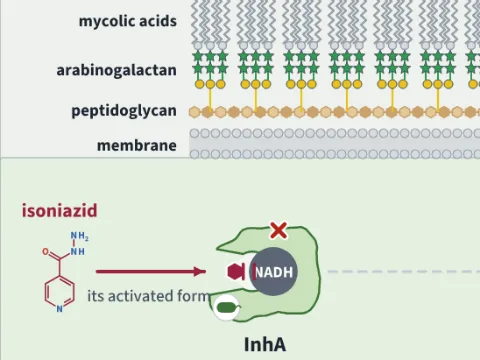
Isoniazid: the cell wall blocked
Isoniazid blocks the making of mycolic acids, an essential part of the mycobacterial cell wall, and kills growing TB bacteria. It is used for all forms of TB with susceptible bacteria.2
- B
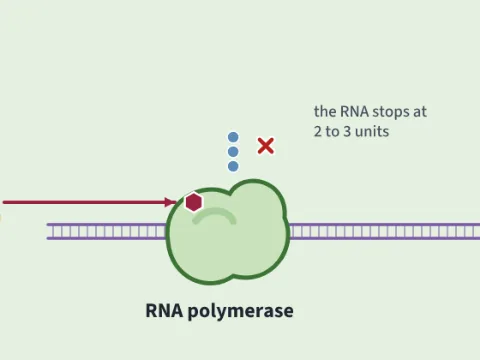
Rifampin: the bacterial RNA polymerase blocked
Rifampin blocks the DNA-dependent polymerase of TB bacteria, but not the human enzyme.3
What the source says
“Rifampin inhibits DNA-dependent RNA polymerase activity in susceptible Mycobacterium tuberculosis organisms. Specifically, it interacts with bacterial RNA polymerase but does not inhibit the mammalian enzyme.”
Source 3 - C
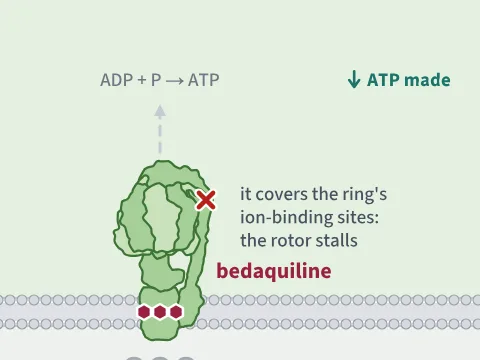
Bedaquiline: the energy supply cut
Bedaquiline blocks the mycobacterial synthase, which the bacterium needs to make energy. With other medicines, it treats lung TB resistant to rifampin and isoniazid.4
What the source says
“SIRTURO is a diarylquinoline antimycobacterial drug that inhibits mycobacterial ATP (adenosine 5'- triphosphate) synthase, by binding to subunit c of the enzyme that is essential for the generation of energy in M. tuberculosis .”
Source 4“with pulmonary tuberculosis (TB) due to Mycobacterium tuberculosis resistant to at least rifampin and isoniazid.”
Source 4
See also
Body systems: infections and lungs & airways.
Also used for it: methylprednisolone (“fulminating or disseminated pulmonary tuberculosis when used concurrently with appropriate antituberculous chemotherapy”5), hydrocortisone (“fulminating or disseminated pulmonary tuberculosis when used concurrently with appropriate antituberculous chemotherapy”6) and dexamethasone (“Fulminating or disseminated pulmonary tuberculosis when used concurrently with appropriate antituberculous chemotherapy”7).
Related medicines: linezolid and prednisone.
Other conditions: asthma, adrenal insufficiency, ankylosing spondylitis, Crohn disease, gout and high calcium from cancer.
Interactions: rifampin and other medicines; and isoniazid and phenytoin.
Side effects: why isoniazid can damage nerves; why linezolid can cause lactic acidosis and nerve damage; and why TNF blockers such as adalimumab raise the risk of tuberculosis.
Sources
- 1TuberculosisPai M et al. Nat Rev Dis Primers 2016 (abstract). Saved copy
- 2Isoniazid tablets: FDA labelIndications and Usage; Clinical Pharmacology. Saved copy
- 3Rifadin (rifampin): FDA labelMechanism of Action. Saved copy
- 4Sirturo (bedaquiline): FDA label1 Indications and Usage; 12.4 Mechanism of Action. Saved copy
- 5Solu-Medrol (methylprednisolone sodium succinate): FDA labelIndications and Usage. Saved copy
- 6Solu-Cortef (hydrocortisone sodium succinate): FDA labelIndications and Usage. Saved copy
- 7Dexamethasone sodium phosphate injection: FDA labelIndications and Usage. Saved copy
- 8Mycobacterium smegmatis ATP synthase with bedaquilinePDB 7JGA; Guo, H. et al. Nature 2021;589:143-147. The ATP synthase outline in the drawing is traced from this structure. Saved copy
Notes and limits
- Treatment needs a long course of several medicines, and drug-resistant TB is a major concern.1
Notes that apply to every page are on How to read a page.
Spotted a mistake? Report an error (hello@openmechanism.com). Since launch, every published error we fix is listed on the corrections page.
Cite this page
Tran D. Tuberculosis [Internet]. OpenMechanism; 2026 [updated 2026 Oct 21; cited 2026 Oct 21]. Available from: https://openmechanism.com/conditions/tuberculosis