Miltefosine
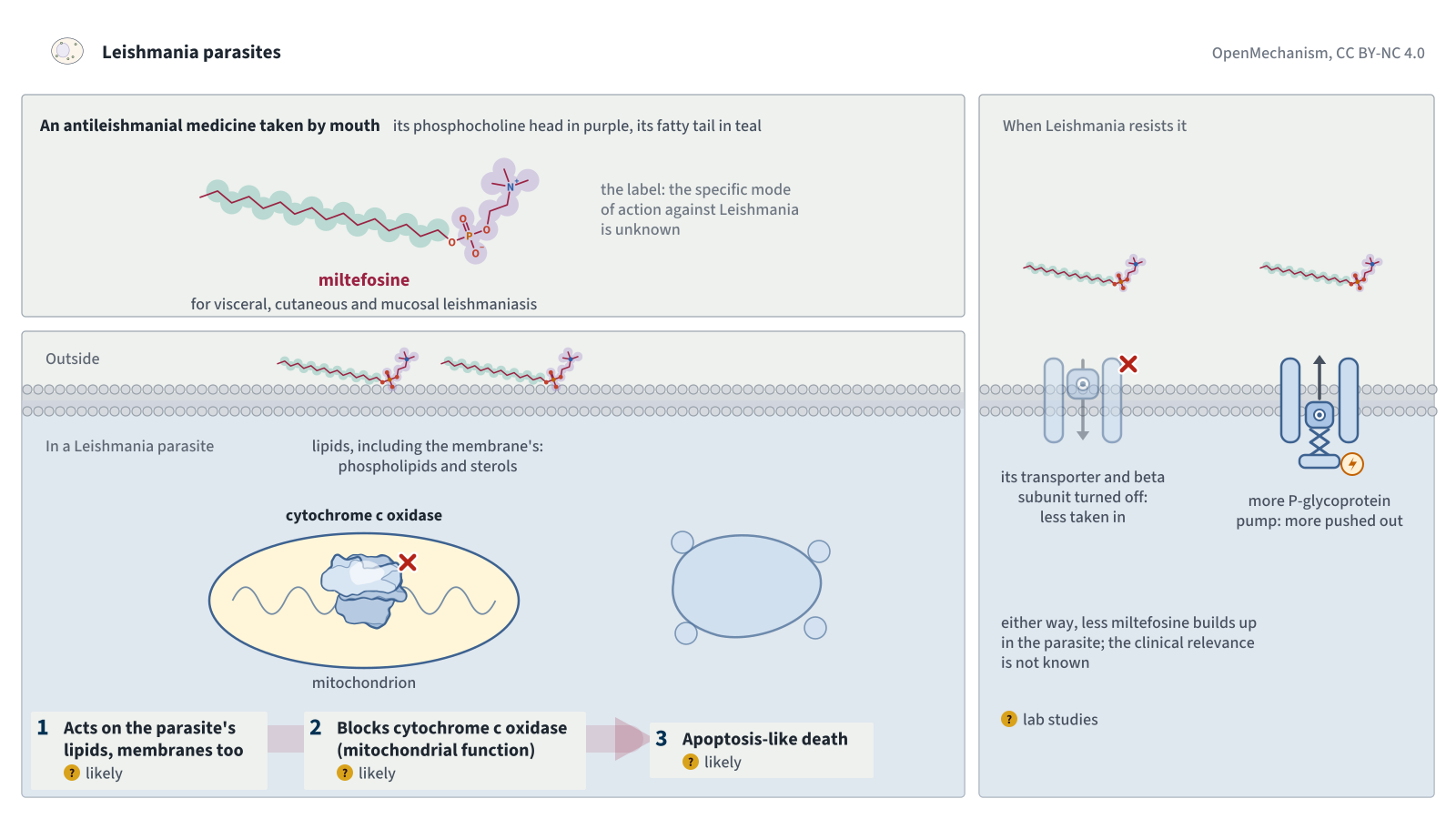
The label says miltefosine's specific mode of action against Leishmania is unknown. It is likely to involve interaction with the parasite's lipids, including its membranes, inhibition of cytochrome c oxidase in its mitochondria, and apoptosis-like death of the parasite.
- Acts on
- Leishmania membrane lipids and cytochrome c oxidase (likely)
- Where
- Leishmania parasites
- Medicine type
- Small molecule
- Used for
- Infections
Also called Impavido.
Step 1: likely
The Impavido (miltefosine) label says: The specific mode of action of miltefosine against Leishmania species is unknown. … The mechanism of action of miltefosine is likely to involve interaction with lipids (phospholipids and sterols), including membrane lipids, inhibition of cytochrome c oxidase (mitochondrial function), and apoptosis-like cell death.
Source 1: Impavido (miltefosine): FDA label, 11 Description; 12.4 Microbiology: Mechanism of Action
Clinical study: In a randomized, open-label trial in India, 299 people with visceral leishmaniasis took miltefosine by mouth and 99 had amphotericin B infusions; the trial measured cure, not how miltefosine works: By six months after the completion of treatment, 282 of the 299 patients in the miltefosine group (94 percent [95 percent confidence interval, 91 to 97]) and 96 of the 99 patients in the amphotericin B group (97 percent) had not had a relapse; these patients were classified as cured.
Sundar S et al., N Engl J Med 2002 (PMID 12456849)
This study was picked with a literature search and is not yet checked by our reviewer.
Step 2: likely
The Impavido (miltefosine) label says: The mechanism of action of miltefosine is likely to involve interaction with lipids (phospholipids and sterols), including membrane lipids, inhibition of cytochrome c oxidase (mitochondrial function), and apoptosis-like cell death.
Source 1: Impavido (miltefosine): FDA label, 11 Description; 12.4 Microbiology: Mechanism of Action
Clinical study: In a randomized, open-label trial in India, 299 people with visceral leishmaniasis took miltefosine by mouth and 99 had amphotericin B infusions; the trial measured cure, not how miltefosine works: By six months after the completion of treatment, 282 of the 299 patients in the miltefosine group (94 percent [95 percent confidence interval, 91 to 97]) and 96 of the 99 patients in the amphotericin B group (97 percent) had not had a relapse; these patients were classified as cured.
Sundar S et al., N Engl J Med 2002 (PMID 12456849)
This study was picked with a literature search and is not yet checked by our reviewer.
Step 3: likely
The Impavido (miltefosine) label says: The mechanism of action of miltefosine is likely to involve interaction with lipids (phospholipids and sterols), including membrane lipids, inhibition of cytochrome c oxidase (mitochondrial function), and apoptosis-like cell death.
Source 1: Impavido (miltefosine): FDA label, 11 Description; 12.4 Microbiology: Mechanism of Action
Clinical study: In a randomized, open-label trial in India, 299 people with visceral leishmaniasis took miltefosine by mouth and 99 had amphotericin B infusions; the trial measured cure, not how miltefosine works: By six months after the completion of treatment, 282 of the 299 patients in the miltefosine group (94 percent [95 percent confidence interval, 91 to 97]) and 96 of the 99 patients in the amphotericin B group (97 percent) had not had a relapse; these patients were classified as cured.
Sundar S et al., N Engl J Med 2002 (PMID 12456849)
This study was picked with a literature search and is not yet checked by our reviewer.
Lab studies
The Impavido (miltefosine) label says: Drug resistance could be due to a decrease in miltefosine accumulation within Leishmania parasite which is thought to be due to either an increase in drug efflux, mediated by the overexpression of the ABC transporter P-glycoprotein and/or a decrease in drug uptake by the inactivation of the miltefosine transport machinery that consists of the miltefosine transporter and its beta subunit. … However, the clinical relevance of these findings is not known.
Source 1: Impavido (miltefosine): FDA label, 11 Description; 12.4 Microbiology: Mechanism of Action
Clinical study: In a randomized, open-label trial in India, 299 people with visceral leishmaniasis took miltefosine by mouth and 99 had amphotericin B infusions; the trial measured cure and relapse, not resistance in the parasites: By six months after the completion of treatment, 282 of the 299 patients in the miltefosine group (94 percent [95 percent confidence interval, 91 to 97]) and 96 of the 99 patients in the amphotericin B group (97 percent) had not had a relapse; these patients were classified as cured.
Sundar S et al., N Engl J Med 2002 (PMID 12456849)
This study was picked with a literature search and is not yet checked by our reviewer.
How it works
Acts on the parasite's lipids, membranes too. The mechanism of action of miltefosine is likely to involve interaction with lipids (phospholipids and sterols), including membrane lipids.1
Blocks cytochrome c oxidase (mitochondrial function). It is likely to involve inhibition of cytochrome c oxidase (mitochondrial function).1
Apoptosis-like death. It is likely to involve apoptosis-like cell death.1
For teachers: download this drawing.
See also
Condition pages: leishmaniasis.
More medicines for infections: acyclovir; albendazole; amoxicillin; amoxicillin and clavulanate; amphotericin B; artesunate; atovaquone; azithromycin; and 51 more.
Body system: infections.
Sources
- 1Impavido (miltefosine): FDA label11 Description; 12.4 Microbiology: Mechanism of Action
- 2ChEMBL CHEMBL125Target and action classification: Unknown
- 3Oral miltefosine for Indian visceral leishmaniasisSundar S et al. N Engl J Med 2002 (abstract)
Also used for the drawing
The cytochrome c oxidase outline is traced from the crystal structure below.
- 4Bovine heart cytochrome c oxidase, fully oxidized (the catalytic core, subunits I to III, drawn)PDB 5B1A; Yano, N. et al. J.Biol.Chem. 2016; 291:23882-23894
Spotted a mistake? Report an error (hello@openmechanism.com). Since launch, every published error we fix is listed on the corrections page.
Notes and limits
- A schematic teaching drawing: not to scale, not exact structures, binding poses or a complete pathway, and not a guide to dosing, treatment or how a person will respond.
- The label says the specific mode of action of miltefosine against Leishmania is unknown; these are the mechanisms it is likely to involve.
All recorded limits are on the evidence page, and notes that apply to every page are on How to read a page. Version 1.0.0, not yet medically reviewed.
Cite this page
Tran D. Miltefosine [Internet]. OpenMechanism; 2026 [updated 2026 Oct 16; cited 2026 Oct 16]. Available from: https://openmechanism.com/medicines/miltefosine