Bulevirtide
Hepatitis B and D viruses enter liver cells by binding , a bile salt transporter, with the part of their envelope protein. Bulevirtide, made from preS1, binds NTCP and blocks this, so the viruses cannot dock. In mice with human liver cells, it stopped hepatitis B virus spreading to new cells.
- Acts on
- NTCP (sodium taurocholate co-transporting polypeptide) on liver cells
- Where
- Liver cells (hepatitis B and D viruses)
- Medicine type
- Protein
- Used for
- Infections
- Drug class
- Antivirals
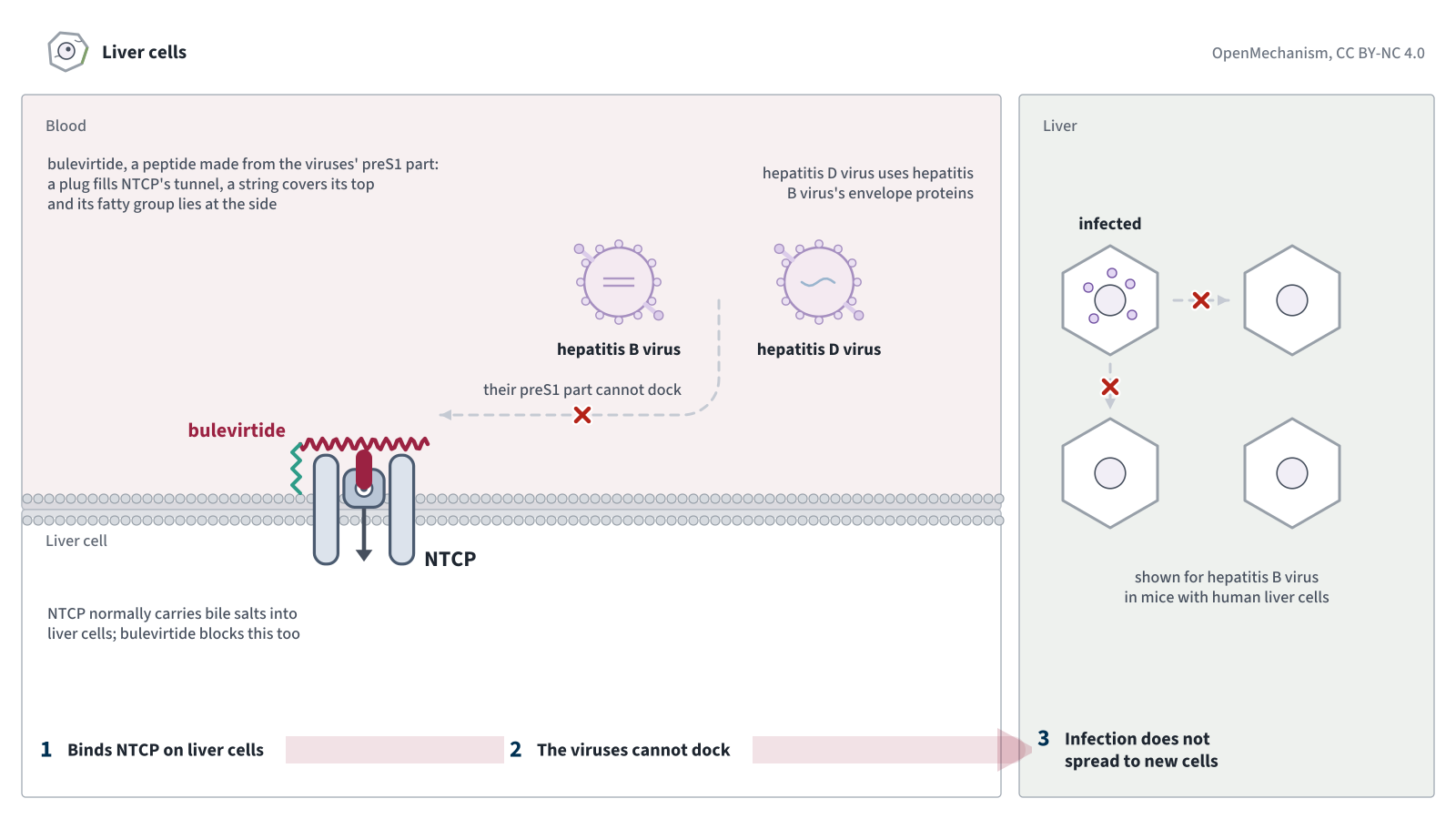
Key terms in this drawing
- NTCP
- Sodium taurocholate co-transporting polypeptide. A liver cell protein that carries bile salts into the cell; hepatitis B and D viruses dock on it, and bulevirtide blocks it.
- preS1
- Pre-S1 part of the hepatitis B surface protein. The part of the hepatitis B and D virus surface that docks on NTCP; bulevirtide is a peptide copied from it.
How it works
Binds NTCP on liver cells. Bulevirtide (formerly Myrcludex B), a derivative of the viral preS1 polypeptide, binds NTCP, a bile salt transporter of liver cells: one part plugs NTCP's bile salt tunnel, a string-like part covers its outer surface, and its fatty (myristoyl) group touches the receptor's lipid-facing surface.1,2
The viruses cannot dock. Hepatitis B and D viruses enter liver cells by binding the preS1 part of their envelope protein to NTCP; bulevirtide blocks this interaction.1,3
Infection does not spread to new cells. In mice with human liver cells infected with hepatitis B virus, Myrcludex B (bulevirtide) prevented the virus spreading from the first infected cells.4
For teachers: download this drawing.
See also
Condition pages: hepatitis B and hepatitis D.
Other antivirals: acyclovir; baloxavir marboxil; darunavir; doravirine; enfuvirtide; glecaprevir and pibrentasvir; lenacapavir; nirmatrelvir; and 6 more.
Body system: infections.
Sources
- 1Structure of antiviral drug bulevirtide bound to hepatitis B and D virus receptor protein NTCPLiu H et al., Nat Commun 2024 (abstract)
- 2Hepatitis B and D viruses exploit sodium taurocholate co-transporting polypeptide for species-specific entry into hepatocytesNi Y et al., Gastroenterology 2014 (abstract)
- 3Sodium taurocholate cotransporting polypeptide is a functional receptor for human hepatitis B and D virusYan H et al., Elife 2012 (abstract)
- 4The entry inhibitor Myrcludex-B efficiently blocks intrahepatic virus spreading in humanized mice previously infected with hepatitis B virusVolz T et al., J Hepatol 2013 (abstract)
- 5ChEMBL CHEMBL4297711Target and action classification: Bile acid transporter inhibitor
Also used for the drawing
The drawing also shows the two viruses that use NTCP, what bulevirtide is made from, and NTCP's own job. These sources support those parts; the steps above come from the sources listed above.
- 6Efficient inhibition of hepatitis B virus infection by acylated peptides derived from the large viral surface proteinGripon P et al., J Virol 2005 (abstract)
- 7Bulevirtide: first approvalKang C, Syed YY, Drugs 2020 (abstract)
- 8Bulevirtide: ChEMBL CHEMBL4297711synonyms and molecule type from the Atlas catalog snapshot
- 9Taurocholic acid: PubChem CID 6675isomeric SMILES
Spotted a mistake? Report an error (hello@openmechanism.com). Since launch, every published error we fix is listed on the corrections page.
Notes and limits
- A schematic teaching drawing: not to scale, not exact structures, binding poses or a complete pathway, and not a guide to dosing, treatment or how a person will respond.
- Built from published abstracts; no FDA label for bulevirtide was available to the source tools.
- Shown for hepatitis B virus in mice with human liver cells (per the study).
All recorded limits are on the evidence page, and notes that apply to every page are on How to read a page. Version 1.0.0, not yet medically reviewed.
Cite this page
Tran D. Bulevirtide [Internet]. OpenMechanism; 2026 [updated 2026 Oct 15; cited 2026 Oct 15]. Available from: https://openmechanism.com/medicines/bulevirtide