Doxycycline
Doxycycline binds the small part () of the bacterial ribosome. This blocks protein making in bacteria, and a broad range of bacteria stop growing. It has also been found to act on the asexual forms of malaria parasites in red blood cells, by a mechanism the label says is not known. It is almost fully absorbed, but antacids containing aluminum, calcium or magnesium, iron and bismuth subsalicylate in the gut cut its absorption. Its label lists it for many infections caused by susceptible bacteria, among them rickettsial infections, plague and cholera, and for some, such as syphilis, only when penicillin is ruled out; as a possibly useful add-on in severe acne; and to prevent Plasmodium falciparum malaria in short-term travelers (under 4 months) to areas where strains resist chloroquine or pyrimethamine-sulfadoxine.
- Acts on
- The bacterial ribosome's 30S (small) subunit
- Where
- Bacterial ribosomes
- Medicine type
- Small molecule
- Used for
- Infections
- Drug class
- Antibiotics
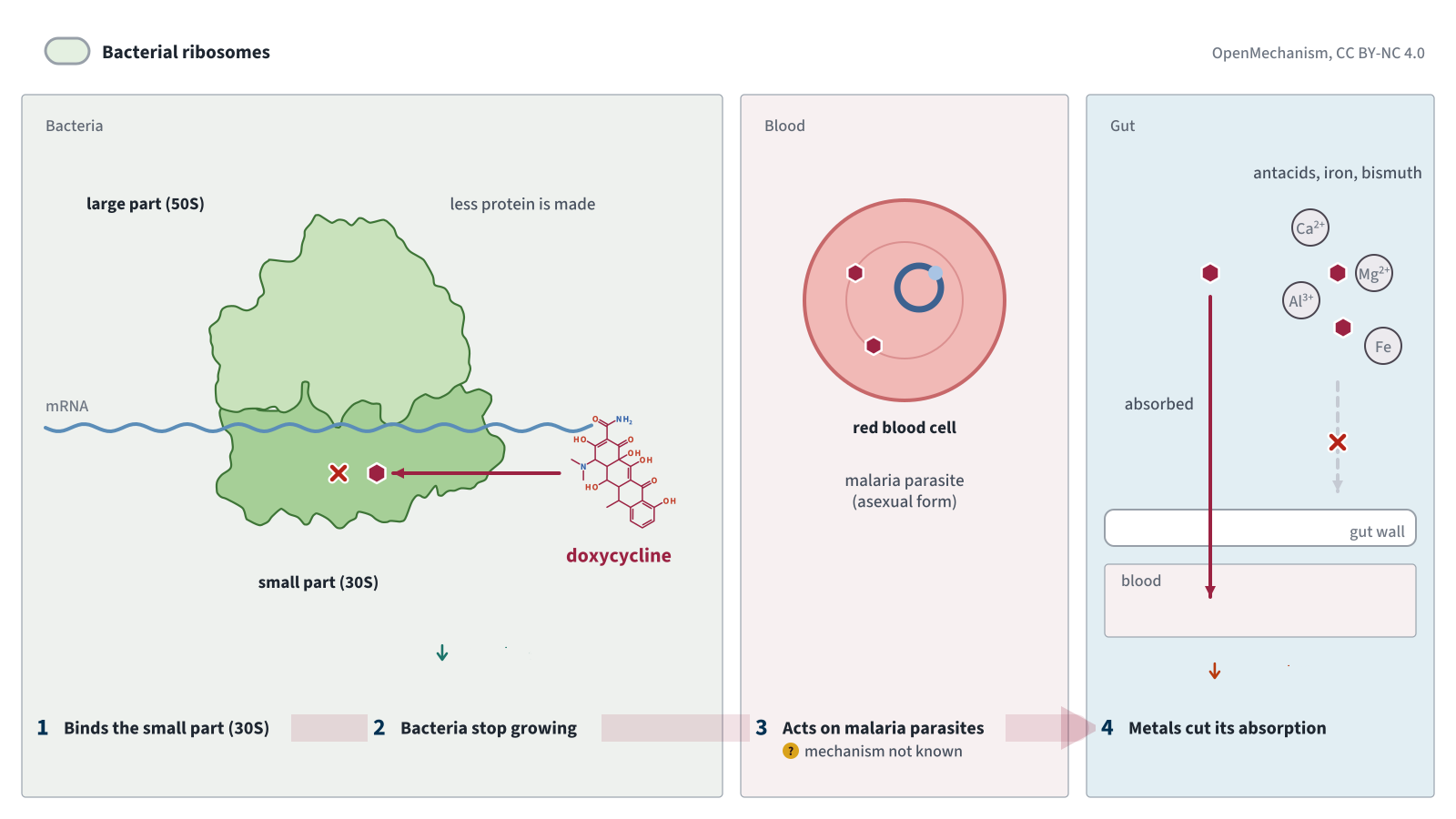
Step 3: mechanism not known
The doxycycline hyclate label says: Doxycycline has been found to be active against the asexual erythrocytic forms of Plasmodium falciparum, but not against the gametocytes of P. falciparum . The precise mechanism of action of the drug is not known. … Doxycycline offers substantial but not complete suppression of the asexual blood stages of Plasmodium strains.
Clinical study: In Ohrt and colleagues' 1997 randomized, double-blind, placebo-controlled field trial of malaria prevention in northeastern Irian Jaya, Indonesia, 204 Indonesian soldiers, first treated to clear any malaria, were assigned to doxycycline 100 mg a day, mefloquine 250 mg a week (after a 3-day loading dose) or placebo for about 13 weeks; the trial measured who developed malaria, not how doxycycline works: In the placebo group, 53 of 69 soldiers developed malaria (9.1 person-years) … In the doxycycline group, P. falciparum malaria occurred in 1 of 67 soldiers (16.0 person-years), yielding a protective efficacy of 99% (CI, 94% to 100%).
Ohrt C et al., Ann Intern Med 1997 (PMID 9182474)
Key terms in this drawing
- 30S
- 30S ribosomal subunit. The small part of the bacterial ribosome.
- 50S
- 50S ribosomal subunit. The large part of the bacterial ribosome.
- mRNA
- Messenger RNA. A copy of a gene that a cell reads to make a protein.
How it works
Binds the small part (30S). Doxycycline binds the 30S (small) subunit of the bacterial ribosome.1
Bacteria stop growing. This inhibits bacterial protein synthesis: doxycycline is bacteriostatic against a broad range of Gram-positive and Gram-negative bacteria.1
Acts on malaria parasites. Doxycycline has been found to be active against the asexual forms of Plasmodium falciparum in red blood cells, but not against its gametocytes, the parasite's sexual blood stage; the label says the precise mechanism is not known.1
Metals cut its absorption. Doxycycline is virtually completely absorbed after oral administration, but antacids containing aluminum, calcium or magnesium, iron-containing preparations and bismuth subsalicylate impair the absorption of tetracyclines. The label adds that taking doxycycline with food or milk does not markedly affect its absorption.1
For teachers: download this drawing.
See also
Condition pages: acne, malaria, syphilis and urinary tract infections.
Other antibiotics: amoxicillin; amoxicillin and clavulanate; azithromycin; bedaquiline; ceftazidime and avibactam; ceftriaxone; cephalexin; ciprofloxacin; and 14 more.
Explained: antibiotics and antacids, calcium or iron; and why tetracyclines can stain developing teeth.
Body system: infections.
Sources
- 1Doxycycline hyclate: FDA labelIndications and Usage; Clinical Pharmacology; Microbiology; Drug Interactions; Precautions
- 2ChEMBL CHEMBL1433Target and action classification: Bacterial 70S ribosome inhibitor; Matrix metalloproteinase 13 inhibitor; Matrix metalloproteinase 7 inhibitor; Matrix metalloproteinase 8 inhibitor; Matrix metalloproteinase-1 inhibitor
- 3Mefloquine compared with doxycycline for the prophylaxis of malaria in Indonesian soldiers. A randomized, double-blind, placebo-controlled trialOhrt C et al. Ann Intern Med 1997 (abstract)
Also used for the drawing
The ribosome outline is traced from the electron microscopy structure below.
- 4Escherichia coli stalled ribosome with linezolidPDB 7S1G; Tsai, K. et al. Nat.Struct.Mol.Biol. 2022; 29:162-171
Spotted a mistake? Report an error (hello@openmechanism.com). Since launch, every published error we fix is listed on the corrections page.
Notes and limits
- A schematic teaching drawing: not to scale, not exact structures, binding poses or a complete pathway, and not a guide to dosing, treatment or how a person will respond.
- The steps are in the order that explains them; one step is said to cause the next only where the source says so.
- The label says doxycycline is active against the asexual erythrocytic forms of Plasmodium falciparum but not the gametocytes, and that the precise mechanism of action of the medicine is not known.
All recorded limits are on the evidence page, and notes that apply to every page are on How to read a page. Version 1.0.1, medically reviewed by Daniel Tran, PharmD, on 6 November 2026.
Cite this page
Tran D. Doxycycline [Internet]. OpenMechanism; 2026 [updated 2026 Nov 6; cited 2026 Nov 6]. Available from: https://openmechanism.com/medicines/doxycycline