Bloodstream infections and endocarditis
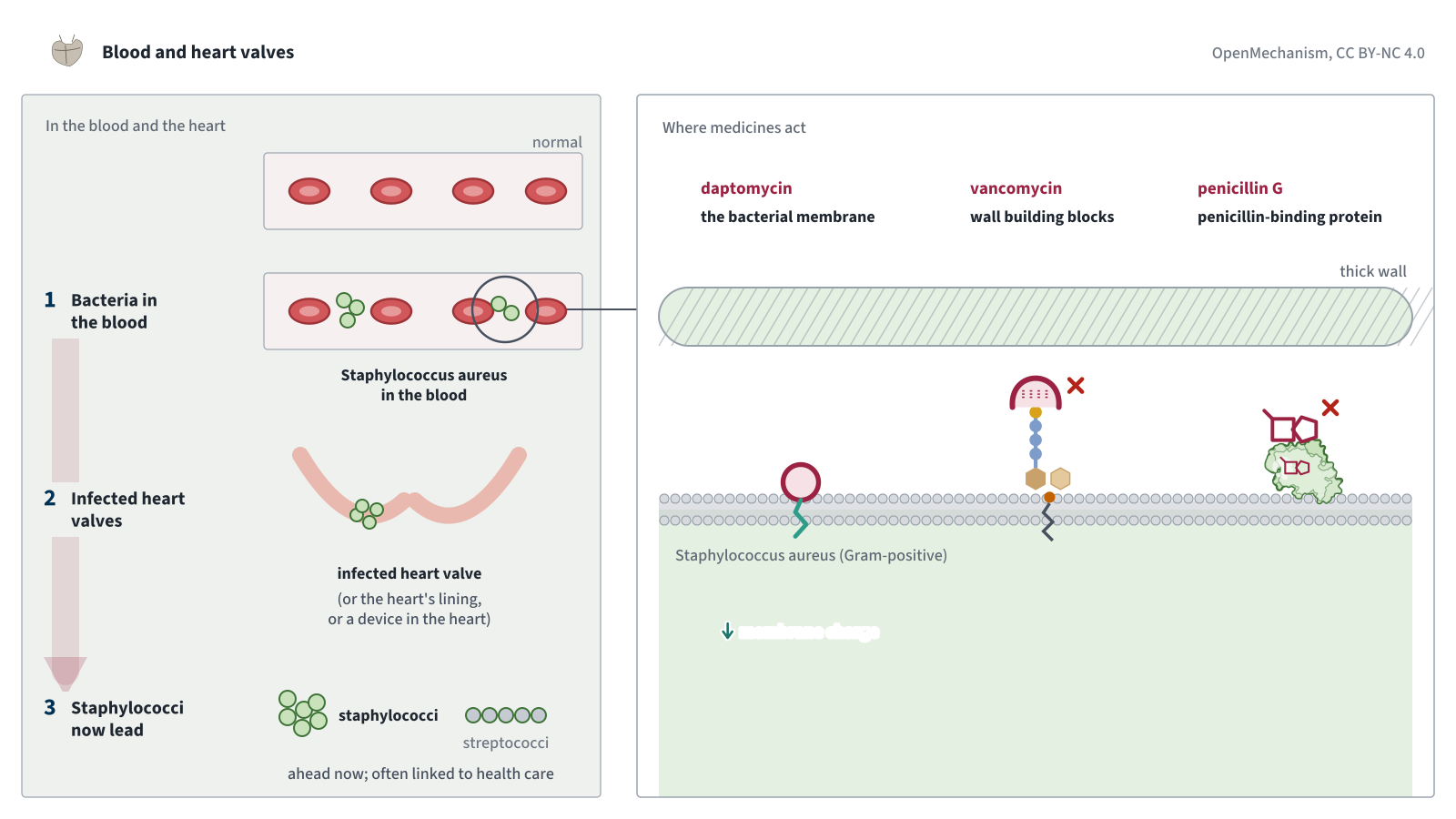
Staphylococcus aureus is a leading cause of bloodstream infection (bacteremia) and of infective endocarditis, infection of a heart valve, the heart's lining or a device inside the heart. Staphylococci, often linked to health care, now cause more endocarditis than streptococci, and 30% of people die within a year. Daptomycin, vancomycin and penicillin G are used.
- Where
- Blood and heart valves
- Body systems
- Infections; Heart, vessels & cholesterol; Blood & clotting
- Medicines
- 3 medicines
For teachers: download this drawing.
Key terms in this drawing
- PBP
- Penicillin-binding protein. A bacterial enzyme that builds the cell wall; beta-lactam antibiotics, such as penicillins and cephalosporins, bind it.
What goes wrong
Bacteria in the blood. Staphylococcus aureus is a major cause of many infections and a leading cause of bloodstream infection and of endocarditis.1
What the source says
“It is a leading cause of bacteremia and infective endocarditis”
Source 1Infected heart valves. Infective endocarditis is infection of a natural or artificial heart valve, the heart's inner lining, or a device inside the heart.2
What the source says
“Infective endocarditis occurs worldwide, and is defined by infection of a native or prosthetic heart valve, the endocardial surface, or an indwelling cardiac device.”
Source 2Staphylococci now lead. Staphylococci, often linked to health care and invasive procedures, have overtaken streptococci as the most common cause.2
What the source says
“staphylococci, most often associated with health-care contact and invasive procedures, have overtaken streptococci as the most common cause of the disease.”
Source 2
Where medicines act
- A
Daptomycin: the bacterial membrane's charge lost
Daptomycin binds the bacterial membrane and quickly discharges it. It treats Staphylococcus aureus bloodstream infections in adults, including right-sided endocarditis; a 2014 review calls vancomycin and daptomycin the first-line antibiotic choices for MRSA bacteremia.3,4
What the source says
“Daptomycin binds to bacterial cell membranes and causes a rapid depolarization of membrane potential.”
Source 3“Staphylococcus aureus bloodstream infections (bacteremia), in adult patients including those with right-sided infective endocarditis,”
Source 3“Vancomycin and daptomycin are the first-line antibiotic choices for MRSA bacteremia.”
Source 4 - B
Vancomycin: wall building blocked
Vancomycin mainly blocks the building of the bacterial wall. It is effective in staphylococcal endocarditis and bloodstream infection (septicemia).5
What the source says
“results primarily from inhibition of cell-wall biosynthesis.”
Source 5“Vancomycin Hydrochloride for Injection is effective in the treatment of staphylococcal endocarditis.”
Source 5“including septicemia, bone infections, lower respiratory tract infections, skin and skin structure infections.”
Source 5 - C
Penicillin G: the bacterial wall broken
Penicillin G blocks the building of the bacterial wall. It treats bloodstream infection and endocarditis caused by susceptible streptococci and other bacteria.6



See also
Body systems: infections; heart, vessels & cholesterol; and blood & clotting.
Also used for it: gentamicin (“Clinical studies have shown Gentamicin Sulfate Injection, USP to be effective in bacterial neonatal sepsis; bacterial septicemia; and serious bacterial infections of the central nervous system (meningitis), urinary tract, respiratory tract, gastrointestinal tract (including peritonitis), skin, bone and soft tissue (including burns). … It has also been found effective when used in conjunction with a penicillin-type drug for the treatment of endocarditis caused by group D streptococci.”7); and ceftriaxone (for bacterial septicemia, a bloodstream infection: “Bacterial Septicemia Caused by Staphylococcus aureus, Streptococcus pneumoniae, Escherichia coli, Haemophilus influenzae or Klebsiella pneumoniae .”8).
Related medicines: clindamycin.
Other conditions: blood clots on artificial heart valves; skin and soft-tissue infections; pneumonia; antibiotic-resistant infections; urinary tract infections; and C. difficile infection.
Side effects: why fast vancomycin infusions cause flushing; why gentamicin can damage hearing and balance; and why vancomycin can harm the kidneys.
Sources
- 1Staphylococcus aureus infections: epidemiology, pathophysiology, clinical manifestations, and managementTong SY et al. Clin Microbiol Rev 2015 (abstract). Saved copy
- 2Infective endocarditisCahill TJ, Prendergast BD. Lancet 2016 (abstract). Saved copy
- 3Daptomycin for injection: FDA label1 Indications and Usage; 12.4 Microbiology. Saved copy
- 4Clinical management of Staphylococcus aureus bacteremia: a reviewHolland TL et al. JAMA 2014 (abstract). Saved copy
- 5Vancomycin hydrochloride for injection: FDA labelIndications and Usage; Microbiology. Saved copy
- 6Pfizerpen (penicillin G potassium): FDA labelIndications and Usage; Microbiology. Saved copy
- 7Gentamicin sulfate injection (Hospira): FDA labelIndications and Usage. Saved copy
- 8Ceftriaxone for injection (Hospira): FDA labelIndications and Usage. Saved copy
- 9Streptococcus pneumoniae penicillin-binding protein 2x acyl-enzyme complexPDB 1QMF; Gordon, E.J. et al. J.Mol.Biol. 2000;299:501. The penicillin-binding protein outline in the drawing is traced from this structure. Saved copy
Notes and limits
- The daptomycin label says it is not for left-sided S. aureus endocarditis.3
- Better studies of how to treat S. aureus bacteremia are needed, and whether to give antibiotics to prevent endocarditis is still debated.2,4
Notes that apply to every page are on How to read a page.
Spotted a mistake? Report an error (hello@openmechanism.com). Since launch, every published error we fix is listed on the corrections page.
Cite this page
Tran D. Bloodstream infections and endocarditis [Internet]. OpenMechanism; 2026 [updated 2026 Nov 18; cited 2026 Nov 18]. Available from: https://openmechanism.com/conditions/bloodstream-infections-and-endocarditis