Ciprofloxacin
Ciprofloxacin, a fluoroquinolone, blocks gyrase and , bacterial enzymes needed to copy, read and repair DNA. The label says its bacteria-killing action results from blocking these enzymes. Its label lists it for infections caused by susceptible bacteria in adults, and for a few in children, though the label says it is not a first choice in children, because side effects, including problems in the joints and nearby tissues, were more common than in the comparison groups. For simple bladder infections, acute sinusitis and flare-ups of chronic bronchitis, the label reserves it for patients with no other treatment option, because fluoroquinolones have been associated with serious adverse reactions and, for some patients, these infections clear on their own.
- Acts on
- DNA gyrase, topoisomerase IV
- Where
- Bacterial DNA
- Medicine type
- Small molecule
- Used for
- Infections
- Drug class
- Antibiotics
Also called Cipro.
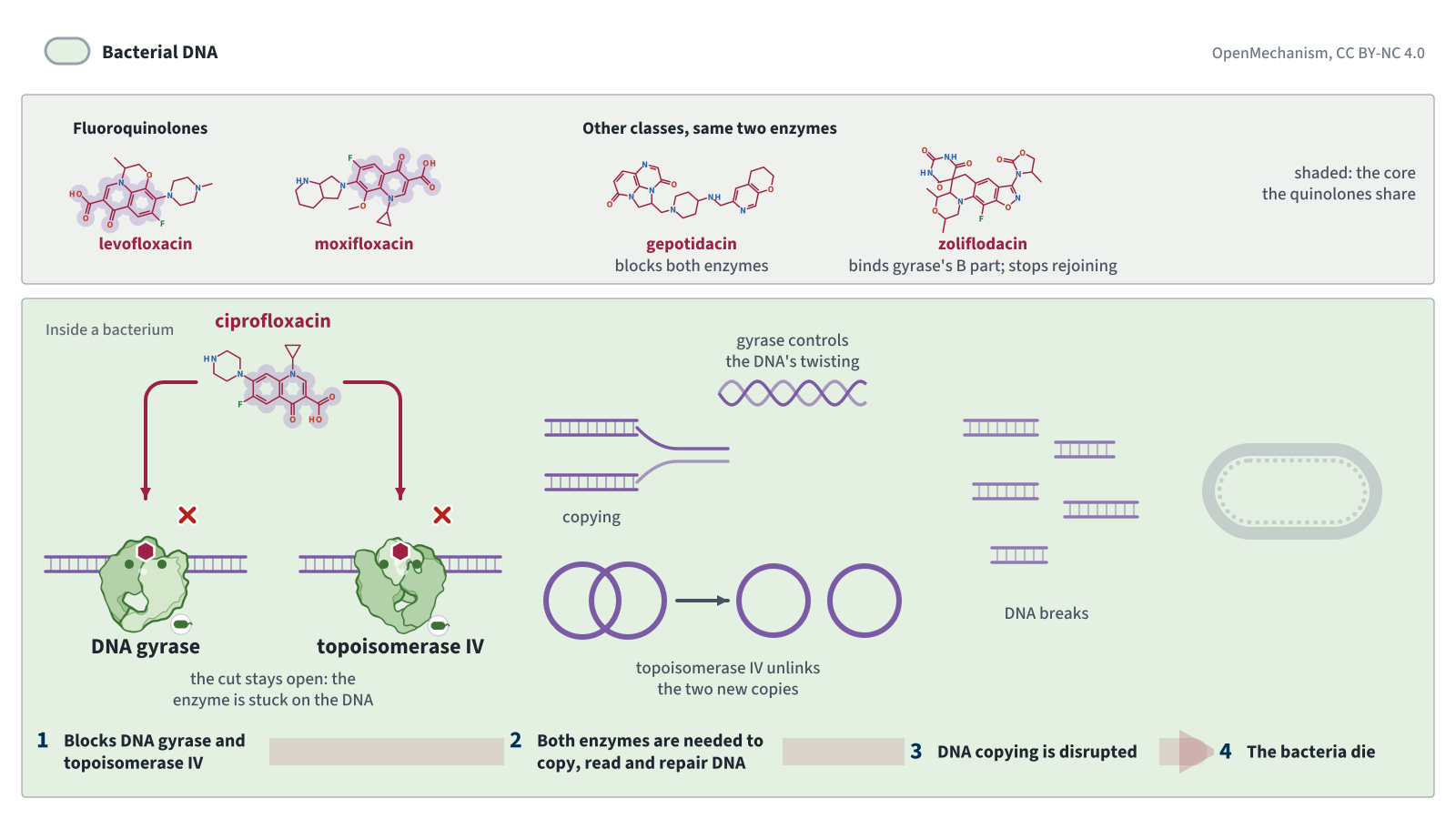
Key terms in this drawing
- DNA
- Deoxyribonucleic acid. The molecule that stores genes.
- topoisomerase IV
- Topoisomerase IV. A bacterial enzyme, like DNA gyrase, needed to copy, read, repair and recombine the bacterium's DNA; ciprofloxacin blocks it.
How it works
Blocks DNA gyrase and topoisomerase IV. Ciprofloxacin inhibits bacterial DNA gyrase and topoisomerase IV.1
Both enzymes are needed to copy, read and repair DNA. These enzymes are required for replication, transcription, repair and recombination.1
DNA copying is disrupted. Blocking them disrupts these DNA processes.1
The bacteria die. The label says ciprofloxacin's bactericidal (bacteria-killing) action results from inhibiting these enzymes.1
For teachers: download this drawing or build a slide deck.
See also
Condition pages: antibiotic-resistant infections; skin and soft-tissue infections; and urinary tract infections.
Other antibiotics: amoxicillin; amoxicillin and clavulanate; azithromycin; bedaquiline; ceftazidime and avibactam; ceftriaxone; cephalexin; clindamycin; and 14 more.
Explained: antibiotics and antacids, calcium or iron; why fluoroquinolones such as ciprofloxacin can damage tendons; and tizanidine with ciprofloxacin or fluvoxamine.
Body system: infections.
Sources
- 1Cipro (ciprofloxacin): FDA label1 Indications and Usage; 12.4 Microbiology: Mechanism of Action
- 2ChEMBL CHEMBL8Target and action classification: Bacterial DNA gyrase inhibitor; Topoisomerase IV inhibitor
Also used for the drawing
The drawing also shows the other fluoroquinolones and two other classes that block the same enzymes, what the two enzymes do, and how a quinolone traps them on cut DNA. These sources support those parts; the steps above come from the sources listed above. The DNA gyrase and topoisomerase IV outlines are traced from the crystal structures below.
- 3Levofloxacin injection: FDA label12.4 Microbiology: Mechanism of Action
- 4Blujepa (gepotidacin): FDA label12.4 Microbiology: Mechanism of Action
- 5Nuzolvence (zoliflodacin): FDA label12.4 Microbiology: Mechanism of Action
- 6DNA gyrase, topoisomerase IV, and the 4-quinolonesDrlica K, Zhao X, Microbiol Mol Biol Rev 1997 (abstract)
- 7Quinolones: action and resistance updatedDrlica K et al., Curr Top Med Chem 2009 (abstract)
- 8Mechanism of quinolone action and resistanceAldred KJ et al., Biochemistry 2014 (abstract)
- 9
- 10Staphylococcus aureus DNA gyrase with ciprofloxacin and DNAPDB 2XCT; Bax, B.D. et al. Nature 2010; 466:935
- 11Streptococcus pneumoniae topoisomerase IV with levofloxacin and DNAPDB 3RAE; Veselkov, D.A. et al. Acta Crystallogr.,Sect.D 2016; 72:488-496
Spotted a mistake? Report an error (hello@openmechanism.com). Since launch, every published error we fix is listed on the corrections page.
Notes and limits
- A schematic teaching drawing: not to scale, not exact structures, binding poses or a complete pathway, and not a guide to dosing, treatment or how a person will respond.
- The steps are in the order that explains them; one step is said to cause the next only where the source says so.
- No DNA-break geometry or exact enzyme-inhibitor conformation is reconstructed.
All recorded limits are on the evidence page, and notes that apply to every page are on How to read a page. Version 1.0.1, medically reviewed by Daniel Tran, PharmD, on 6 November 2026.
Cite this page
Tran D. Ciprofloxacin [Internet]. OpenMechanism; 2026 [updated 2026 Nov 6; cited 2026 Nov 6]. Available from: https://openmechanism.com/medicines/ciprofloxacin