Nirsevimab
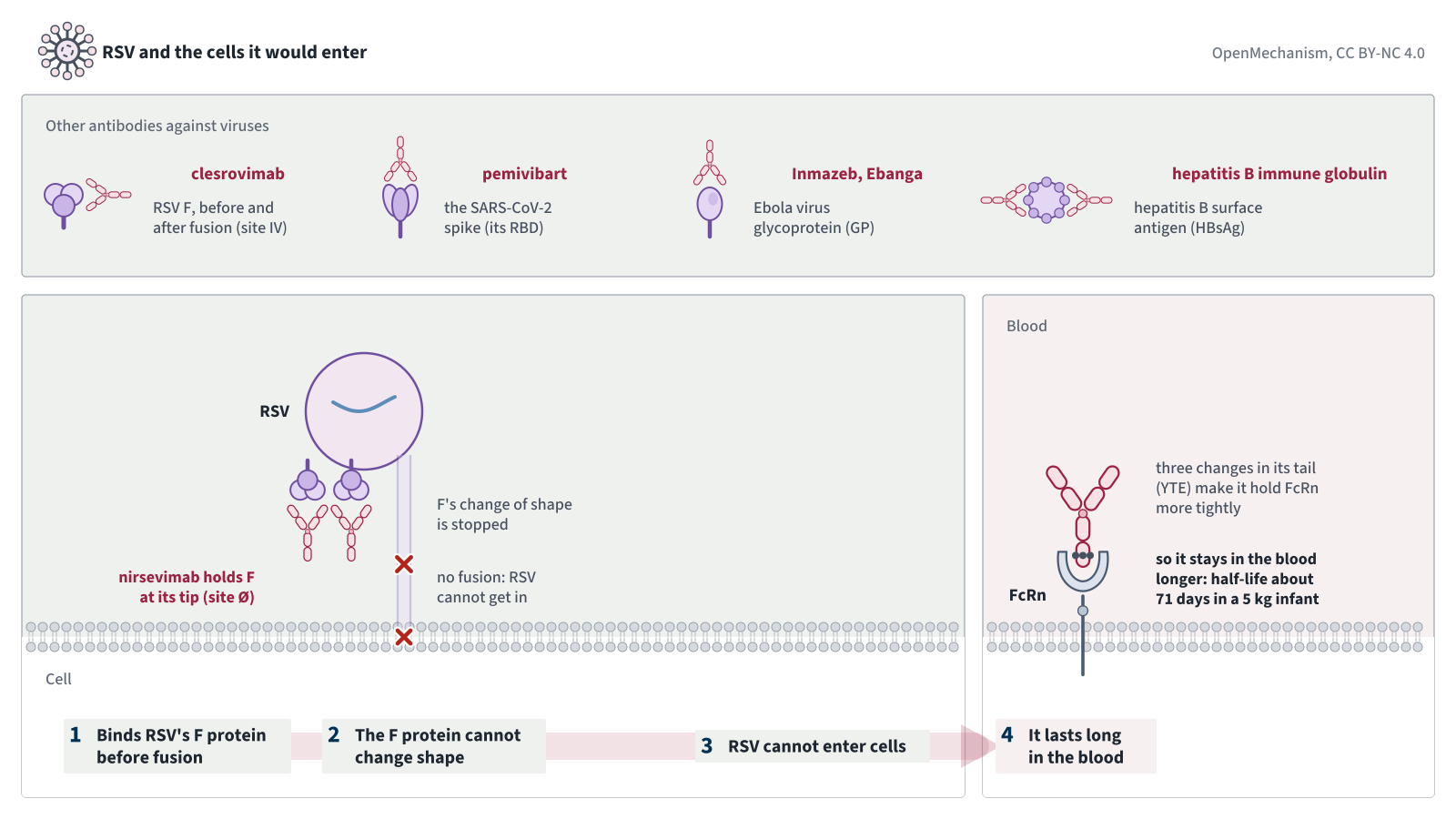
Nirsevimab is a ready-made antibody that gives passive immunity against . It binds the virus's F protein in the form it has before fusion and stops the shape change the virus needs to fuse with a cell, so the virus cannot get in. Three changes in its tail () make it last long in the blood.
- Acts on
- The prefusion form of the RSV F protein (antigenic site Ø)
- Where
- RSV particles and the cells they would enter
- Used for
- Infections
- Drug class
- Antibody medicines
Also called Beyfortus.
Key terms in this drawing (8)
- FcRn
- Neonatal Fc receptor. A cell receptor that recycles antibodies so they last longer; nirsevimab's YTE tail holds it more tightly.
- GP
- Ebola virus glycoprotein. The Ebola virus surface protein that the antibodies in Inmazeb and Ebanga bind.
- half-life
- Half-life. The time it takes for the amount in the blood to fall by half.
- HBsAg
- Hepatitis B surface antigen. A protein from the surface of the hepatitis B virus, used as the vaccine's antigen.
- RBD
- Receptor-binding domain. The part of the coronavirus spike that binds ACE2 on human cells.
- RSV
- Respiratory syncytial virus. A virus of the airways; its F protein is the target of RSV vaccines and of nirsevimab.
- SARS-CoV-2
- Severe acute respiratory syndrome coronavirus 2. The coronavirus that causes COVID-19.
- YTE
- Triple amino acid substitution (YTE) in the Fc region. Three changes in an antibody's tail that increase its binding to FcRn and so make it last longer.
How it works
Binds RSV's F protein before fusion. Nirsevimab is a human monoclonal antibody that targets the prefusion form of the RSV F protein, binding a conserved site (antigenic site Ø) on the prefusion protein of RSV A and B.1
The F protein cannot change shape. It inhibits the changes in shape (conformation) of the F protein that are needed for the viral and cellular membranes to fuse.1
RSV cannot enter cells. Without membrane fusion the virus cannot enter the cell: nirsevimab neutralizes RSV, providing passive immunity.1
It lasts long in the blood. Nirsevimab is long-acting: three amino acid changes (YTE) in its Fc region increase its binding to the neonatal Fc receptor and so extend its serum (about 71 days in a 5 kg infant).1
For teachers: download this drawing.
See also
Condition pages: RSV infection.
Other antibody medicines: adalimumab, bevacizumab, bezlotoxumab, blinatumomab, burosumab, denosumab, dupilumab, eculizumab and 14 more.
Body system: infections.
Sources
- 1Beyfortus (nirsevimab-alip): FDA label11 Description; 12.3 Pharmacokinetics; 12.4 Microbiology: Mechanism of Action
- 2ChEMBL CHEMBL4297575Target and action classification: Fusion glycoprotein F0 inhibitor
Also used for the drawing
The drawing also shows other ready-made antibodies against viruses (clesrovimab, pemivibart, Inmazeb, Ebanga and hepatitis B immune globulin) and where on the F protein nirsevimab binds. These sources support those parts; the steps above come from the sources listed above.
- 3Structure of RSV fusion glycoprotein trimer bound to a prefusion-specific neutralizing antibodyMcLellan JS et al., Science 2013 (abstract)
- 4Enflonsia (clesrovimab): FDA label12.4 Microbiology: Mechanism of Action
- 5Pemgarda (pemivibart): FDA fact sheet (Emergency Use Authorization)12.4 Microbiology: Mechanism of Action
- 6Inmazeb (atoltivimab, maftivimab and odesivimab): FDA label12.4 Microbiology: Mechanism of Action
- 7Ebanga (ansuvimab): FDA label12.4 Microbiology: Mechanism of Action
- 8HepaGam B (hepatitis B immune globulin): FDA label12.1 Mechanism of Action
Spotted a mistake? Report an error (hello@openmechanism.com). Since launch, every published error we fix is listed on the corrections page.
Notes and limits
- A schematic teaching drawing: not to scale, not exact structures, binding poses or a complete pathway, and not a guide to dosing, treatment or how a person will respond.
- In cell culture, RSV variants with changes in the antibody's binding site on the F protein were less susceptible; such variants have been rare (<1%) in surveillance studies.
All recorded limits are on the evidence page, and notes that apply to every page are on How to read a page. Version 1.0.0, not yet medically reviewed.
Cite this page
Tran D. Nirsevimab [Internet]. OpenMechanism; 2026 [updated 2026 Oct 15; cited 2026 Oct 15]. Available from: https://openmechanism.com/medicines/nirsevimab