Gentamicin
Gentamicin is an aminoglycoside antibiotic. Aminoglycosides bind the small part () of the bacterial ribosome, which then misreads the genetic code and stops moving along the , so gentamicin blocks protein making in the bacteria; in the lab, it kills Gram-positive and Gram-negative bacteria. Little of it is changed in the body: the kidneys filter it out, generally 70% or more of a dose in the urine within 24 hours when the kidneys work normally, and a small amount stays in the kidneys.
- Acts on
- The bacterial ribosome; aminoglycosides bind the A site of the 16S in its small part (30S)
- Where
- Bacterial ribosomes; cleared by the kidneys
- Medicine type
- Small molecule
- Used for
- Infections
- Drug class
- Antibiotics, Aminoglycosides
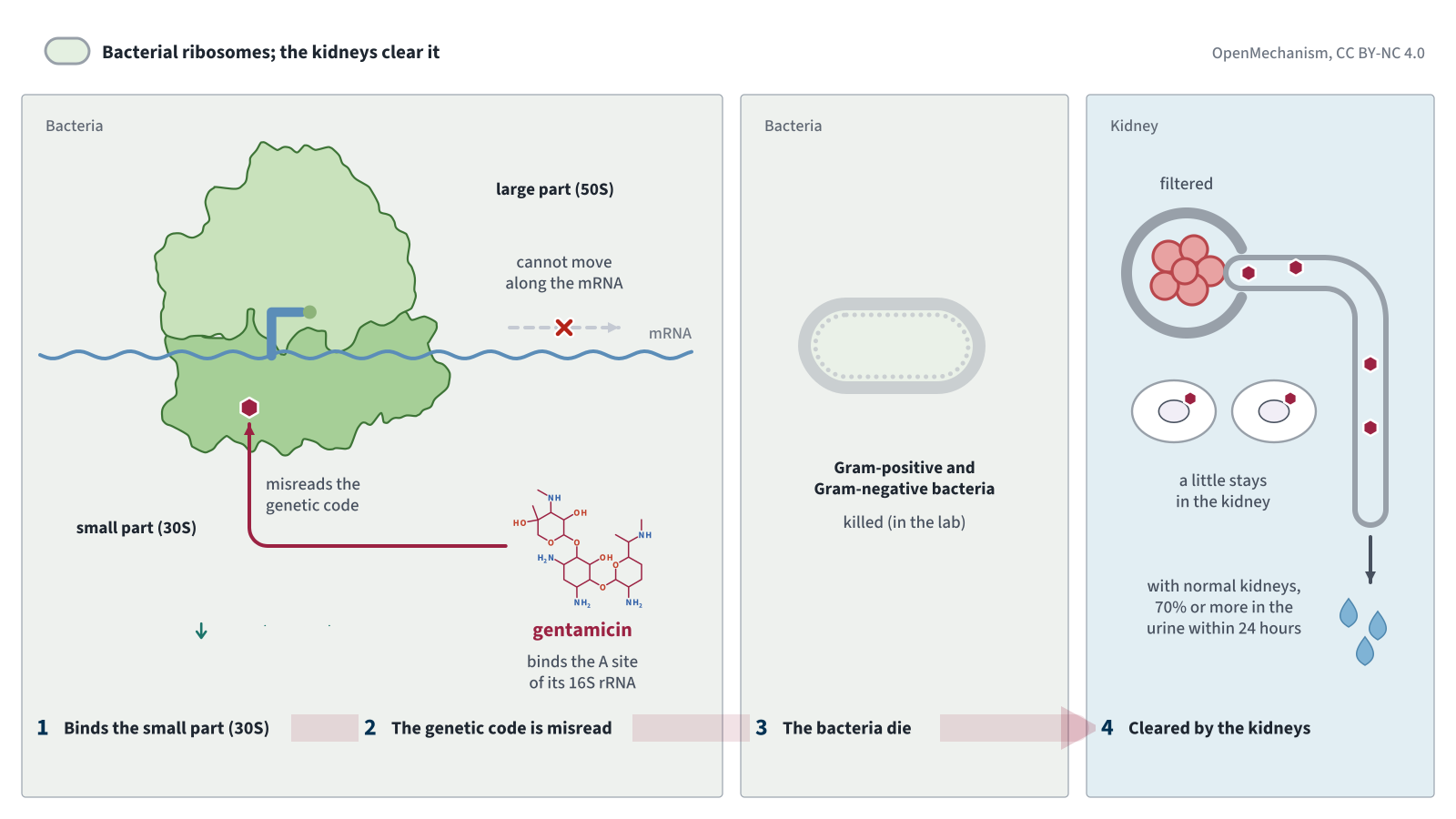
Key terms in this drawing
- 30S
- 30S ribosomal subunit. The small part of the bacterial ribosome.
- 50S
- 50S ribosomal subunit. The large part of the bacterial ribosome.
- mRNA
- Messenger RNA. A copy of a gene that a cell reads to make a protein.
- rRNA
- Ribosomal RNA. RNA that is part of the ribosome, such as the bacterial ribosome's 16S and 23S rRNA.
How it works
Binds the small part (30S). Gentamicin, an aminoglycoside, binds the bacterial ribosome. Aminoglycosides bind the A site of the 16S rRNA in the ribosome's small part (30S).1,2
The genetic code is misread. Bound there, aminoglycosides make the ribosome misread the genetic code and block its movement along the mRNA (translocation): gentamicin inhibits protein making in susceptible bacteria.1,2
The bacteria die. Gentamicin is bactericidal in vitro against Gram-positive and Gram-negative bacteria: it kills them.1
Cleared by the kidneys. Little if any gentamicin is changed in the body: it leaves mainly by glomerular filtration, and in people with normal kidney function generally 70% or more of a dose is in the urine within 24 hours. A small amount stays in tissues, especially the kidneys, where levels in the renal cortex may sometimes be eight times the usual blood level.1
For teachers: download this drawing.
See also
Condition pages: bloodstream infections and endocarditis; pneumonia; skin and soft-tissue infections; and urinary tract infections.
Other antibiotics: amoxicillin; amoxicillin and clavulanate; azithromycin; bedaquiline; ceftazidime and avibactam; ceftriaxone; cephalexin; ciprofloxacin; and 14 more.
Explained: why gentamicin can damage hearing and balance.
Body system: infections.
Sources
- 1Gentamicin sulfate injection (Hospira): FDA labelClinical Pharmacology; Microbiology
- 2Structure of the A site of Escherichia coli 16S ribosomal RNA complexed with an aminoglycoside antibioticFourmy D et al., Science 1996 (abstract)
- 3ChEMBL CHEMBL6067485Target and action classification: Bacterial 70S ribosome inhibitor
Also used for the drawing
The ribosome outline is traced from the electron microscopy structure below.
- 4Escherichia coli stalled ribosome with linezolidPDB 7S1G; Tsai, K. et al. Nat.Struct.Mol.Biol. 2022; 29:162-171
Spotted a mistake? Report an error (hello@openmechanism.com). Since launch, every published error we fix is listed on the corrections page.
Notes and limits
- A schematic teaching drawing: not to scale, not exact structures, binding poses or a complete pathway, and not a guide to dosing, treatment or how a person will respond.
All recorded limits are on the evidence page, and notes that apply to every page are on How to read a page. Version 1.0.0, not yet medically reviewed.
Cite this page
Tran D. Gentamicin [Internet]. OpenMechanism; 2026 [updated 2026 Nov 6; cited 2026 Nov 6]. Available from: https://openmechanism.com/medicines/gentamicin