Kidney
How the kidneys filter blood and take back glucose and water; chronic kidney disease.
For teachers: download this drawing.
Key terms in this drawing (5)
- GFR
- Glomerular filtration rate. A measure of kidney function; guidelines define chronic kidney disease partly by a GFR below 60 mL/min per 1.73 m².
- glomerulus
- Glomerulus. The filter at the start of each nephron: it passes water and small solutes from the blood into the nephron's tubule.
- nephron
- Nephron. One of the kidney's filtering units: a glomerulus, which filters the blood, and the tubule the filtrate runs into.
- SGLT2
- Sodium-glucose cotransporter 2. The kidney's main transporter for taking glucose back from the filtrate into the blood.
- V2 receptor
- Vasopressin V2 receptor. The kidney receptor that antidiuretic hormone acts on to save water.
How it works
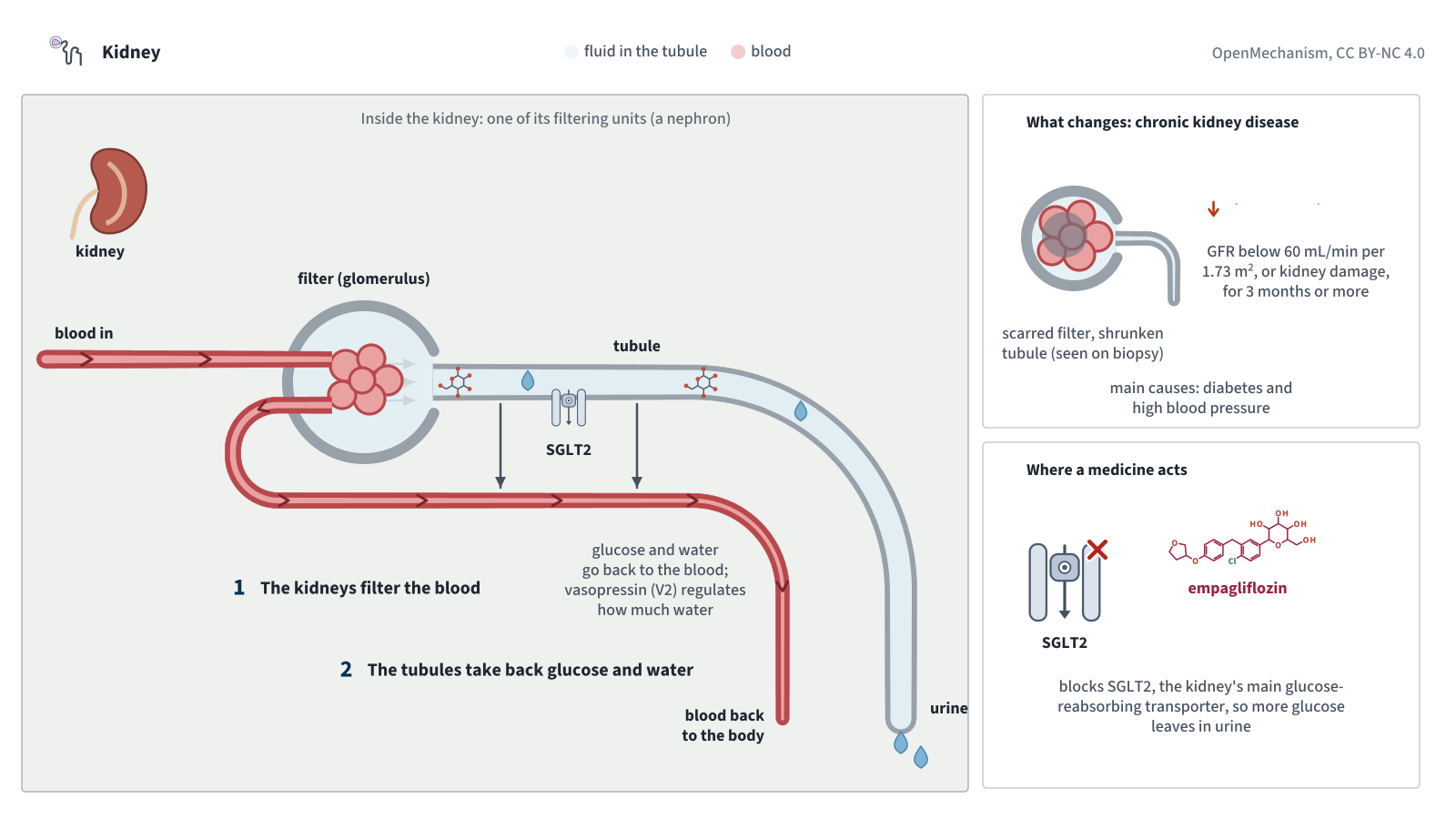
The kidneys filter the blood. The kidneys filter the blood into their tubules; the glomerular filtration rate () is the best available measure of overall kidney function.1,2
The tubules take back glucose and water. In the tubules, (in the proximal tubules) takes back most of the filtered glucose into the blood, and vasopressin, through its , regulates how much water is taken back.1,3,4
What the source says
“Sodium-glucose cotransporter 2 (SGLT2), expressed in the proximal renal tubules, is responsible for the majority of the reabsorption of filtered glucose from the tubular lumen.”
Source 1“reabsorption of glucose from the glomerular filtrate back into the circulation”
Source 3“AVP regulates vascular tone and free-water reabsorption, respectively, through the vasopressin V(1a) and V(2) receptor subtypes”
Source 4
What changes in disease
Chronic kidney disease. Chronic kidney disease is kidney function below a glomerular filtration rate of 60 mL/min per 1.73 m², or signs of kidney damage, or both, for at least 3 months. Diabetes and high blood pressure are its main causes in high- and middle-income countries, and in many low-income countries. Kidney biopsies can show scarred , shrunken tubules and .2
What the source says
“current international guidelines define this condition as decreased kidney function shown by glomerular filtration rate (GFR) of less than 60 mL/min per 1·73 m”
Source 2“or markers of kidney damage, or both, of at least 3 months duration, regardless of the underlying cause.”
Source 2“Diabetes and hypertension are the main causes of CKD in all high-income and middle-income countries, and also in many low-income countries.”
Source 2“Kidney biopsy samples can show definitive evidence of CKD, through common changes such as glomerular sclerosis, tubular atrophy, and interstitial fibrosis.”
Source 2
Where medicines act
- b
Empagliflozin
Blocks SGLT2, the kidney's main glucose-reabsorbing transporter, so more glucose leaves in urine.
From each medicine's label.3
See also
Zoom in: inside the kidney and saving water in the kidney.
Animations: glucose in the kidney.
Conditions
- ANCA vasculitis
- Atypical hemolytic uremic syndrome (aHUS)
- Bedwetting (nocturnal enuresis)
- Chronic kidney disease
- Cystinosis
- Diabetes insipidus
- Ethylene glycol and methanol poisoning
- Fabry disease
- Fluid retention
- Focal segmental glomerulosclerosis (FSGS)
- Heart failure
- Heavy metal poisoning
- High blood potassium
- High blood pressure
- High calcium from cancer
- High phosphate on dialysis
- IgA nephropathy
- Kidney cancer
- Low blood potassium (hypokalemia)
- Low blood sodium
- Lupus nephritis
- Methotrexate toxicity
- Polycystic kidney disease
- Primary aldosteronism
- Primary hyperoxaluria type 1
- Primary hyperparathyroidism
- Secondary hyperparathyroidism
- Transplant rejection
- Tumor lysis syndrome
- Type 2 diabetes
- Urinary tract infections
- Von Hippel-Lindau disease
- X-linked hypophosphatemia
More medicines for this area
Sources
- 1Farxiga (dapagliflozin): FDA label12.1 Mechanism of Action. Saved copy
- 2Chronic kidney diseaseWebster AC et al. Lancet 2017 (abstract). Saved copy
- 3Jardiance (empagliflozin): FDA label12.1 Mechanism of Action. Saved copy
- 4Neurohormonal activation in congestive heart failure and the role of vasopressinChatterjee K. Am J Cardiol 2005 (abstract). Saved copy
Notes and limits
- Selected qualitative comparison, schematic and not to scale; not a complete physiological or treatment model.
- The glucose-transport intervention does not demonstrate every downstream cardiorenal benefit or repair all causes of kidney disease.
- The drawing is schematic and not to scale; it shows only what the statements above say.
Spotted a mistake? Report an error (hello@openmechanism.com). Since launch, every published error we fix is listed on the corrections page.
Cite this page
Tran D. Kidney [Internet]. OpenMechanism; 2026 [updated 2026 Oct 13; cited 2026 Oct 13]. Available from: https://openmechanism.com/body/kidney