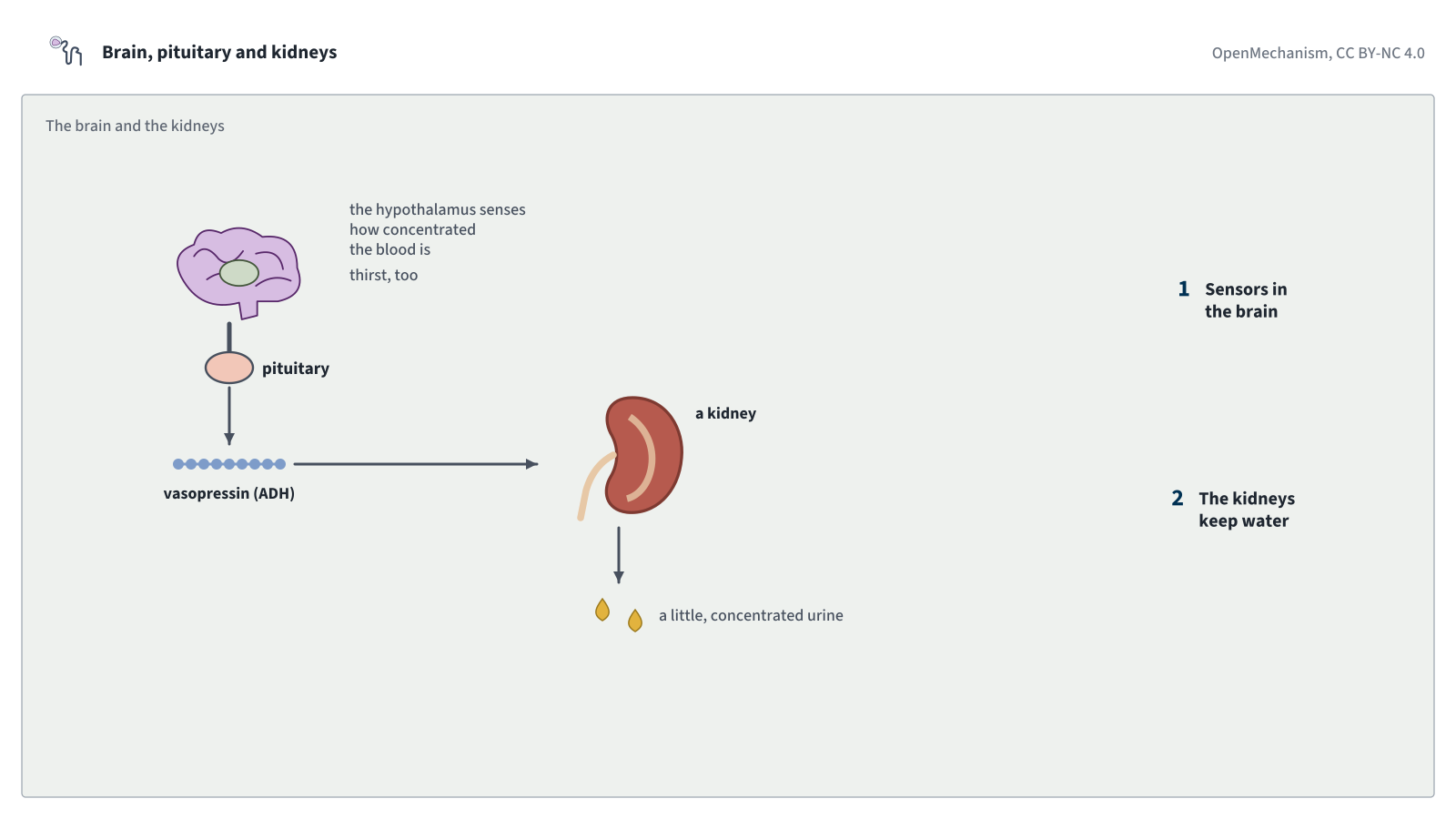
Sensors in the brain. When the blood becomes more concentrated, osmoreceptors in the hypothalamus sense it. The hypothalamus then has the posterior pituitary release (vasopressin) into the blood, and brings on thirst.1
What the source says
“Osmoreceptors are sensory receptors in the thirst center in the hypothalamus that monitor the concentration of solutes (osmolality) of the blood.”
“When the osmoreceptors in the hypothalamus detect an increase in the concentration of blood plasma, the hypothalamus signals the release of ADH from the posterior pituitary into the blood.”
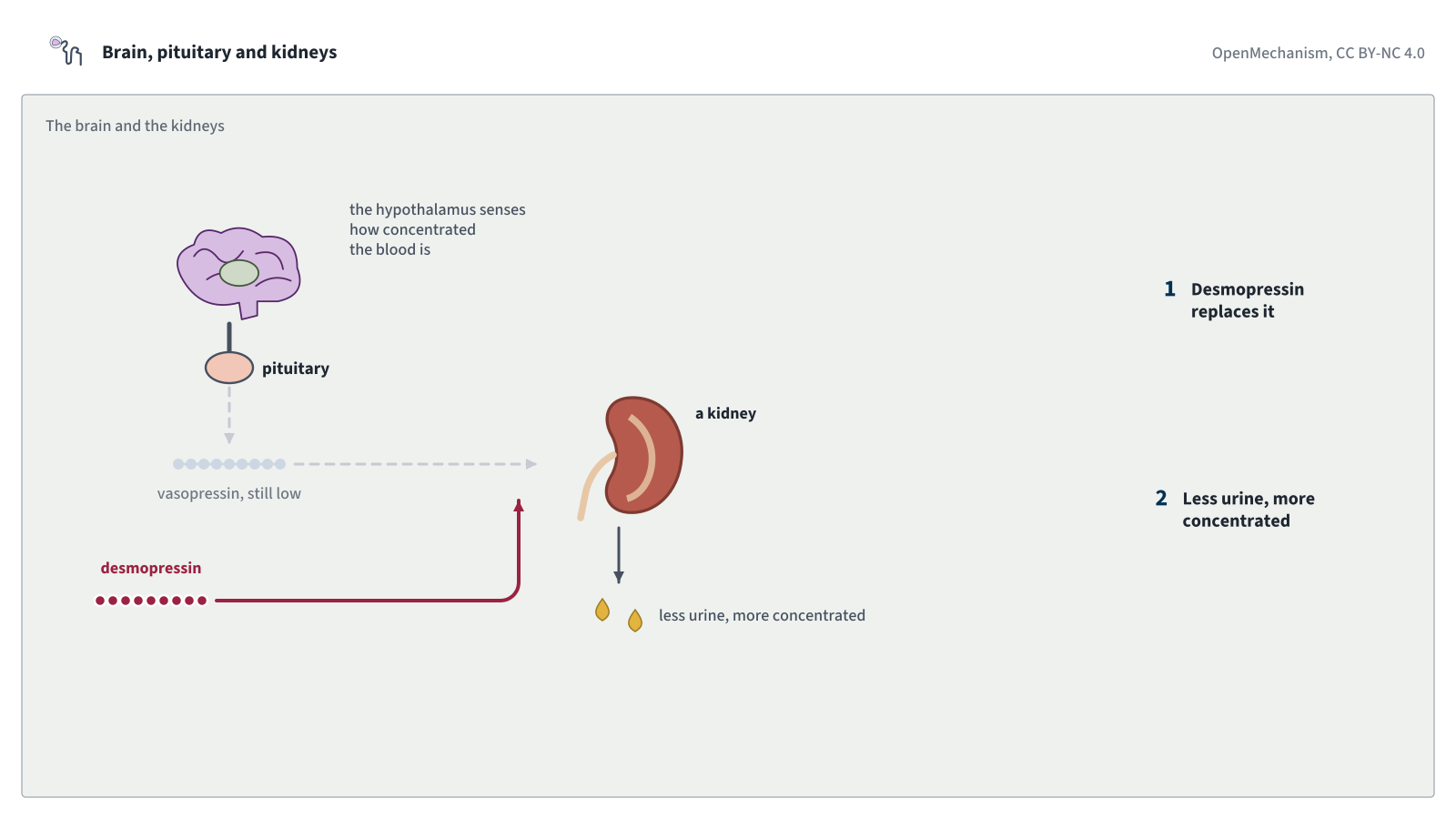
Desmopressin replaces it. Desmopressin, made in the lab to resemble the pituitary hormone vasopressin (ADH), replaces the missing hormone in central diabetes insipidus.3,4
What the source says
“a synthetic analogue of the natural pituitary hormone 8-arginine vasopressin (ADH), an antidiuretic hormone affecting renal water conservation”
Less urine, more concentrated. It reduces the urine made, makes the urine more concentrated and makes the blood less concentrated.4
What the source says
“The use of DDAVP Injection in patients with central diabetes insipidus reduces urinary output, increases urine osmolality, and decreases plasma osmolality.”
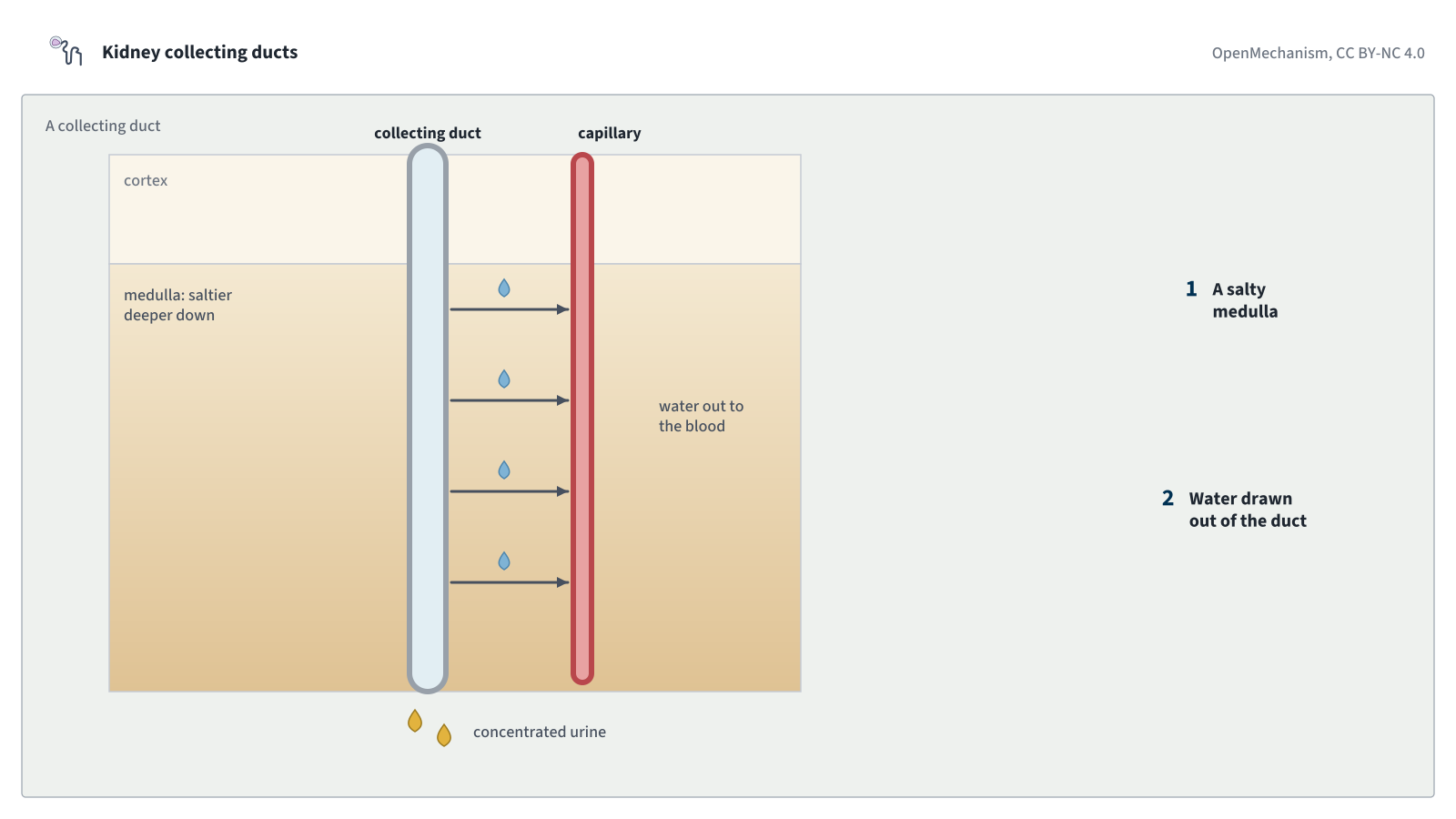
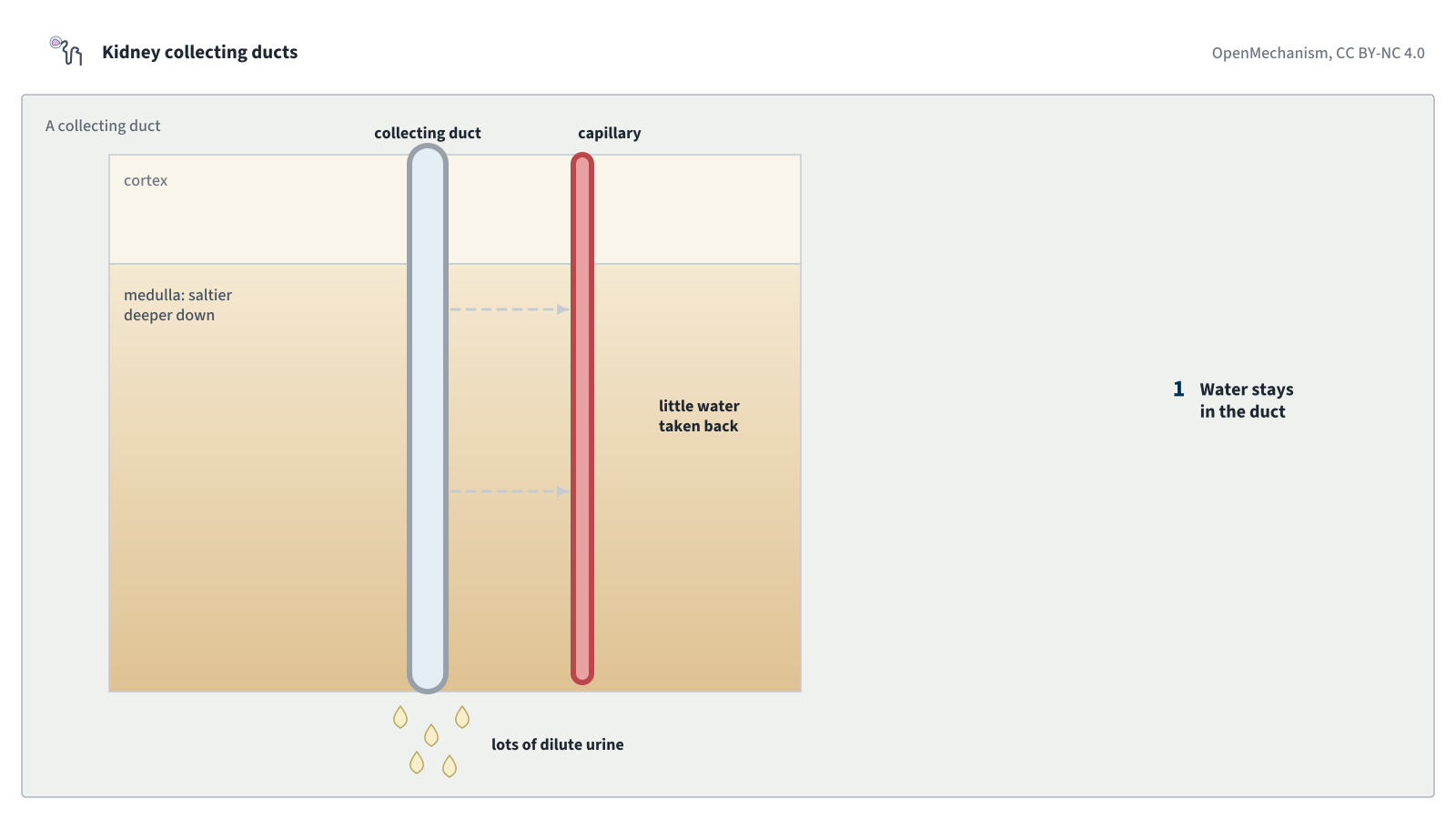
A salty medulla. Deep in the medulla, sodium and urea make the fluid around the tubules very concentrated, and as the collecting ducts run down through the medulla, the fluid around them gets more and more concentrated.5
What the source says
“Thus, the movement of Na+ and urea into the interstitial spaces by these mechanisms creates the hyperosmotic environment of the medulla.”
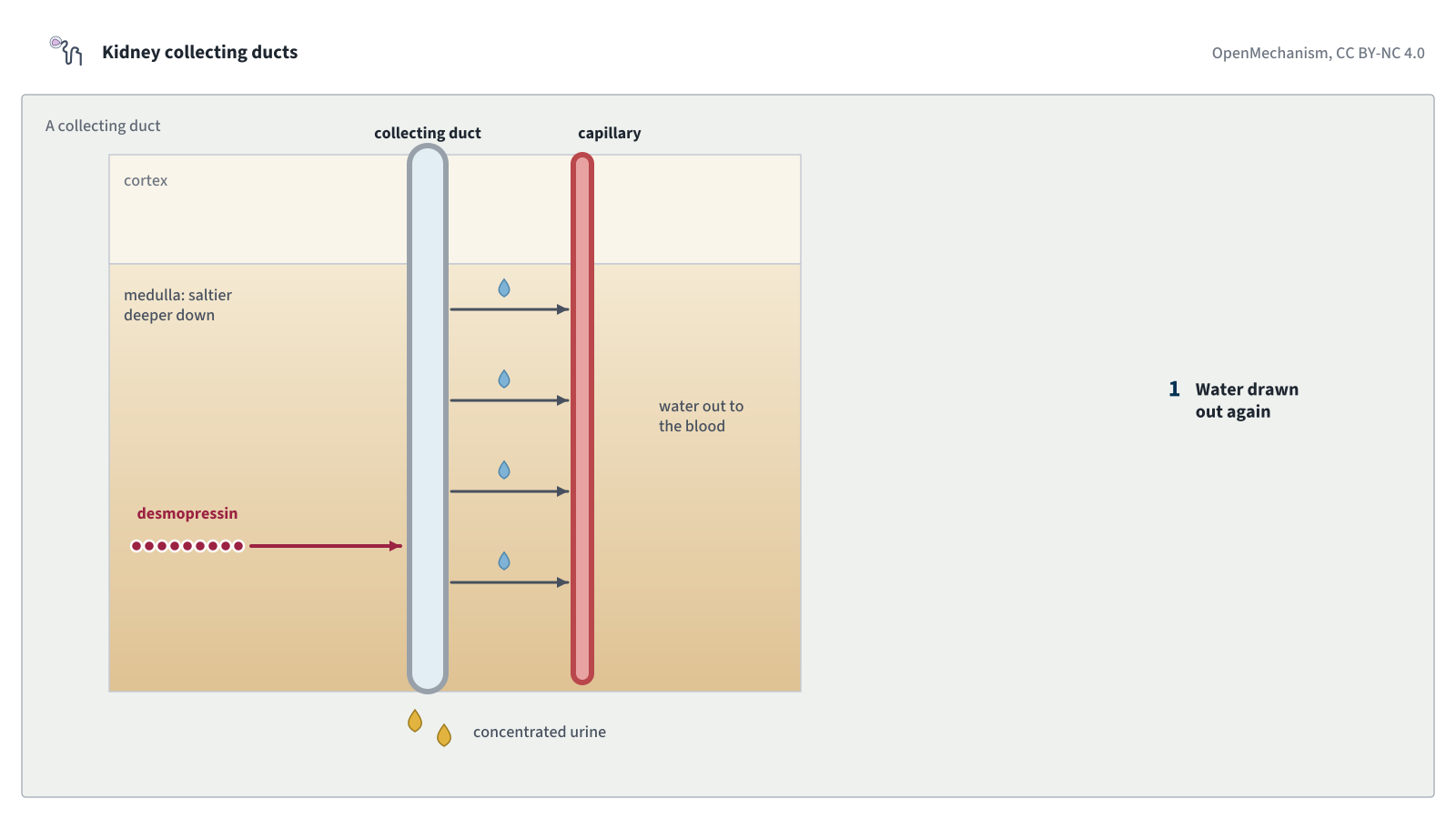
Water drawn out of the duct. Where the duct has aquaporin channels, water is drawn out by osmosis into the fluid around it and the capillaries; with ADH, the ducts can recover almost all the water passing through them.5
What the source says
“If aquaporin water channels are present, water will be osmotically pulled from the collecting duct into the surrounding interstitial space and into the peritubular capillaries.”
“The collecting ducts, under the influence of ADH, can recover almost all of the water passing through them, in cases of dehydration, or almost none of the water, in cases of over-hydration.”
Water drawn out again. Desmopressin stimulates the , which increases water reabsorption in the kidney and reduces the urine made.4
What the source says
“The antidiuretic effects of desmopressin acetate are mediated by stimulation of vasopressin 2 (V2) receptors, thereby increasing water re-absorption in the kidney, and hence reducing urine production.”
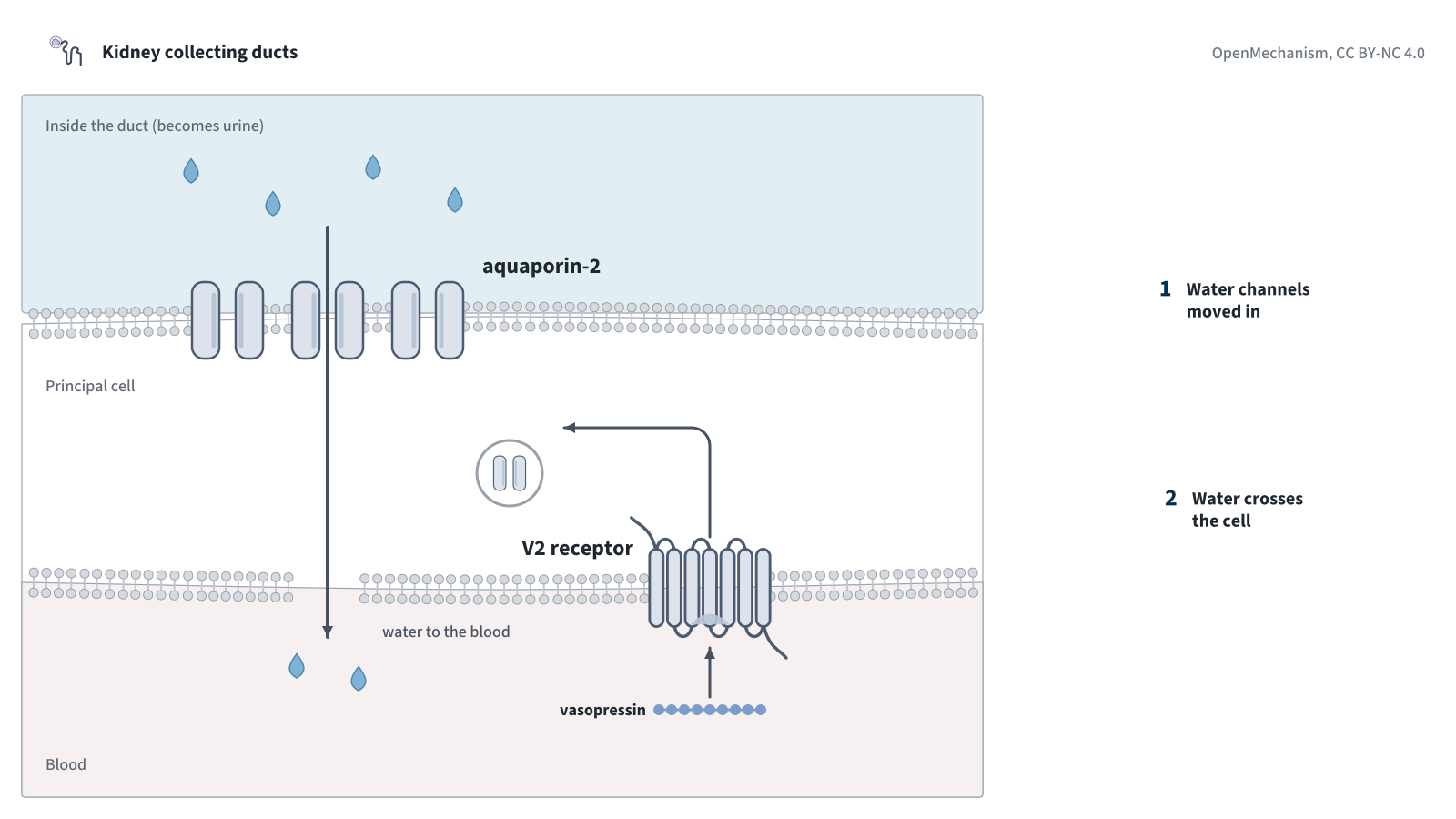
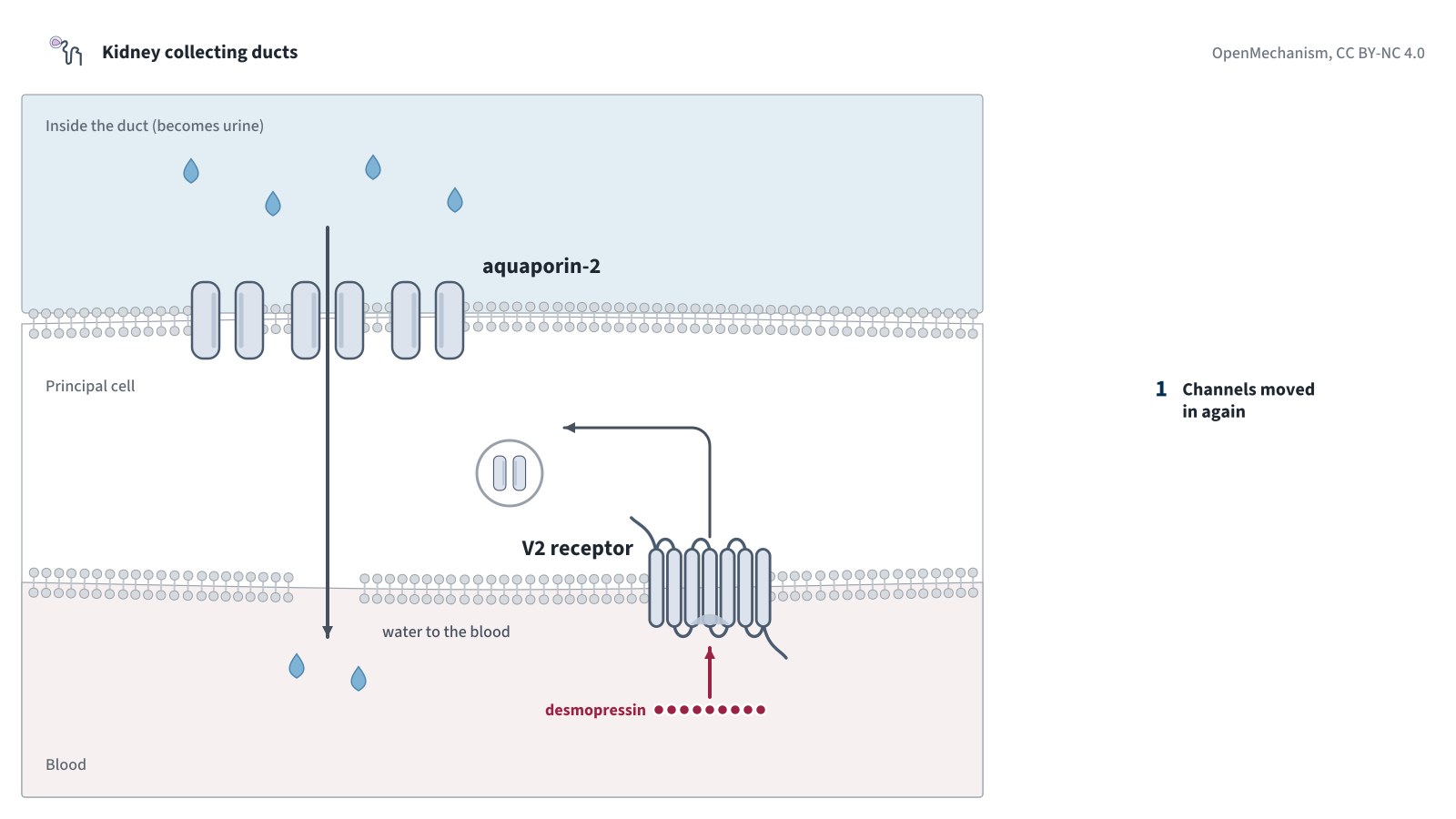
Water channels moved in. ADH makes the principal cells lining the ducts move aquaporin water channels from inside the cell into the membrane facing the urine.1,5
What the source says
“ADH also causes the epithelial cells that line the renal collecting tubules to move water channel proteins, called aquaporins, from the interior of the cells to the apical surface, where these proteins are inserted into the cell membrane”
Water crosses the cell. Water then moves by osmosis from the duct, through the cell, into the fluid of the medulla.6
What the source says
“It does so by stimulating the movement of aquaporin proteins into the apical cell membrane of principal cells of the collecting ducts to form water channels, allowing the transcellular movement of water from the lumen of the collecting duct into the interstitial space in the medulla of the kidney by osmosis.”
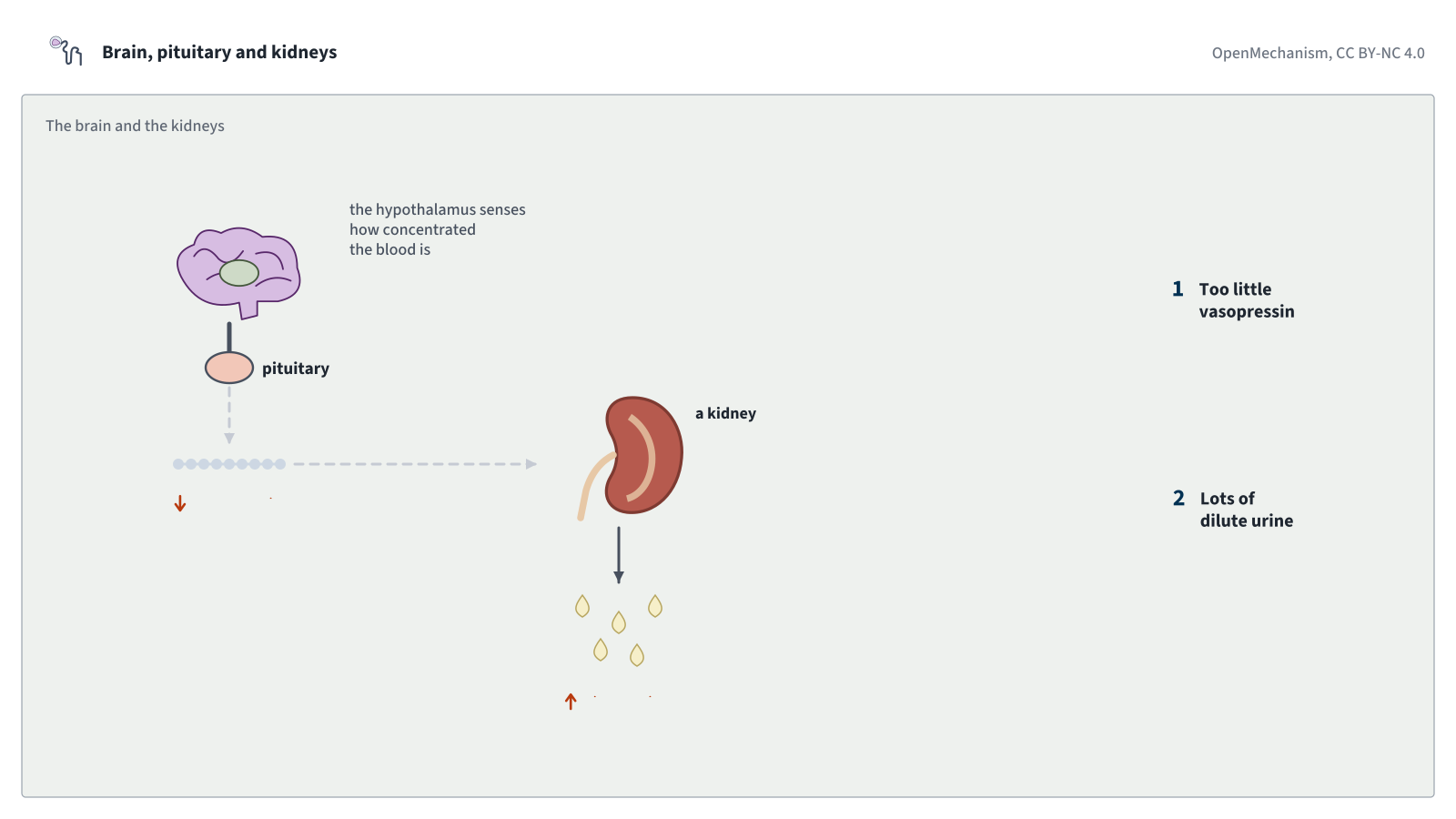
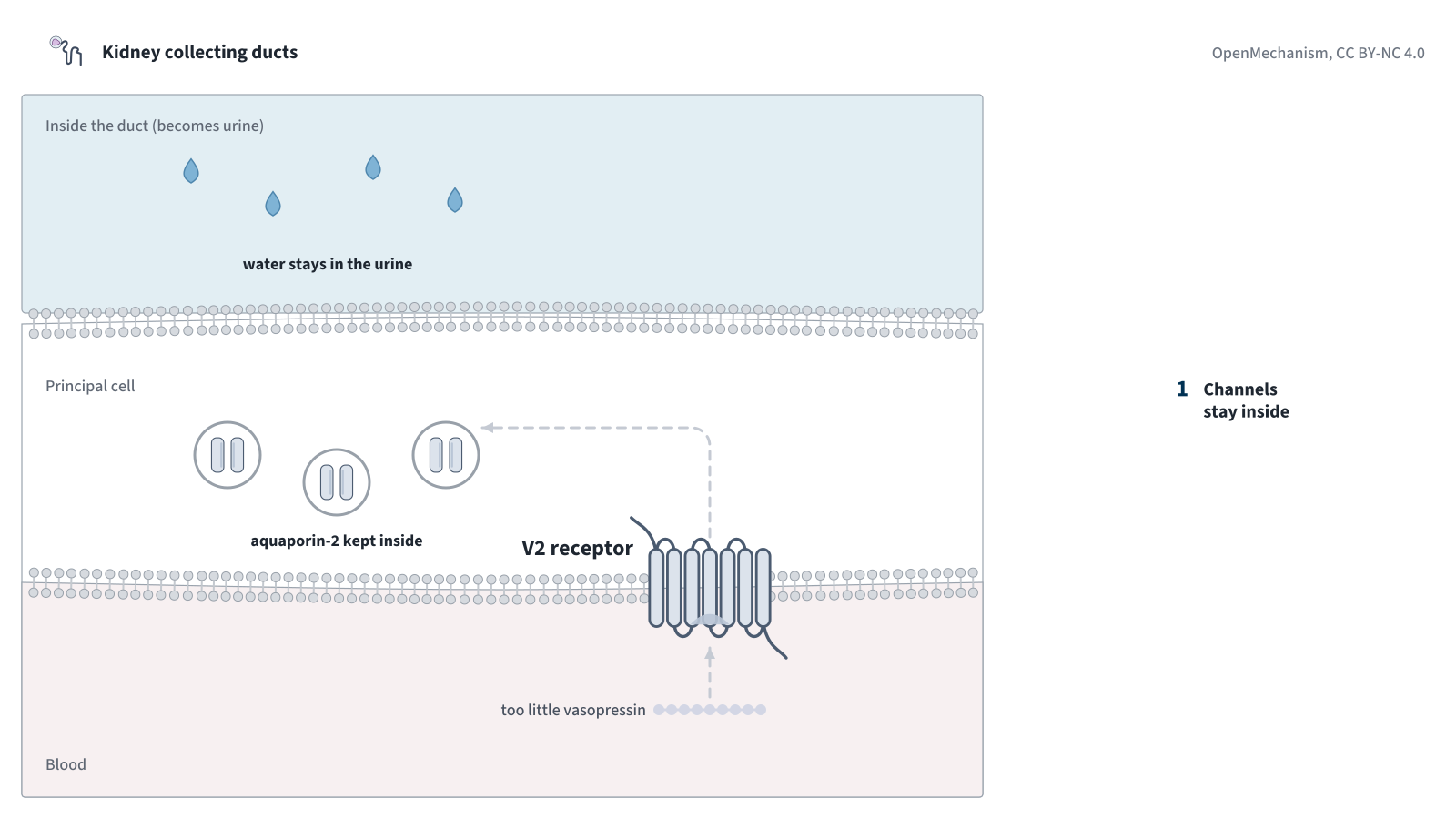
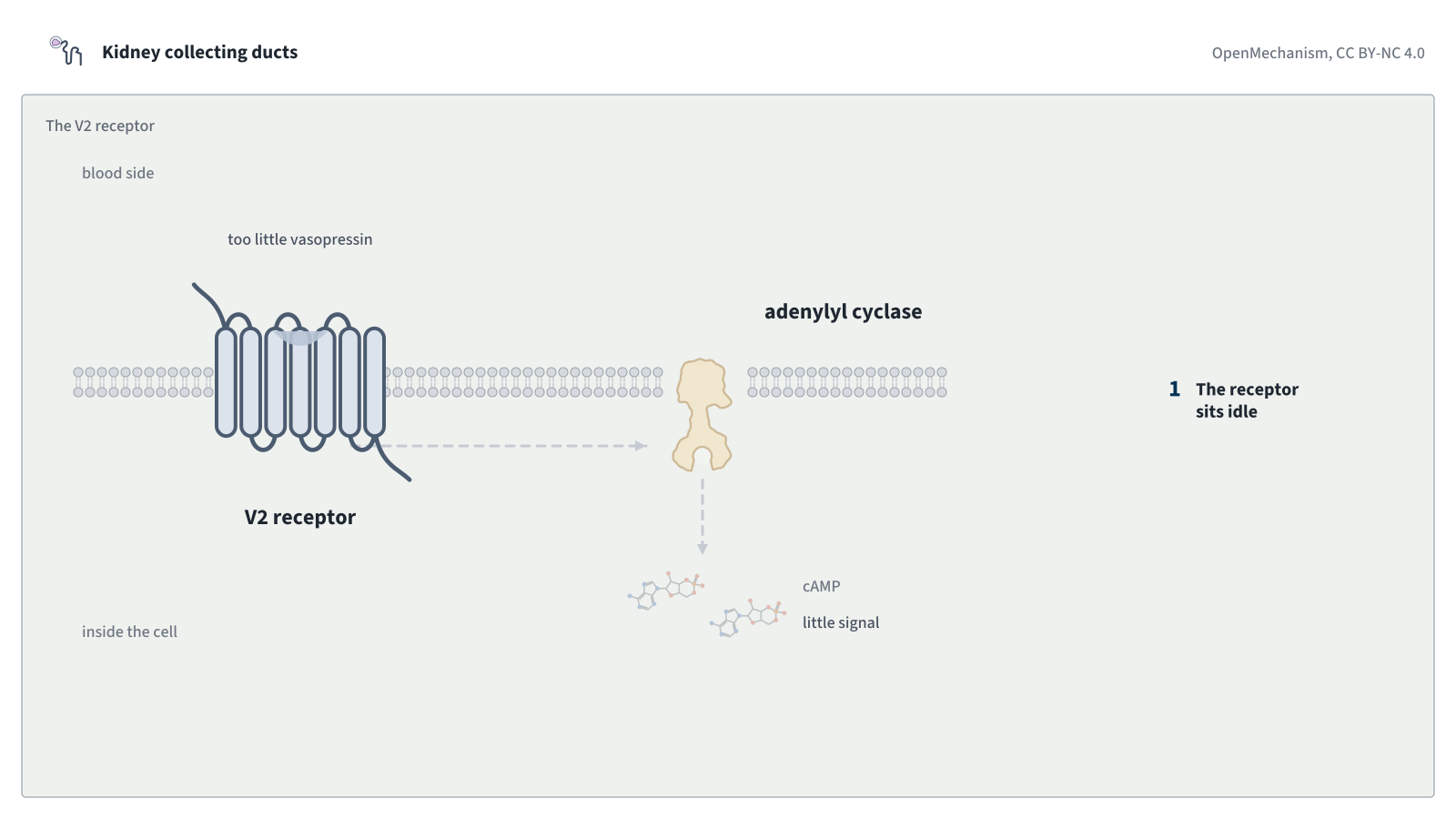
Channels stay inside. When ADH is low, aquaporins are removed from the membrane and less water passes out of the urine into the blood; the two forms of diabetes insipidus show how much the kidneys rely on vasopressin and aquaporin-2.1,7
What the source says
“When the blood plasma becomes less concentrated and the level of ADH decreases, aquaporins are removed from collecting tubule cell membranes, and the passage of water out of urine and into the blood decreases.”
Channels moved in again. Desmopressin stimulates the V2 receptors in vasopressin's place, so water reabsorption rises again; vasopressin's signal controls the water channel aquaporin-2.4,8
What the source says
“The antidiuretic effects of desmopressin acetate are mediated by stimulation of vasopressin 2 (V2) receptors, thereby increasing water re-absorption in the kidney, and hence reducing urine production.”
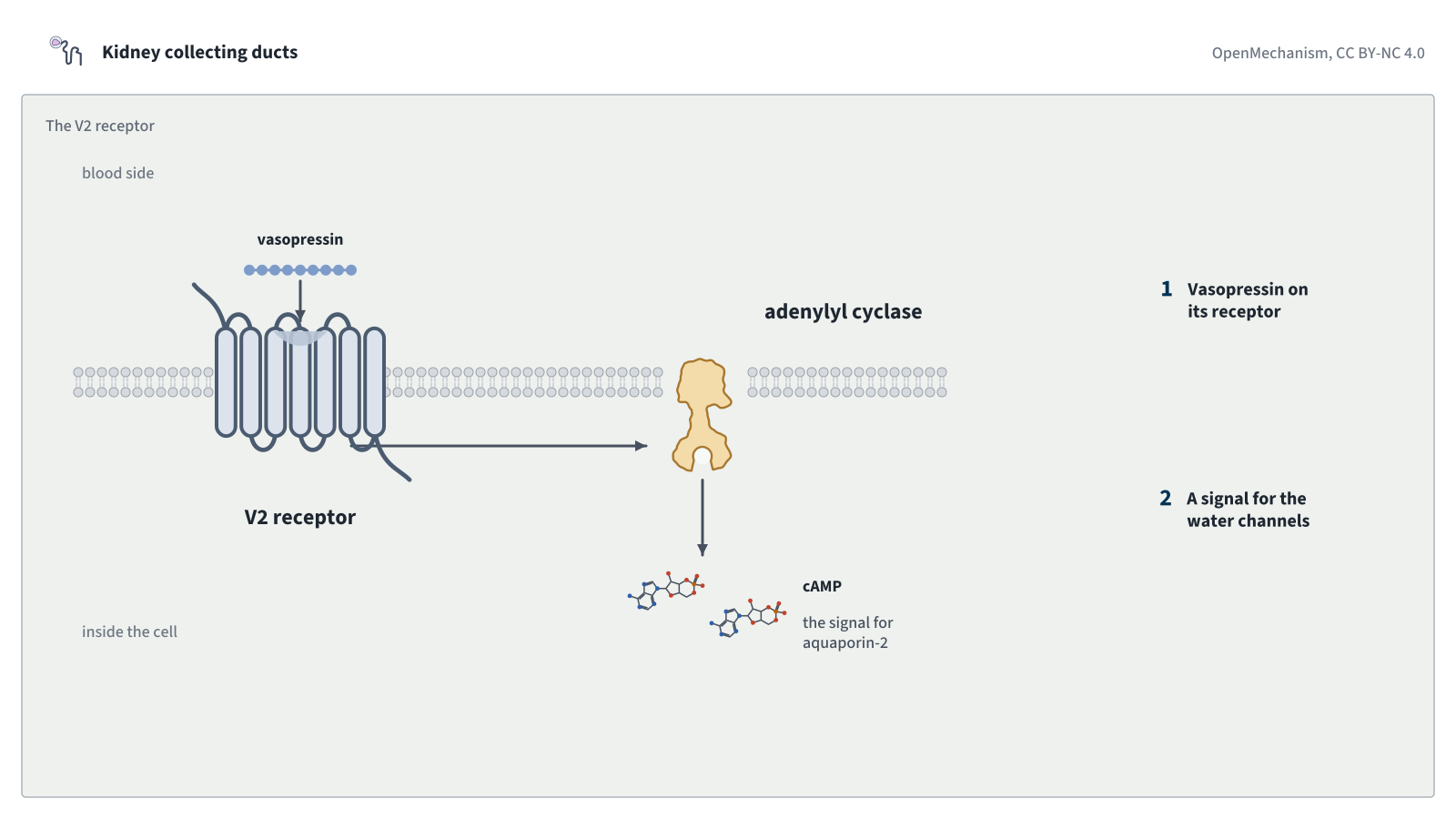
Vasopressin on its receptor. Vasopressin acts on V2 receptors in the kidney, which are coupled to adenylyl cyclase; at the low levels typical of the hormone, it holds back the loss of water in the urine.9
What the source says
“In addition, vasopressin stimulates antidiuresis via stimulation of V 2 receptors which are coupled to adenyl cyclase.”
A signal for the water channels. The signal controls aquaporin-2 in two ways: how many channels reach the membrane facing the urine, and how much of the channel the cell holds.8
What the source says
“Water permeability is controlled by vasopressin through regulation of the water channel, aquaporin-2 (AQP2).”
“Two processes contribute: (1) regulation of AQP2 trafficking to the apical plasma membrane; and (2) regulation of the total amount of the AQP2 protein in the cells.”
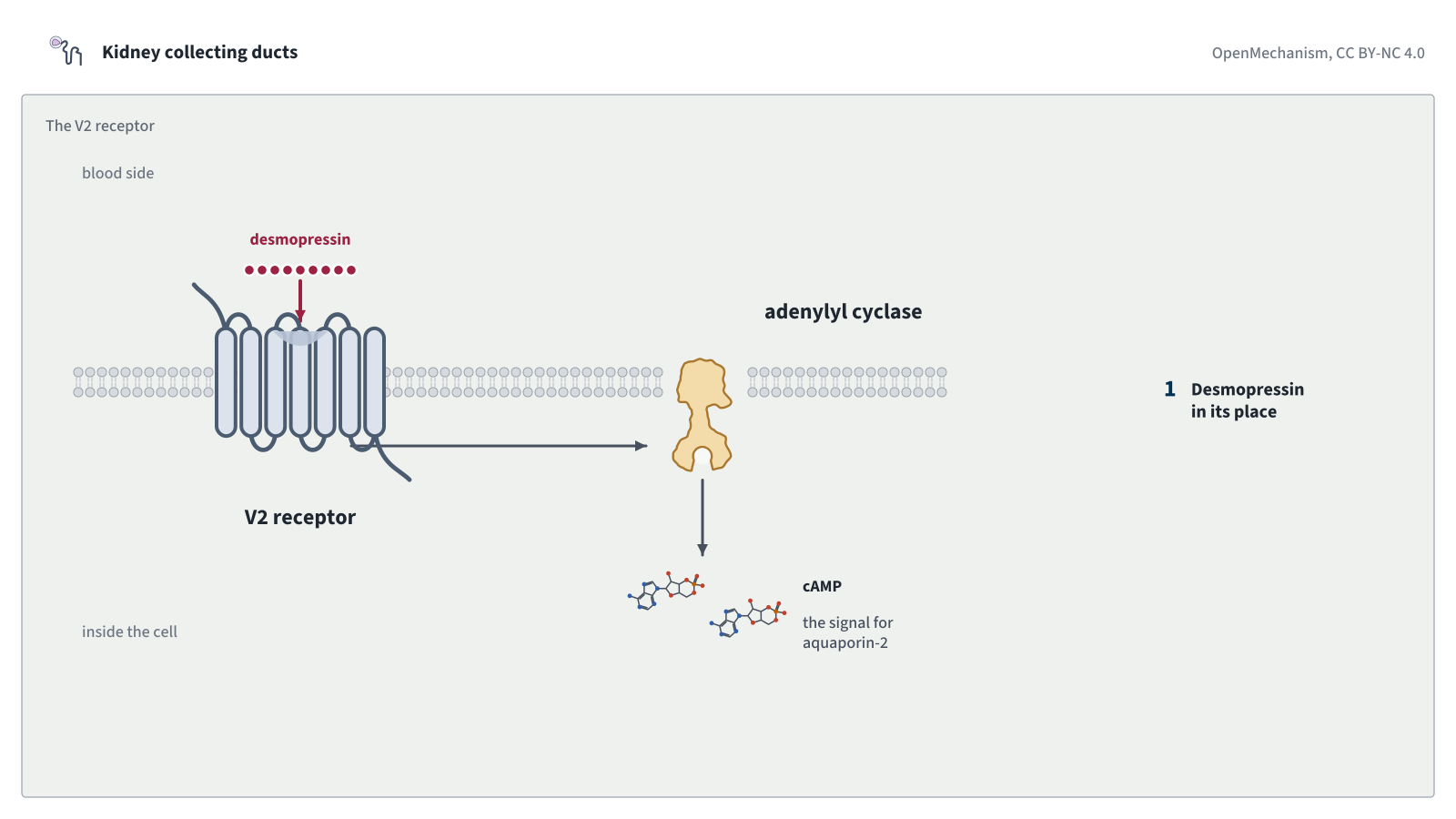
Desmopressin in its place. Desmopressin stimulates the V2 receptors in vasopressin's place. Changing vasopressin's structure made it act longer, with less effect on blood vessels and other smooth muscle.4
What the source says
“The antidiuretic effects of desmopressin acetate are mediated by stimulation of vasopressin 2 (V2) receptors, thereby increasing water re-absorption in the kidney, and hence reducing urine production.”
“The change in structure of arginine vasopressin to desmopressin acetate resulted in increased duration of action and a decreased vasopressor action and decreased actions on visceral smooth muscle relative to the enhanced antidiuretic activity”
Tran D. Saving water in the kidney [Internet]. OpenMechanism; 2026 [updated 2026 Nov 13; cited 2026 Nov 13]. Available from: https://openmechanism.com/body/scales/water