Fabry disease
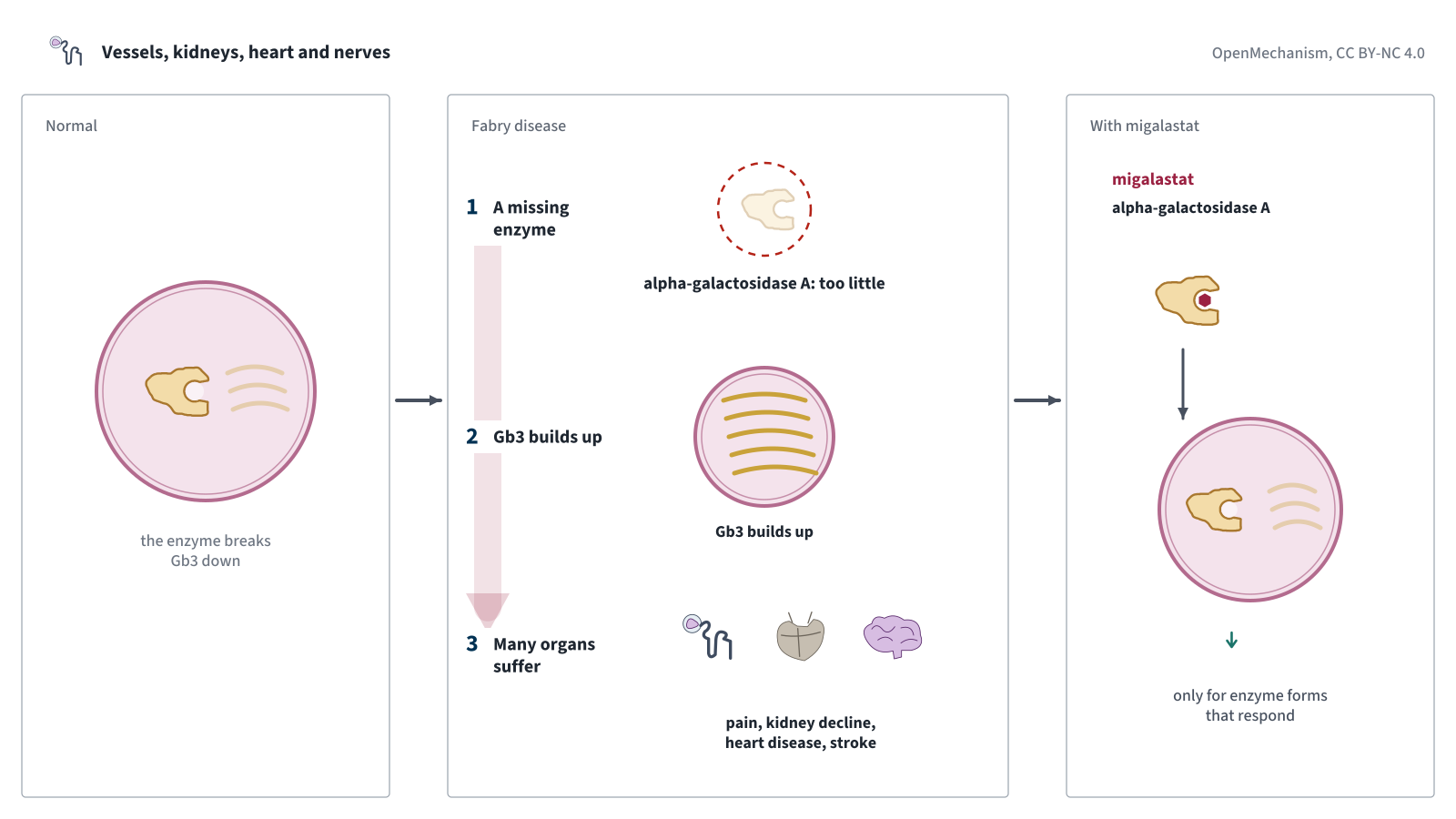
Fabry disease is an X-linked inherited lysosomal storage disease: the enzyme alpha-galactosidase A is lacking, so a fatty substance, Gb3, builds up in small blood vessels, nerves, kidneys and heart muscle. It brings pain, gut problems, skin spots, worsening kidney function, heart disease and stroke. Migalastat steadies certain faulty forms of the enzyme so they reach the lysosome and work.
- Where
- Vessels, kidneys, heart and nerves
- Body systems
- Hormones & metabolism, Kidney
- Medicines
- 1 medicine
For teachers: download this drawing.
Key terms in this drawing
- GL-3
- Globotriaosylceramide. A fatty substance that builds up in Fabry disease.
What goes wrong
A missing enzyme. Fabry disease is an X-linked inherited lysosomal storage disease caused by too little of the enzyme alpha-galactosidase A.1
What the source says
“Fabry disease is an X-linked, hereditary, lysosomal storage disease caused by deficiency of the enzyme alpha-galactosidase A”
Source 1Gb3 builds up. A fatty substance, globotriaosylceramide (), builds up in the walls of small blood vessels, in nerves, in kidney cells and in heart muscle cells.1
What the source says
“which results in the accumulation of the neutral glycosphingolipid globotriaosylceramide (Gb3) in the walls of small blood vessels, nerves, dorsal root ganglia, renal glomerular and tubular epithelial cells, and cardiomyocytes.”
Source 1Many organs suffer. It brings long-lasting pain and tingling, gut problems, skin spots, worsening kidney function, heart muscle disease and stroke.1
What the source says
“It is a complex, multisystem disorder that is characterized clinically by chronic pain and acroparesthesia, gastrointestinal disturbances, characteristic skin lesions (angiokeratomata), progressive renal impairment, cardiomyopathy, and stroke.”
Source 1
Where medicines act
- A
Migalastat: the faulty enzyme steadied
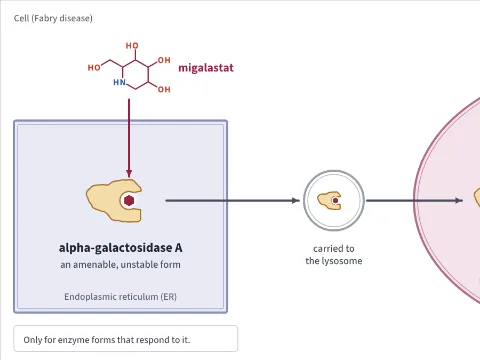
Migalastat binds the enzyme's active site and steadies it, so it can travel to the lysosome; there it lets go, and the enzyme breaks down Gb3. It treats adults whose gene variant responds in laboratory tests.2
What the source says
“Migalastat is a pharmacological chaperone that reversibly binds to the active site of the alpha-galactosidase A (alpha-Gal A) protein”
Source 2“This binding stabilizes alpha-Gal A allowing its trafficking from the endoplasmic reticulum into the lysosome where it exerts its action.”
Source 2“migalastat dissociates from alpha-Gal A allowing it to break down the glycosphingolipids globotriaosylceramide (GL-3)”
Source 2“GALAFOLD is indicated for the treatment of adults with a confirmed diagnosis of Fabry disease and an amenable galactosidase alpha gene ( GLA ) variant based on in vitro assay data”
Source 2
See also
Body systems: hormones & metabolism and kidney.
Other conditions: cystinosis, diabetes insipidus, high calcium from cancer, primary aldosteronism, primary hyperoxaluria type 1 and primary hyperparathyroidism.
Sources
- 1Narrative review: Fabry diseaseClarke JT. Ann Intern Med 2007 (abstract). Saved copy
- 2Galafold (migalastat): FDA label1 Indications and Usage; 12.1 Mechanism of Action. Saved copy
- 3Human alpha-galactosidase A with migalastat (1-deoxygalactonojirimycin)PDB 3S5Y; Guce, A.I. et al. Chem.Biol. 2011;18:1521-1526. The alpha-galactosidase A outline in the drawing is traced from this structure. Saved copy
Notes and limits
- Migalastat works only for certain gene variants, and its approval is accelerated, based on less Gb3 in kidney cells.2
- Enzyme replacement clears Gb3 from blood vessel lining cells, but its effects on other tissues are less clear.1
Notes that apply to every page are on How to read a page.
Spotted a mistake? Report an error (hello@openmechanism.com). Since launch, every published error we fix is listed on the corrections page.
Cite this page
Tran D. Fabry disease [Internet]. OpenMechanism; 2026 [updated 2026 Oct 16; cited 2026 Oct 16]. Available from: https://openmechanism.com/conditions/fabry-disease