Hydrochlorothiazide
Hydrochlorothiazide blocks , the sodium-chloride carrier of the kidney's distal convoluted tubule. More sodium and chloride leave in the urine, and some potassium and bicarbonate may go with them. It lowers high blood pressure, but the label says how it does so is unknown.
- Acts on
- The thiazide-sensitive sodium-chloride cotransporter (NCC)
- Where
- Kidney: distal tubule
- Medicine type
- Small molecule
- Used for
- Heart & circulation
- Drug class
- Diuretics, Thiazide diuretics
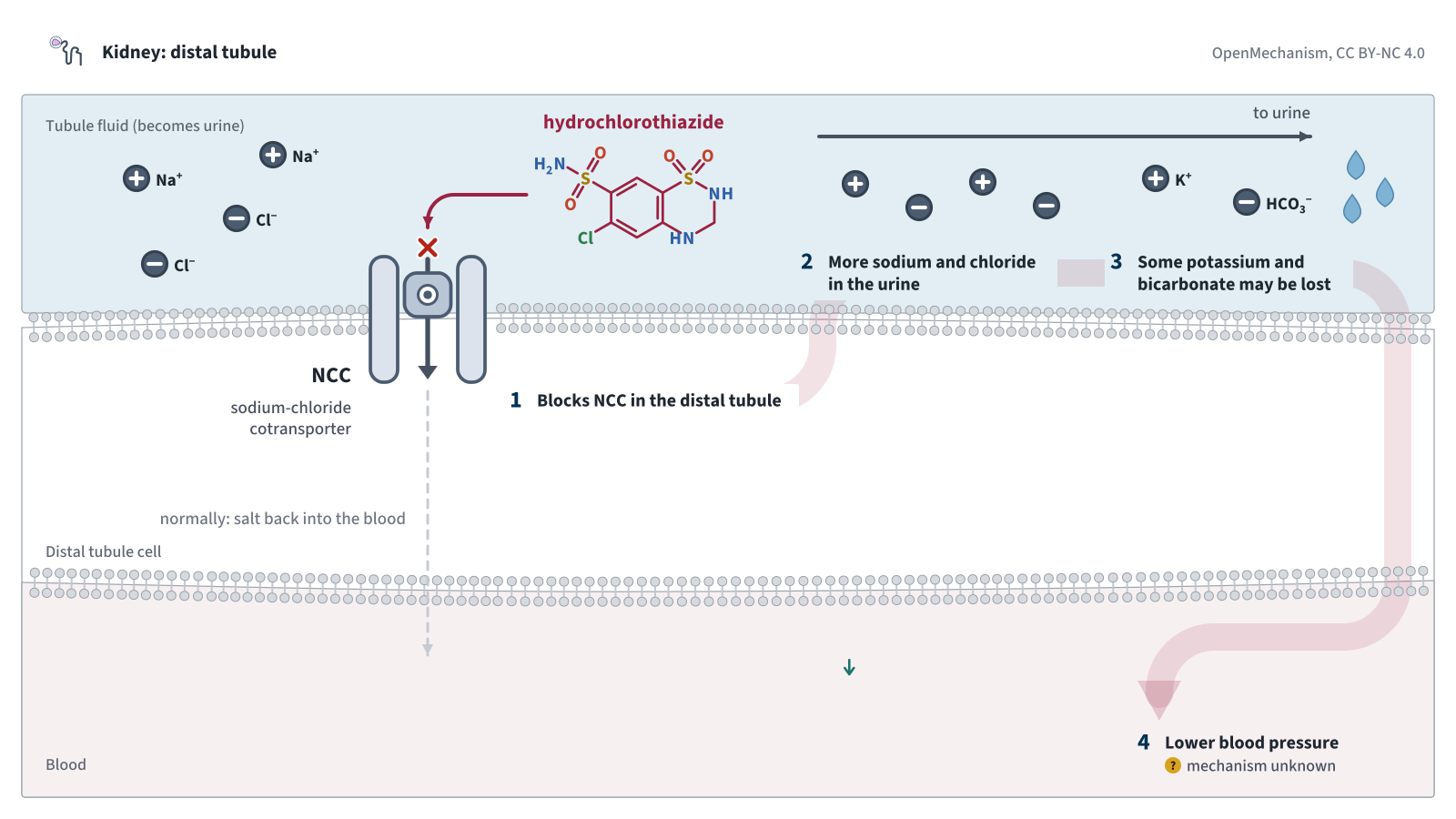
Step 4: mechanism unknown
The hydrochlorothiazide label says: The mechanism of the antihypertensive effect of thiazides is unknown.
Source 1: Hydrochlorothiazide tablets: FDA label, Indications and Usage; Clinical Pharmacology
Clinical study: In a 1980 study of 13 people with high blood pressure, measured on placebo and after 1, 4 and 12 weeks on hydrochlorothiazide 100 mg a day (9 of them also at 24 and 36 weeks), blood pressure fell, but resistance in the blood vessels fell only in the responders, whose blood pressure fell by more than 10%: Hydrochlorothiazide lowered mean arterial pressure (p less than 0.01)
, and total peripheral resistance was lowered only in responders.
van Brummelen P et al., Clin Pharmacol Ther 1980 (PMID 6987024)
Key terms in this drawing
- NCC
- Sodium-chloride cotransporter. A salt carrier in the kidney tubule; it helps set blood pressure and is the target of thiazide diuretics.
How it works
Blocks NCC in the distal tubule. Hydrochlorothiazide acts on the distal tubule's mechanism of electrolyte (salt) reabsorption. Thiazide diuretics target the sodium-chloride cotransporter (NCC), which has a major role in salt reabsorption in the distal convoluted tubule, and block its transport.1,2
More sodium and chloride in the urine. Hydrochlorothiazide increases the excretion of sodium and chloride in about equal amounts; after a dose by mouth, diuresis begins within 2 hours, peaks in about 4 hours and lasts about 6 to 12 hours.1
Some potassium and bicarbonate may be lost. The extra sodium excretion may come with some loss of potassium and bicarbonate.1
Lower blood pressure. It lowers high blood pressure; the label says the mechanism of the antihypertensive effect of thiazides is unknown, and that hydrochlorothiazide does not usually affect normal blood pressure.1
For teachers: download this drawing.
See also
Condition pages: fluid retention and high blood pressure.
Side effects: low blood potassium (hypokalemia).
Other diuretics: amiloride, chlorthalidone, finerenone, furosemide, spironolactone, tolvaptan and torsemide.
Explained: digoxin and diuretics; why diuretics can lower potassium; and lithium and NSAIDs, diuretics or ACE inhibitors.
Body systems: kidney; and heart, vessels & cholesterol.
Sources
- 1Hydrochlorothiazide tablets: FDA labelIndications and Usage; Clinical Pharmacology
- 2Structure and thiazide inhibition mechanism of the human Na-Cl cotransporterFan M et al., Nature 2023 (abstract)
- 3ChEMBL CHEMBL435Target and action classification: Thiazide-sensitive sodium-chloride cotransporter inhibitor
- 4Hemodynamic changes during long-term thiazide treatment of essential hypertension in responders and nonrespondersvan Brummelen P et al. Clin Pharmacol Ther 1980 (abstract)
Also used for the drawing
The drawing names the cotransporter NCC. This source supports that name; the steps above come from the sources listed above.
- 5WNK kinases regulate thiazide-sensitive Na-Cl cotransportYang CL et al. J Clin Invest 2003 (abstract)
Spotted a mistake? Report an error (hello@openmechanism.com). Since launch, every published error we fix is listed on the corrections page.
Notes and limits
- A schematic teaching drawing: not to scale, not exact structures, binding poses or a complete pathway, and not a guide to dosing, treatment or how a person will respond.
- The label says the mechanism of the antihypertensive effect of thiazides is unknown.
All recorded limits are on the evidence page, and notes that apply to every page are on How to read a page. Version 1.0.1, medically reviewed by Daniel Tran, PharmD, on 29 October 2026.
Cite this page
Tran D. Hydrochlorothiazide [Internet]. OpenMechanism; 2026 [updated 2026 Oct 29; cited 2026 Oct 29]. Available from: https://openmechanism.com/medicines/hydrochlorothiazide