IgA nephropathy
IgA nephropathy is the most common primary glomerulonephritis. Many people with it have more IgA1 lacking galactose in its hinge region; antibodies against that IgA1 form immune complexes that settle in the and activate their mesangial cells, injuring the kidney. Sparsentan blocks the endothelin A and angiotensin II type 1 receptors and slows the loss of kidney function.
- Where
- The kidney's filters (glomeruli)
- Body system
- Kidney
- Medicines
- 1 medicine
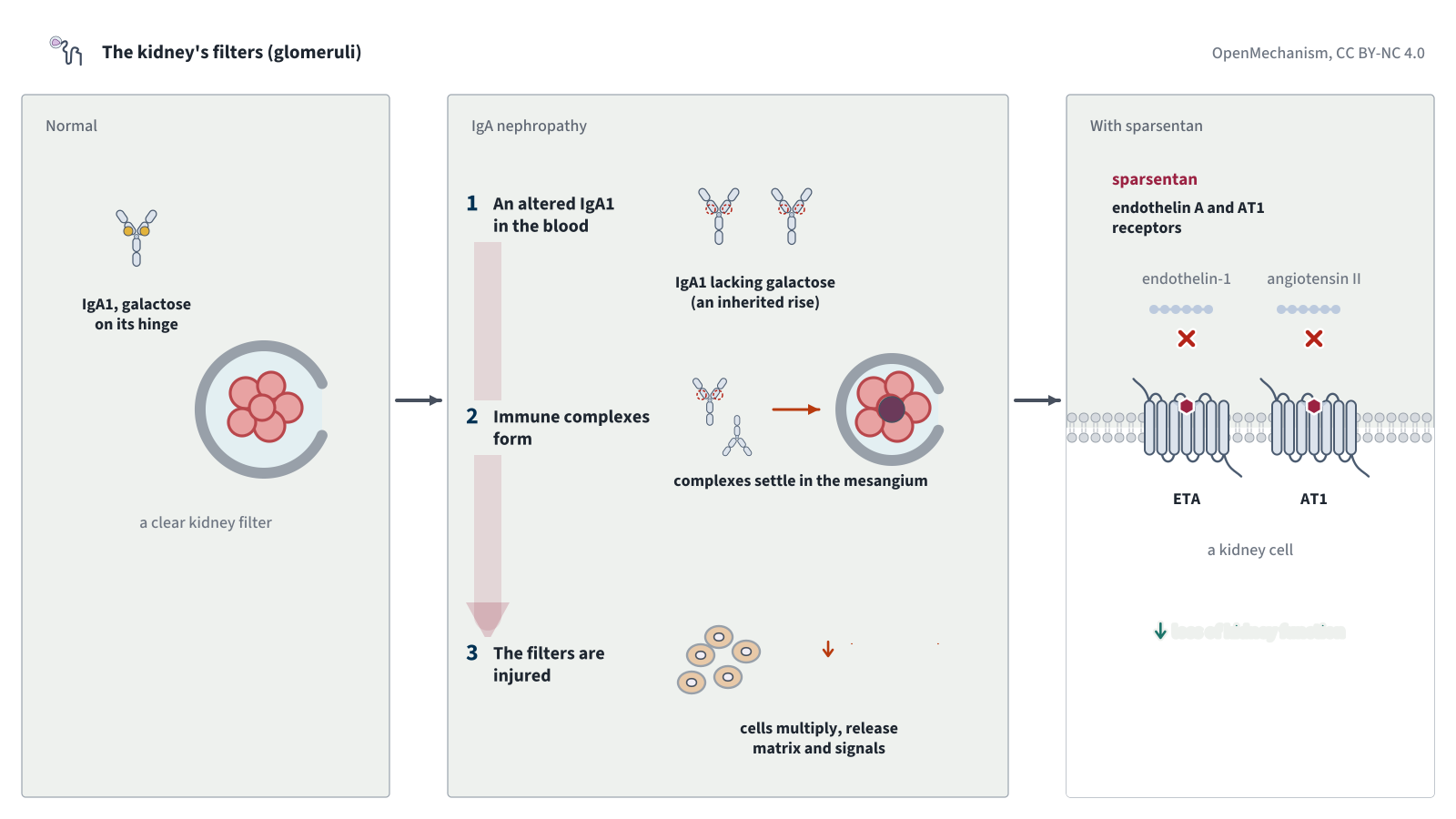
For teachers: download this drawing.
Key terms in this drawing (6)
- angiotensin II
- Angiotensin II. A hormone that strongly tightens blood vessels; ACE makes it from angiotensin I.
- AT1 receptor
- Angiotensin II type 1 receptor. The receptor angiotensin II acts on to tighten blood vessels and stimulate aldosterone release.
- ET-1
- Endothelin-1. A potent signaling peptide made in the body; it acts on blood-vessel muscle and lining through two receptors, ETA and ETB.
- ETA receptor
- Endothelin receptor type A. The endothelin-1 receptor whose main actions are tightening blood vessels and making their cells multiply.
- glomerulus
- Glomerulus. The filter at the start of each nephron: it passes water and small solutes from the blood into the nephron's tubule.
- IgA
- Immunoglobulin A. A type of antibody. In IgA nephropathy, IgA1 lacking galactose forms immune complexes that collect in the kidney's filters.
What goes wrong
An altered IgA1 in the blood. Many people with nephropathy have an inherited rise in IgA1 that lacks galactose on its hinge region.1
What the source says
“Patients with IgA nephropathy often have a genetically determined increase in circulating levels of IgA1 with galactose-deficient O-glycans in the hinge-region (Hit 1).”
Source 1Immune complexes form. Antibodies against this IgA1 form immune complexes, which collect in the glomerular mesangium.1
What the source says
“Synthesis and binding of antibodies directed against galactose-deficient IgA1 are required for formation of immune complexes that accumulate in the glomerular mesangium (Hits 2 and 3).”
Source 1The filters are injured. The complexes activate the mesangial cells, which multiply and release matrix, and chemokines, injuring the kidney.1
What the source says
“These immune complexes activate mesangial cells, inducing proliferation and secretion of extracellular matrix, cytokines, and chemokines, which result in renal injury (Hit 4).”
Source 1
Where medicines act
- A
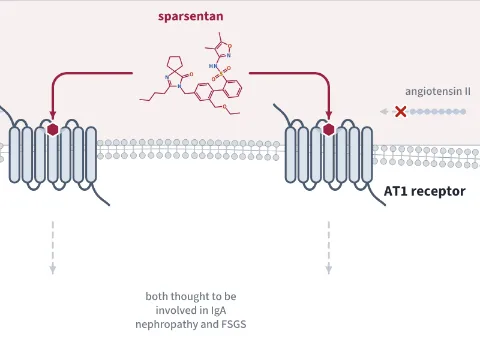
Sparsentan: endothelin A and AT1 receptors blocked
Sparsentan, one molecule that blocks both the endothelin type A and , slows the loss of kidney function in adults with IgA nephropathy at risk of progression.2
What the source says
“Sparsentan is a single molecule with antagonism of the endothelin type A receptor (ET A R) and the angiotensin II type 1 receptor (AT 1 R).”
Source 2“To slow kidney function decline in adults with primary immunoglobulin A nephropathy (IgAN) who are at risk for disease progression”
Source 2
See also
Body system: kidney.
Other conditions: chronic kidney disease and focal segmental glomerulosclerosis (FSGS).
Sources
- 1The pathophysiology of IgA nephropathySuzuki H et al. J Am Soc Nephrol 2011 (abstract). Saved copy
- 2Filspari (sparsentan): FDA label1 Indications and Usage; 12.1 Mechanism of Action. Saved copy
Notes and limits
- The altered IgA1 alone is not enough to injure the kidney; endothelin-1 and angiotensin II are thought to be involved, through the receptors sparsentan blocks.1,2
Notes that apply to every page are on How to read a page.
Spotted a mistake? Report an error (hello@openmechanism.com). Since launch, every published error we fix is listed on the corrections page.
Cite this page
Tran D. IgA nephropathy [Internet]. OpenMechanism; 2026 [updated 2026 Oct 16; cited 2026 Oct 16]. Available from: https://openmechanism.com/conditions/iga-nephropathy