Patiromer
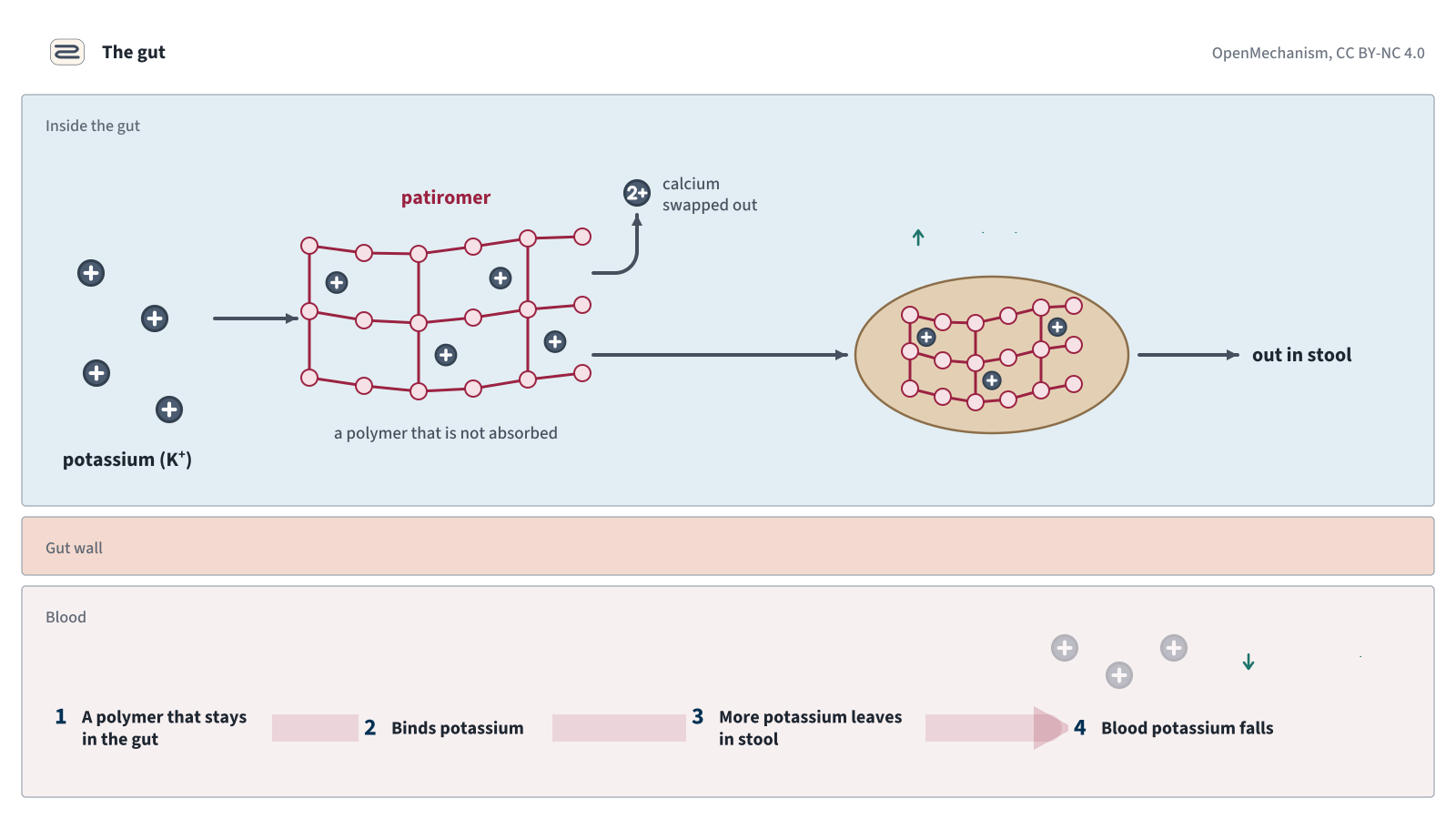
Patiromer is a polymer that stays in the gut and swaps calcium for potassium. It binds potassium there, more potassium leaves in the stool, and blood potassium falls.
- Acts on
- Intestinal potassium
- Where
- The gut
- Used for
- Kidney & electrolytes
Also called Veltassa.
How it works
A polymer that stays in the gut. Patiromer provides a nonabsorbed cation-exchange polymer with a calcium-sorbitol counterion.1
Binds potassium. The polymer binds potassium in the gastrointestinal lumen.1
More potassium leaves in stool. Potassium binding reduces free luminal potassium and increases fecal potassium excretion.1
Blood potassium falls. This luminal mechanism reduces serum potassium levels.1
For teachers: download this drawing or build a slide deck.
See also
Condition pages: chronic kidney disease and high blood potassium.
More medicines for kidney & electrolytes: icodextrin, potassium chloride and sevelamer.
Body system: kidney.
Sources
- 1Veltassa (patiromer): FDA label12.1 Mechanism of Action
Spotted a mistake? Report an error (hello@openmechanism.com). Since launch, every published error we fix is listed on the corrections page.
Notes and limits
- A schematic teaching drawing: not to scale, not exact structures, binding poses or a complete pathway, and not a guide to dosing, treatment or how a person will respond.
- Other medicines in the same family may not follow every step or share the same clinical endpoint.
- The steps are in the order that explains them; one step is said to cause the next only where the source says so.
- The source ChEMBL chelating action label is preserved separately; the product label describes cation exchange rather than a drawn metal-chelate coordination complex.
- The catalog calcium form and the labeled calcium-sorbitol counterion are explicitly qualified rather than treated as identical polymer formulations.
All recorded limits are on the evidence page, and notes that apply to every page are on How to read a page. Version 1.0.0, not yet medically reviewed.
Cite this page
Tran D. Patiromer [Internet]. OpenMechanism; 2026 [updated 2026 Oct 14; cited 2026 Oct 14]. Available from: https://openmechanism.com/medicines/patiromer