Cystinosis
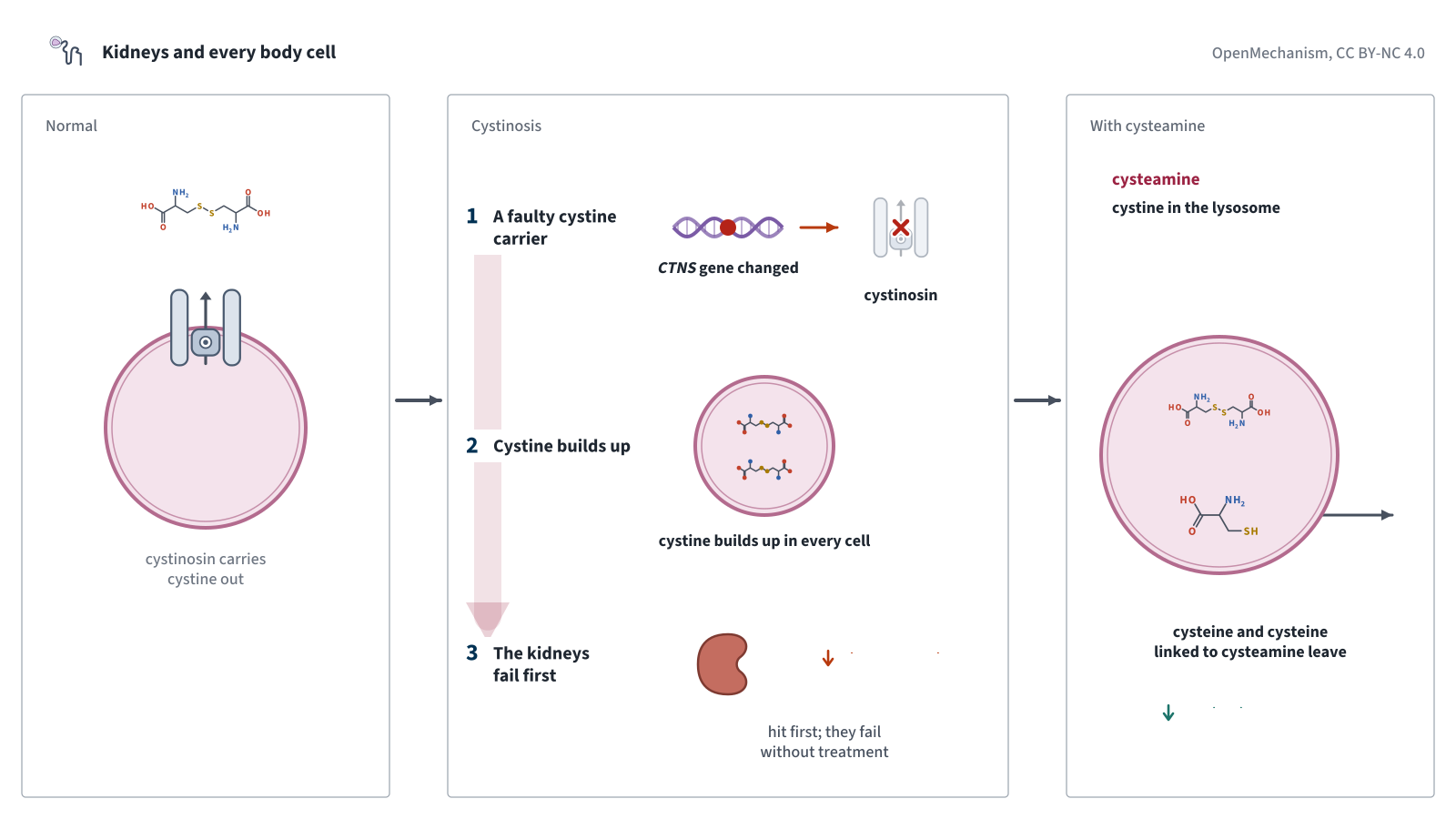
Cystinosis is an inherited lysosomal storage disorder: changes in the CTNS gene disable cystinosin, the carrier that moves cystine out of lysosomes, so cystine builds up in the cells of every organ. The kidneys are hit first, in the first year of life; without treatment they fail by mid-childhood. Cysteamine turns cystine into substances that can leave the lysosome.
- Where
- Kidneys and every body cell
- Body systems
- Kidney, Hormones & metabolism
- Medicines
- 1 medicine
For teachers: download this drawing.
Key terms in this drawing
- CTNS
- CTNS gene (cystinosin). The gene for cystinosin, the carrier that moves cystine out of lysosomes; mutations in it cause cystinosis.
What goes wrong
A faulty cystine carrier. Cystinosis is an inherited lysosomal storage disorder caused by changes in the gene, which makes cystinosin, the carrier that moves cystine out of the lysosome.1
What the source says
“It is an autosomal recessive lysosomal storage disorder caused by mutations in the CTNS gene encoding for the carrier protein cystinosin, transporting cystine out of the lysosomal compartment.”
Source 1Cystine builds up. When cystinosin fails, cystine builds up inside the lysosomes of all body cells and organs.1
What the source says
“Defective cystinosin function leads to intra-lysosomal cystine accumulation in all body cells and organs.”
Source 1The kidneys fail first. The kidneys are affected first, in the first year of life; without treatment, kidney failure follows by mid-childhood.1
What the source says
“The kidneys are initially affected during the first year of life through proximal tubular damage followed by progressive glomerular damage and end stage renal failure during mid-childhood if not treated.”
Source 1
Where medicines act
- A
Cysteamine: cystine let out
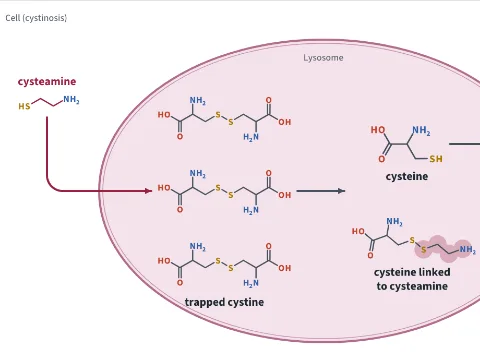
Inside lysosomes, cysteamine turns cystine into cysteine and a cysteine-cysteamine compound, both of which can leave the lysosome. It treats nephropathic cystinosis.2
What the source says
“Cysteamine is an aminothiol that participates within lysosomes in a thiol-disulfide interchange reaction converting cystine into cysteine and cysteine-cysteamine mixed disulfide, both of which can exit the lysosome in patients with cystinosis.”
Source 2“PROCYSBI is indicated for the treatment of nephropathic cystinosis in adults and pediatric patients 1 year of age and older.”
Source 2
See also
Body systems: kidney and hormones & metabolism.
Other conditions: diabetes insipidus, Fabry disease, high calcium from cancer, primary aldosteronism, primary hyperoxaluria type 1 and primary hyperparathyroidism.
Sources
- 1Cystinosis: a reviewElmonem MA et al. Orphanet J Rare Dis 2016 (abstract). Saved copy
- 2Procysbi (cysteamine bitartrate): FDA label1 Indications and Usage; 12.1 Mechanism of Action. Saved copy
Notes and limits
- Other organs are affected too: eyes, thyroid, pancreas, sex glands, muscles and the brain.1
- No treatment cures it yet.1
Notes that apply to every page are on How to read a page.
Spotted a mistake? Report an error (hello@openmechanism.com). Since launch, every published error we fix is listed on the corrections page.
Cite this page
Tran D. Cystinosis [Internet]. OpenMechanism; 2026 [updated 2026 Oct 16; cited 2026 Oct 16]. Available from: https://openmechanism.com/conditions/cystinosis