High phosphate on dialysis
When the kidneys fail, phosphate builds up in the blood and calcium and vitamin D handling is disturbed, harming bones and minerals. High phosphate is linked to worse outcomes. Diet and phosphate binders are the usual treatments. Sevelamer binds phosphate in the gut; tenapanor blocks NHE3 so less phosphate is absorbed.
- Where
- Kidneys and gut
- Body system
- Kidney
- Medicines
- 2 medicines
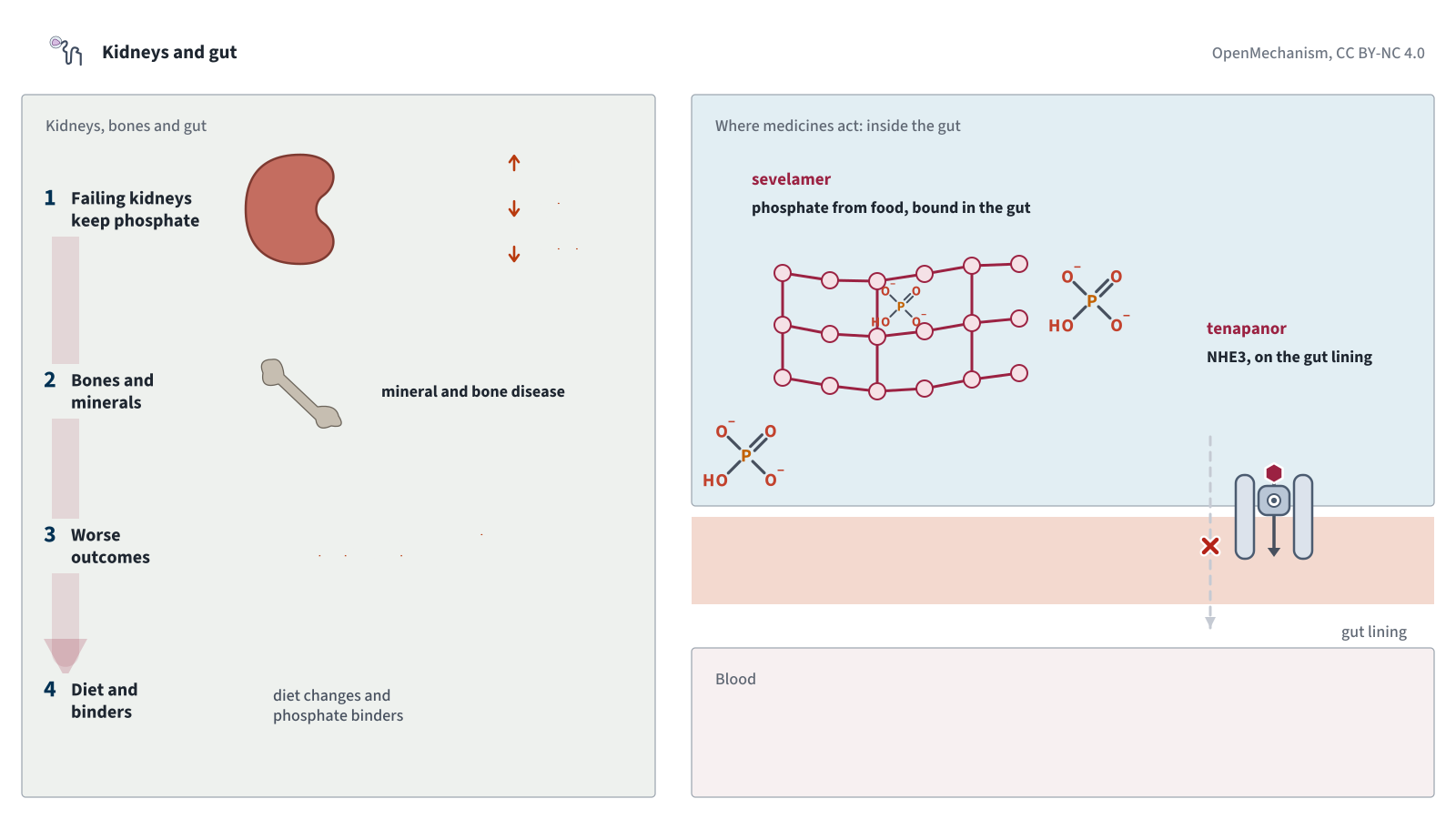
For teachers: download this drawing.
Key terms in this drawing
- NHE3
- Sodium/hydrogen exchanger 3. A carrier on the lining of the small intestine and colon that takes up most of the sodium from food; tenapanor blocks it.
What goes wrong
Failing kidneys keep phosphate. In chronic kidney disease, failing kidneys and low calcitriol (active vitamin D) leave phosphate high and calcium low.1
What the source says
“the hypocalcemia and hyperphosphatemia that develop in chronic kidney disease patients with secondary hyperparathyroidism (SHPT) as a result of low calcitriol levels and decreased kidney function.”
Source 1Bones and minerals. Disturbed vitamin D, calcium and phosphate handling causes mineral and bone disease.2
What the source says
“mineral bone disease caused by disturbed vitamin D, calcium, and phosphate metabolism.”
Source 2Worse outcomes. High phosphate is consistently linked to worse outcomes, above all in chronic kidney disease.3
What the source says
“Hyperphosphatemia has consistently been shown to be associated with dismal outcome in a wide variety of populations, particularly in chronic kidney disease (CKD).”
Source 3Diet and binders. Treatment has been diet changes and phosphate binders.3
What the source says
“These interventions consisted of dietary modifications and phosphate binders.”
Source 3
Where medicines act
- A
Sevelamer: phosphate bound in the gut
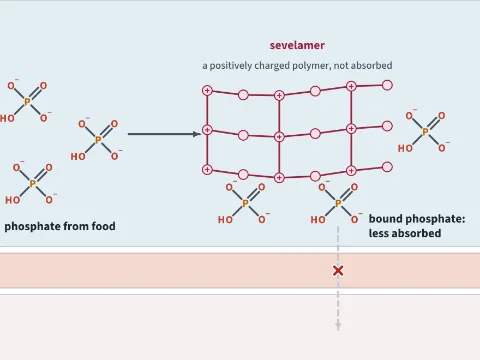
Sevelamer is a polymer that is not absorbed; it binds phosphate in the gut. It controls blood phosphate in people with chronic kidney disease on dialysis.4
- B
Tenapanor: NHE3 blocked in the gut
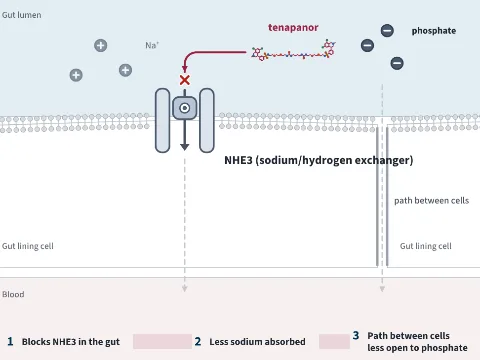
Tenapanor blocks on the gut lining, which cuts phosphate absorption between the cells. It is an add-on for people on dialysis when binders are not enough or not tolerated.5
What the source says
“Tenapanor is a locally acting inhibitor that targets the sodium/hydrogen exchanger 3 (NHE3), an antiporter expressed on the apical surface of the epithelium of the small intestine and colon.”
Source 5“Inhibition of NHE3 by tenapanor results in reduced sodium absorption and decreased phosphate absorption by reducing phosphate permeability through the paracellular pathway.”
Source 5“XPHOZAH is indicated to reduce serum phosphorus in adults with chronic kidney disease (CKD) on dialysis as add-on therapy in patients who have an inadequate response to phosphate binders or who are intolerant of any dose of phosphate binder therapy.”
Source 5
See also
Body system: kidney.
Other conditions: chronic kidney disease, secondary hyperparathyroidism and chronic constipation.
Sources
- 1The calcium-sensing receptor: a key factor in the pathogenesis of secondary hyperparathyroidismRodriguez M et al. Am J Physiol Renal Physiol 2005 (abstract). Saved copy
- 2Chronic kidney diseaseWebster AC et al. Lancet 2017 (abstract). Saved copy
- 3Prevention and treatment of hyperphosphatemia in chronic kidney diseaseVervloet MG, van Ballegooijen AJ. Kidney Int 2018 (abstract). Saved copy
- 4Renvela (sevelamer carbonate): FDA label1 Indications and Usage; 12.1 Mechanism of Action. Saved copy
- 5Xphozah (tenapanor): FDA label1 Indications and Usage; 12.1 Mechanism of Action. Saved copy
Notes and limits
- Trials have not convincingly shown that lowering phosphate improves hard outcomes.3
Notes that apply to every page are on How to read a page.
Spotted a mistake? Report an error (hello@openmechanism.com). Since launch, every published error we fix is listed on the corrections page.
Cite this page
Tran D. High phosphate on dialysis [Internet]. OpenMechanism; 2026 [updated 2026 Oct 15; cited 2026 Oct 15]. Available from: https://openmechanism.com/conditions/high-phosphate-on-dialysis