Lupus nephritis
Lupus nephritis is inflammation of the kidney's filters (glomerulonephritis) and one of the most serious organ effects of systemic lupus erythematosus. Continuing inflammation, stressed kidney cells, faulty repair and scarring drive kidney damage; within ten years of lupus diagnosis, 5 to 20 percent of people with lupus nephritis reach kidney failure. Voclosporin, a calcineurin blocker, curbs lymphocyte activation.
- Where
- Kidneys
- Body systems
- Kidney, Immune system
- Medicines
- 1 medicine
Not fully established
The Lupkynis (voclosporin) label says: The mechanism of voclosporin suppression of calcineurin has not been fully established.
Source 3: Lupkynis (voclosporin): FDA label, 1 Indications and Usage; 12.1 Mechanism of Action
Clinical study: In a double-blind trial in 357 people with lupus nephritis, voclosporin or placebo was added to mycophenolate mofetil and low-dose steroids; the trial measured kidney response at 52 weeks, not how voclosporin works: Voclosporin in combination with MMF and low-dose steroids led to a clinically and statistically superior complete renal response rate versus MMF and low-dose steroids alone, with a comparable safety profile.
Rovin BH et al., Lancet 2021 (PMID 33971155)
This study was picked with a literature search and is not yet checked by our reviewer.
For teachers: download this drawing.
Key terms in this drawing
- cytokines
- Cytokines. Signal molecules involved in inflammation, such as interleukin-2, interferon-γ, interleukin-4 and TNF-α, which T cells make.
- T cell
- T lymphocyte. A white blood cell of the immune system.
What goes wrong
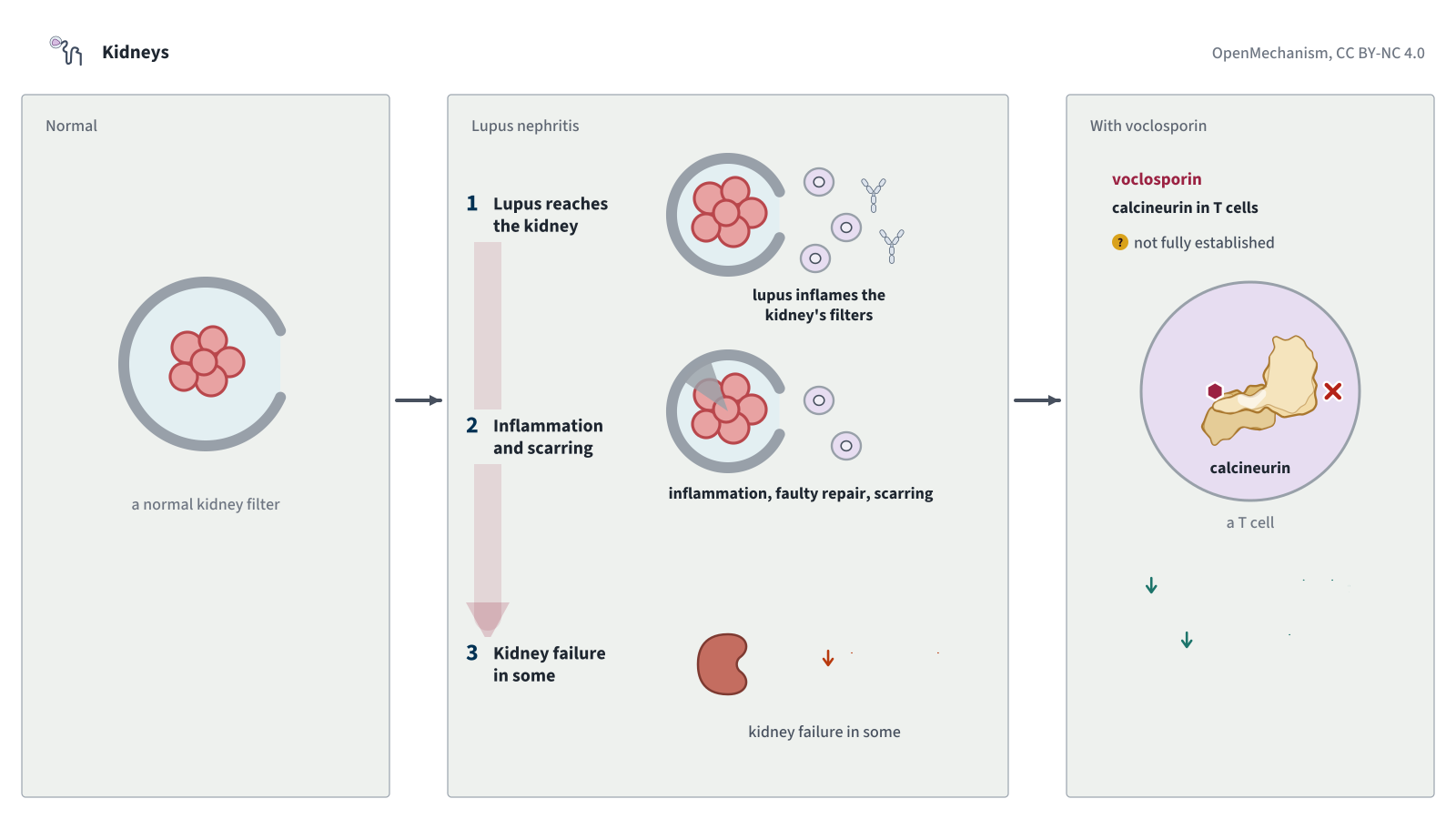
Lupus reaches the kidney. Lupus nephritis is inflammation of the kidney's filters and one of the most serious organ effects of the autoimmune disease lupus.1
What the source says
“Lupus nephritis (LN) is a form of glomerulonephritis that constitutes one of the most severe organ manifestations of the autoimmune disease systemic lupus erythematosus (SLE).”
Source 1Inflammation and scarring. Continuing inflammation, activated kidney cells, cell stress, faulty repair and scarring all add to kidney injury.2
What the source says
“Processes that contribute to end-stage renal injury include continuing inflammation, activation of intrinsic renal cells, cell stress and hypoxia, metabolic abnormalities, aberrant tissue repair and tissue fibrosis.”
Source 2Kidney failure in some. Within ten years of a lupus diagnosis, 5 to 20 percent of people with lupus nephritis reach end-stage kidney disease.1
What the source says
“Within 10 years of an initial SLE diagnosis, 5-20% of patients with LN develop end-stage kidney disease”
Source 1
Where medicines act
- A
Voclosporin: lymphocyte activation curbed
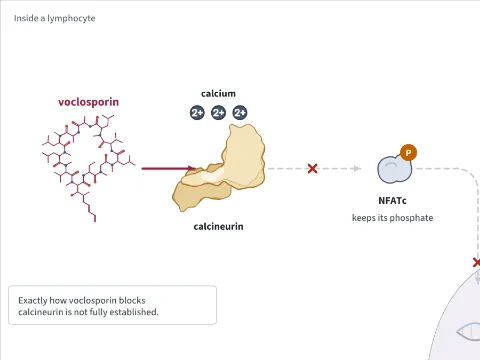
Voclosporin is a calcineurin-blocking immunosuppressant that reduces lymphocyte multiplication and T-cell ; exactly how it blocks calcineurin is not fully known. It treats active lupus nephritis with other immunosuppressants.3
What the source says
“LUPKYNIS is a calcineurin-inhibitor immunosuppressant.”
Source 3“The immunosuppressant activity results in inhibition of lymphocyte proliferation, T-cell cytokine production, and expression of T-cell activation surface antigens.”
Source 3“The mechanism of voclosporin suppression of calcineurin has not been fully established.”
Source 3“for the treatment of adult patients with active lupus nephritis (LN).”
Source 3
See also
Body systems: kidney and immune system.
Also used for it: methylprednisolone (“To induce diuresis or remission of proteinuria in idiopathic nephrotic syndrome or that due to lupus erythematosus.”4); hydrocortisone (“To induce diuresis or remission of proteinuria in idiopathic nephrotic syndrome, or that due to lupus erythematosus.”5); dexamethasone (“To induce diuresis or remission of proteinuria in the nephrotic syndrome, without uremia, of the idiopathic type, or that due to lupus erythematosus”6); cyclophosphamide (“Treatment of LN usually involves immunosuppressive therapy, typically with mycophenolate mofetil or cyclophosphamide and with glucocorticoids, although these treatments are not uniformly effective.”1); and mycophenolate mofetil (“Treatment of LN usually involves immunosuppressive therapy, typically with mycophenolate mofetil or cyclophosphamide and with glucocorticoids, although these treatments are not uniformly effective.”1).
Related medicines: prednisone.
Other conditions: ankylosing spondylitis, Crohn disease, cutaneous T-cell lymphoma, high calcium from cancer, juvenile idiopathic arthritis and pemphigus.
Side effects: why cyclophosphamide can make the bladder bleed.
Sources
- 1Lupus nephritisAnders HJ et al. Nat Rev Dis Primers 2020 (abstract). Saved copy
- 2What is damaging the kidney in lupus nephritis?Davidson A. Nat Rev Rheumatol 2016 (abstract). Saved copy
- 3Lupkynis (voclosporin): FDA label1 Indications and Usage; 12.1 Mechanism of Action. Saved copy
- 4Solu-Medrol (methylprednisolone sodium succinate): FDA labelIndications and Usage. Saved copy
- 5Solu-Cortef (hydrocortisone sodium succinate): FDA labelIndications and Usage. Saved copy
- 6Dexamethasone sodium phosphate injection: FDA labelIndications and Usage. Saved copy
- 7
- 8Bovine calcineurin A and B with FKBP12 and tacrolimusPDB 1TCO; Griffith, J.P. et al. Cell(Cambridge,Mass.) 1995;82:507-522. The calcineurin outline in the drawing is traced from this structure. Saved copy
Notes and limits
- Fewer than half reach complete remission with immune-suppressing treatment.2
Notes that apply to every page are on How to read a page.
Spotted a mistake? Report an error (hello@openmechanism.com). Since launch, every published error we fix is listed on the corrections page.
Cite this page
Tran D. Lupus nephritis [Internet]. OpenMechanism; 2026 [updated 2026 Oct 20; cited 2026 Oct 20]. Available from: https://openmechanism.com/conditions/lupus-nephritis